About this place
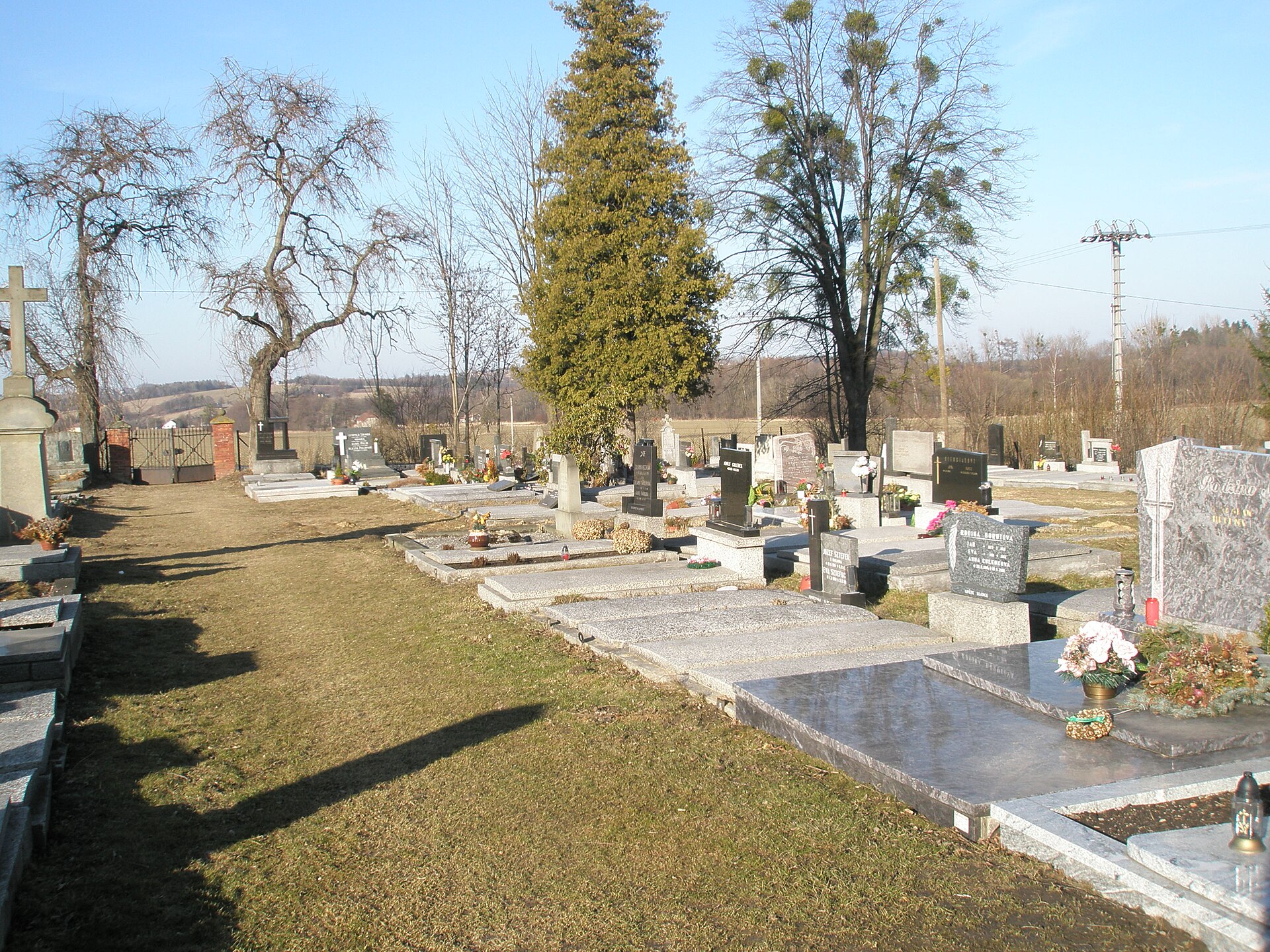
The Lutheran cemetery in Hnojník sits at the edge of the village of Hnojník, in the Frýdek-Místek District of Czech Cieszyn Silesia (Zaolzie), right next to the local evangelical chapel. It is a small but historically significant burial ground of the region's Lutheran community, best known as the resting place of Jan Kubisz, a poet and national awakener of Cieszyn Silesia.
What does the cemetery in Hnojník look like?
The cemetery has a trapezoidal layout and spreads across a gentle slope. Graves are mostly arranged in regular rows, though part of the grounds remains unoccupied. A significant number of the burials belong to former German inhabitants of the region, a reminder of the multi-ethnic history of Cieszyn Silesia before 1945. The cemetery is listed in the Czech heritage register (Památkový katalog) as a protected site.
The grounds are enclosed by a wall built in two distinct sections. The older part is covered in rough plaster, with its top formed by bricks or stone slabs laid crosswise. The second, lower section is built from raw, unworked stone — a difference suggesting the wall was completed in separate stages over time.
Where is the entrance and what does the gate look like?
The entrance is located in the western part of the wall, next to an extension of the chapel. Two tall, pillar-shaped posts flank the gate, connected by a segmental arch covered with roof tiles. A substantial cross with trefoil-ended arms crowns the top of the arch. The gate itself has two wings of latticed ironwork, with vertical rods ending in decorative, flame-like tips — a detail typical of sacred metalwork from the turn of the 19th and 20th centuries.
Until relatively recently, the cemetery also held a collection of valuable wooden crosses of folk craftsmanship. These were photographically documented in January 2005, but they are no longer present on the grounds today, likely lost to natural decay of the wood and replacement with more durable grave markers.
Who was Jan Kubisz, and why does his monument stand here?
The cemetery's best-known feature is the monument to Jan Kubisz (1848–1929). Born in Końska, he began working in January 1889 as a teacher at the Polish evangelical school in Hnojník, where he spent the rest of his life and died in 1929. Kubisz was not only an educator but also a poet and one of the leading figures of the Polish national revival in Cieszyn Silesia. He wrote the poem "Płyniesz Olzo, po dolinie" ("You Flow, Olza, Down the Valley"), centred on the Olza River, which became the unofficial anthem of Zaolzie and remains a symbol of Polish minority identity in the region to this day. For many visitors, his monument is the main reason to seek out this cemetery.
What is the religious background of this place?
Lutheranism in Cieszyn Silesia dates back to the first half of the 16th century, when the inhabitants of the Duchy of Cieszyn embraced the ideas of the Reformation. The modern Slezská církev evangelická a.v. (Silesian Evangelical Church of the Augsburg Confession) continues this tradition — the parish serving Hnojník is based in nearby Komorní Lhotka and gathers members from several surrounding municipalities for services held in local chapels.
Frequently asked questions
Where is the Lutheran cemetery in Hnojník located? At the edge of the village of Hnojník in the Frýdek-Místek District, next to the local evangelical chapel, in Czech Cieszyn Silesia.
What is the cemetery's main attraction? The monument to Jan Kubisz, a poet and teacher who wrote "Płyniesz Olzo, po dolinie," regarded as the unofficial anthem of Zaolzie.
Is the cemetery a protected heritage site? Yes, it is listed in the Czech Památkový katalog as a site under conservation protection.
Can visitors walk around the cemetery on their own? As an active parish cemetery, it is generally accessible to visitors during the day, like other denominational cemeteries in the region — visitors should stay quiet and respectful of the burial ground.
Nearby places

Earn badges for the places you visit
Download NextOnTrip, discover new places and check off your trails.