About this place
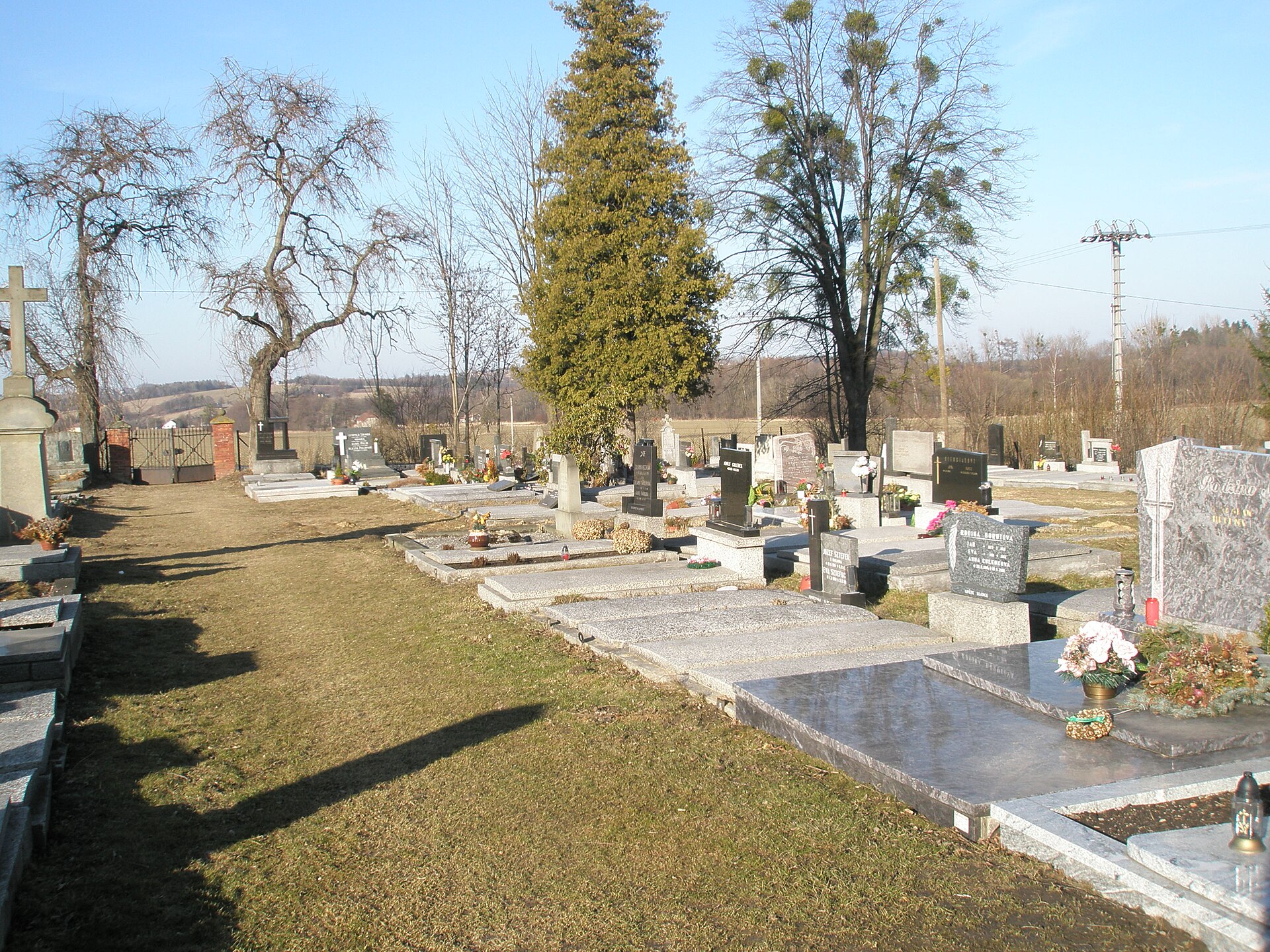
The Evangelical Cemetery in Komorní Lhotka (Polish: Ligotka Kameralna) sits right next to the local Lutheran congregation of the Silesian Evangelical Church of the Augsburg Confession, in a village on the Czech-Polish border in the Frýdek-Místek District of the Moravian-Silesian Region. It serves as the burial ground for a Protestant community whose religious and cultural life has centered on this spot since the late eighteenth century.
How did an evangelical community come to settle here?
The cornerstone of the first evangelical prayer house in Komorní Lhotka was laid on May 1, 1782, shortly after Emperor Joseph II issued the Patent of Toleration, which allowed non-Catholics across the Habsburg monarchy to practice their faith openly for the first time in generations. The neoclassical prayer house itself was built between 1782 and 1783. By 1784, a wooden school, a rectory, and a sexton's house had already been added beside the church, turning Komorní Lhotka into the religious and cultural hub for evangelicals across the wider congregation. The cemetery was laid out directly next to this complex and has served the local community as a burial site ever since.
How many people are buried here?
According to the congregation's own records, roughly 2,000 deceased members of the evangelical community rest in this cemetery — a figure that reflects the site's uninterrupted use across more than two centuries, spanning generations of residents from Komorní Lhotka and the surrounding area since the late 1700s.
Who is buried at the cemetery?
The most striking monument on the grounds is the ornate stone tombstone of Jan Bohumil Tschammer, a knight from Iskrzyczyn (April 5, 1790 – April 26, 1852), and his wife Kristýna Beata, née Tschickard. This decorated grave marker ranks among the oldest and most valuable funerary monuments in the area, testifying to the wealth and standing the Tschammer family held in the Cieszyn Silesia region.
The cemetery also holds the grave of Paweł Heczko, a farmer and presbyter from Dobracice who lived from 1883 to 1940 and died at the Sachsenhausen concentration camp near Berlin. His grave stands as a reminder of what the local evangelical population endured during the Nazi occupation and the Second World War.
What is the historical context of this place?
The cemetery and its adjoining church form part of the broader story of the Silesian Evangelical Church of the Augsburg Confession in historic Cieszyn Silesia — a region long shaped by a strong Lutheran presence and a mixed Polish-Czech population. Komorní Lhotka, also known by its Polish name Ligotka Kameralna, lies right within this cross-border cultural zone, a fact reflected both in the architecture of the church and in the inscriptions found on the cemetery's gravestones.
Frequently asked questions
Is the cemetery open to visitors? The cemetery adjoins an active evangelical congregation and, like most parish cemeteries in the region, is accessible to visitors during daytime hours.
What else is worth seeing besides the Tschammer tombstone? Look out for the older section of the cemetery with its neoclassical and nineteenth-century grave markers, as well as the church building itself, erected in the spirit of the 1781 Patent of Toleration.
Why does this site matter to the local community? For more than two hundred years the cemetery has served as the main burial ground for the evangelical community of Komorní Lhotka, standing as a living record of the religious and cultural continuity of this part of Cieszyn Silesia.
Nearby places

Earn badges for the places you visit
Download NextOnTrip, discover new places and check off your trails.