About this place
The Church of the Assumption of the Virgin Mary stands on a low rise on the western edge of Hnojník, a village in the Frýdek-Místek district of Czech Silesia. The present building was raised between 1808 and 1812 and consecrated on 18 November 1812, replacing an older wooden church that had stood on the same spot since before the early 15th century.
What is the history behind the church?
The original timber church served the local community through the Middle Ages. During the Reformation it passed into Protestant hands and functioned as an Evangelical place of worship for decades, before being returned to the Catholic Church in 1654. By the early 19th century the wooden structure could no longer meet the needs of a growing parish, so construction of a new masonry church began in 1808. Funding shortages repeatedly interrupted the work, stretching the project across four years before the building was finally consecrated in 1812. The church today belongs to the Roman Catholic parish of Hnojník, part of the Frýdek deanery within the Diocese of Ostrava-Opava.
What does the building look like?
The church is built in the Empire style, with a single nave and a rectangular presbytery attached on the north side together with a sacristy. Pilaster strips articulate the façades, and the segment-topped windows are framed in stone surrounds with scrolled "ears." A tall, prism-shaped tower rises from the main façade, capped with a mansard roof, while hipped roofs cover the nave and presbytery. One of the building's more unusual features is its orientation: the main altar faces west rather than the traditional east, with the entrance and tower turned toward the east instead. The tower's base holds a stone portal with scrolled ears and a flat pediment, and the corners of the nave are rounded off.
What surrounds the church?
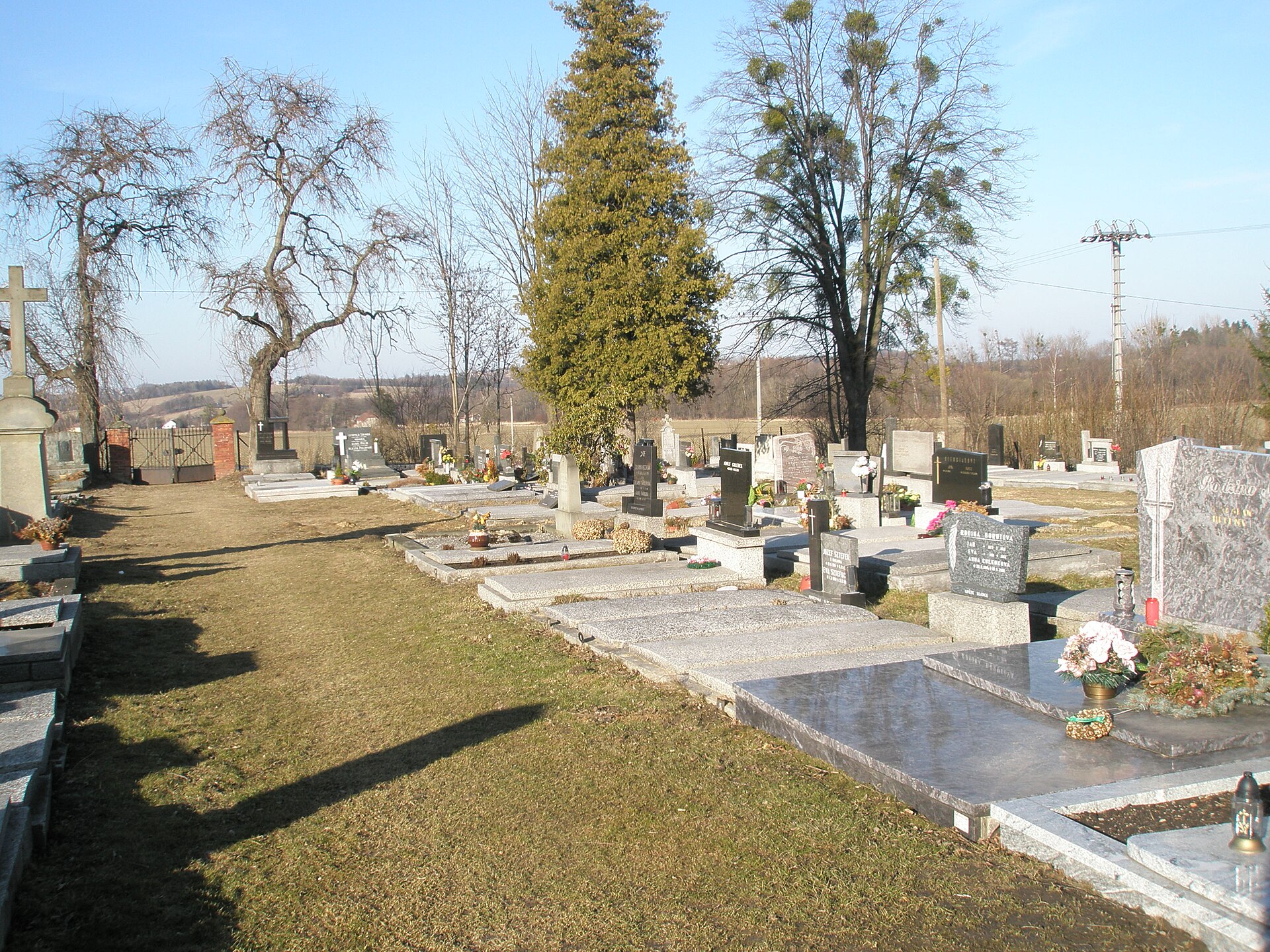
A walled churchyard cemetery encloses the building, accessed through two gates. Nine figural gravestones survive along the inside and outside of the wall, with an additional monument set into the ground directly in front of the main entrance. The most notable is a cross-shaped grave marker for Johanna Horký, who died on 19 February 1880 at the age of 63. The church, its boundary wall, gates, gravestones, and the staircase on the north side are all protected together as a single heritage monument.
When is the parish feast day?
The church's patronal feast, tied to the Assumption of the Virgin Mary, falls on 15 August. On that day the Hnojník parish holds its annual pilgrimage Mass, drawing worshippers from the surrounding area.
Frequently asked questions
Where exactly is the church located? On the western edge of the village of Hnojník, on slightly elevated ground, in the Frýdek-Místek district of the Czech Republic.
When was the current church built? Between 1808 and 1812, on the site of an earlier wooden church dating from before the 15th century. It was consecrated on 18 November 1812.
What architectural style is it? Empire style, with a single nave, a tower on the main façade, and the unusual feature of an altar oriented to the west.
Is there a cemetery next to the church? Yes, a historic walled churchyard with two gates and nine protected gravestones, including that of Johanna Horký, who died in 1880.
Which parish and diocese does it belong to? The Roman Catholic parish of Hnojník, in the Frýdek deanery of the Diocese of Ostrava-Opava.
Nearby places

Earn badges for the places you visit
Download NextOnTrip, discover new places and check off your trails.