About this place
Le Moustier is a modest rock-shelter site in the commune of Saint-Léon-sur-Vézère, on the right bank of the Vézère river in the Dordogne, in the heart of the Périgord Noir. Across the valley stands the troglodyte cliff village of La Roque Saint-Christophe. From the outside it looks like little more than two hollows cut into a limestone cliff, yet for prehistorians it is one of the most important addresses in Europe: this is the place that gave its name to the entire Mousterian culture, the stone-tool tradition of Neanderthal populations in the Middle Palaeolithic.
Where exactly is the site, and what does it consist of?
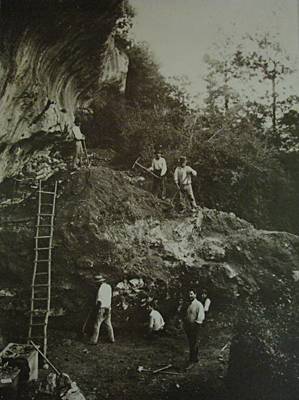
Le Moustier is made up of two separate shelters excavated independently: the upper shelter, often called the "classic" one, and the lower shelter, sitting almost at river level. Digs at both began in the late 19th century, shaping how prehistoric archaeology across Western Europe would be classified from then on.
Why is the whole Mousterian period named after this place?
In 1869 the prehistorian Gabriel de Mortillet used finds from Le Moustier to define a distinctive flint-working tradition, which he called "Mousterian." The label still designates the whole Middle Palaeolithic in Europe, closely associated with Neanderthals. The scrapers, points and flakes recovered here show careful, planned retouching — real technical skill, far from the "primitive caveman" cliché.
How old are the layers, and what has been found in them?
The stratigraphic sequence at Le Moustier spans roughly 56,000 to 35,000 years ago. The successive layers trace the site's occupation history: Mousterian of Acheulean tradition, then typical Mousterian, and in the uppermost, youngest layers, Châtelperronian and Aurignacian material — the first signs of Homo sapiens groups moving into the region. A 2024 study identified traces of a compound adhesive, a mixture of ochre and bitumen, that Neanderthals at Le Moustier used to haft stone tools onto wood or bone handles, pointing to a level of technical know-how rarely credited to them.
What makes the Neanderthal skeletons found here so significant?
Le Moustier owes much of its fame to two remarkable human discoveries. On 10 April 1908, the Swiss antiquities dealer Otto Hauser excavated the skeleton of a Neanderthal adolescent, now known as Le Moustier 1. Hauser sold the find to Berlin's Königliches Museum für Völkerkunde as early as 1910. Its later history was turbulent: the postcranial bones were destroyed in a bombing raid on Berlin near the end of the Second World War, while the skull survived and remains in Berlin's collections today.
A second skeleton, that of a newborn, was unearthed in 1914 and became known as Le Moustier 2. It vanished from record for almost a century, until rediscovered in 2002 in a Dordogne museum's storage. Both individuals, dated to roughly 40,000–50,000 years ago, gave paleoanthropologists valuable evidence on how Neanderthal children grew and developed.
Can visitors actually go to the site?
The excavation itself is normally closed to independent visitors. Guided tours run by reservation only, booked through the ticket office at Font-de-Gaume in Les Eyzies-de-Tayac. On a guided visit, you can see the preserved stratigraphic profile of the dig and hear about more than a century of research here, including recent campaigns led by archaeologist Brad Gravina. Le Moustier forms part of the Prehistoric Sites and Decorated Caves of the Vézère Valley, inscribed on the UNESCO World Heritage List in 1979. The best-preserved Neanderthal-related material from the region is on permanent display at the National Museum of Prehistory in nearby Les Eyzies.
FAQ
What sets Le Moustier apart from other Vézère valley sites? It is the eponymous site — it lent its name to an entire archaeological period, not just to a single local find.
Can visitors see the original Neanderthal remains on site? No. The original bones are held in museum collections in Berlin and the Dordogne; related casts and material are displayed at the National Museum of Prehistory in Les Eyzies.
How do you book a guided visit? Through the Font-de-Gaume ticket office in Les Eyzies-de-Tayac.
How old are the archaeological layers at Le Moustier? Roughly 56,000 to 35,000 years old, spanning the Mousterian through to the later Châtelperronian and Aurignacian layers.
Nearby places

Earn badges for the places you visit
Download NextOnTrip, discover new places and check off your trails.