About this place
Rouffignac Cave, known in French as Grotte de Rouffignac, is one of the most remarkable underground galleries of Ice Age art in France, tucked beneath the hills of the Périgord in the Dordogne department. Because of the sheer number of mammoth images carved and painted on its walls, it has earned the nickname "the cave of a hundred mammoths." It lies within the commune of Rouffignac-Saint-Cernin-de-Reilhac, close to Les Eyzies-de-Tayac, the town often called the unofficial capital of prehistory in this part of France.
What is hidden inside the cave?
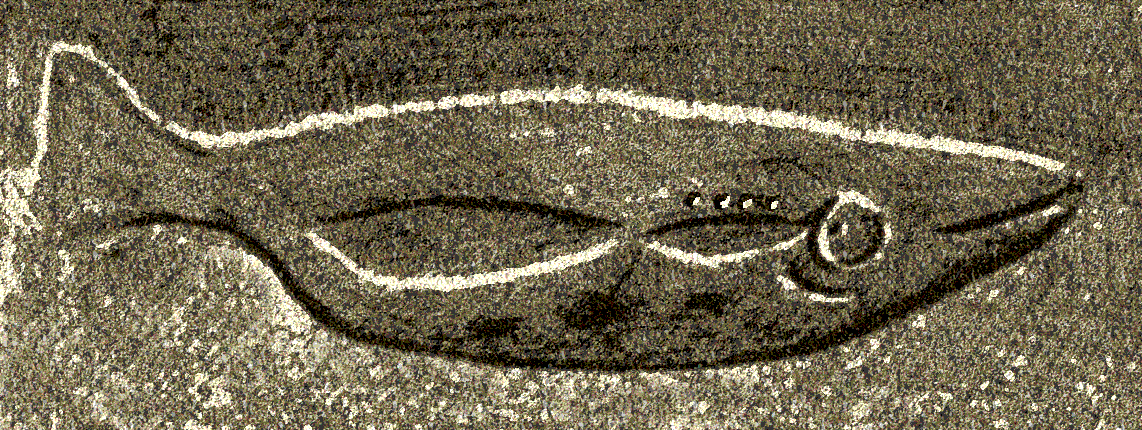
This karst cave stretches for more than eight kilometres, making it one of the longest decorated caves open to visitors anywhere in Europe. Around 250 animal figures survive on its walls and ceilings, combining engraved outlines with paintings done in black pigment. Mammoths dominate the collection, with 158 individual depictions — nearly a third of every known mammoth image from the Ice Age found across Western Europe. Alongside the mammoths, visitors can spot horses, bison, ibex and woolly rhinoceros worked into the rock in the same technique.
How old is the artwork?
Stylistic analysis, including the classification system devised by prehistorian André Leroi-Gourhan, places most of the figures in the Middle Magdalenian period. That puts the art at roughly 13,000 to 15,000 years old, from the closing phase of the last Ice Age, when hunter-gatherer groups moved through the valleys around what is now the Dordogne, leaving similar traces in many of the region's other decorated caves.
Why was the art recognized so late?
The cave itself had been known to local people since at least the 16th century, long before anyone grasped what its walls contained. Its true significance only came to light in the summer of 1956, when Romain Robert and Louis-René Nougier, together with Charles and Louis Plassard, surveyed the galleries in detail. A few weeks later, on 17 July, the renowned prehistorian abbé Henri Breuil confirmed that the images were genuinely Palaeolithic. That authentication placed Rouffignac firmly among France's major sites of prehistoric art.
What protection status does the cave hold?
The year after the paintings were authenticated, in 1957, the cave was listed as a monument historique in the classé category, granting it the highest level of legal heritage protection in France. In 1979 it was also included among the sites forming the UNESCO World Heritage listing for the Prehistoric Sites and Decorated Caves of the Vézère Valley, one of the richest concentrations of Ice Age art anywhere in the world.
What is a visit like?
Because the decorated galleries lie deep inside the hillside, tours run aboard a small electric train that carries visitors roughly two kilometres underground to the areas where the mammoth panels are concentrated. The narrow, dark passages add to the sense of discovery, and the train ride itself tends to be a highlight for younger visitors.
Frequently asked questions
Why is Rouffignac called the cave of a hundred mammoths? Of the roughly 250 surviving animal figures, 158 depict mammoths — the largest concentration of this motif in any decorated cave in Western Europe.
Is Rouffignac Cave part of a UNESCO World Heritage site? Yes. Since 1979 it has been included in the listing for the Prehistoric Sites and Decorated Caves of the Vézère Valley.
How old are the paintings? They date to roughly 13,000–15,000 years ago, attributed mainly to the Middle Magdalenian period.
Do visitors walk through the cave? No. Because the main painted panels lie about two kilometres from the entrance, tours are conducted aboard an electric train that takes visitors into the depths of the cave.
Nearby places

Earn badges for the places you visit
Download NextOnTrip, discover new places and check off your trails.