About this place
Cap Blanc rock shelter sits in the commune of Marquay, in France's Dordogne department, and holds one of prehistoric Europe's most striking works of stone sculpture: a frieze of horses, bison and deer carved directly into the limestone wall. The shelter overlooks the Beune valley, a tributary of the Vézère, just a few kilometers from Les Eyzies-de-Tayac, in a region with the densest cluster of Ice Age cave art anywhere in Europe.
What makes the Cap Blanc frieze so unusual?
Most Ice Age art associated with this valley is painted — Cap Blanc's is carved. Along roughly 13 of the shelter's 16 meters, Magdalenian artists cut horses, bison and deer into the rock face, in places chiseling as deep as 30 centimeters to give the animals real volume and shadow. The result sits closer to sculpture in high relief than to a simple engraving, and specialists regularly rank it among the finest examples of Palaeolithic stone carving found anywhere.
How was the shelter discovered?
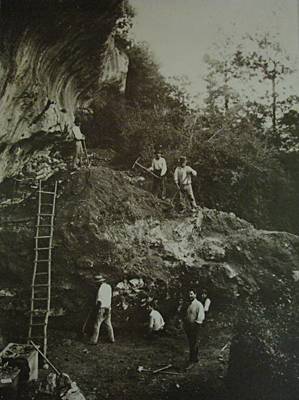
The site was found in 1908 by Raymond Peyrille, who was working under the direction of archaeologist Jean-Gaston Lalanne while Lalanne himself was excavating the nearby shelter at Laussel. The first proper excavation followed in 1909, and it was this dig that brought the sculpted frieze fully to light.
Whose skeleton was found at Cap Blanc?
In 1911, while workers were building a protective wall in front of the shelter, a pickaxe struck something hard — a human skull, which shattered on impact. What followed was the recovery of a near-complete skeleton, one of the best-preserved Magdalenian burials known in northern Europe. The remains were sold in the 1920s and have been held by the Field Museum in Chicago since 1926, where they went on public display and drew large crowds. For years the skeleton was presented as that of a young girl; later anthropological study revised this, showing the individual was a woman between 25 and 35 years old at death.
Where does Cap Blanc fit into the Vézère valley story?
The shelter lies within the Vézère valley, listed as a UNESCO World Heritage site for its extraordinary concentration of decorated caves and rock shelters, alongside better-known names like Lascaux and Font-de-Gaume. What sets Cap Blanc apart is its medium: sculpture rather than painting, and monumental sculpture at that — a rare case of prehistoric relief carving that visitors can still see in its original setting. The site has been protected as a monument historique (classé) since 28 November 1910, France's highest tier of heritage protection.
FAQ
What period does the Cap Blanc frieze date to? The carvings belong to the Magdalenian, the final phase of the Upper Palaeolithic.
Which animals appear on the frieze? Horses, bison and deer, carved in relief that reaches up to 30 centimeters deep in places.
Is the skeleton found at the site still there? No — it has been held by the Field Museum in Chicago since 1926.
Is Cap Blanc part of the Vézère valley's UNESCO listing? Yes, the shelter sits within the Vézère valley, protected by UNESCO for its concentration of Palaeolithic art.
How does Cap Blanc differ from Lascaux? Lascaux is known for its paintings, while Cap Blanc's art takes the form of sculpture cut directly into the rock.
Nearby places

Earn badges for the places you visit
Download NextOnTrip, discover new places and check off your trails.