About this place
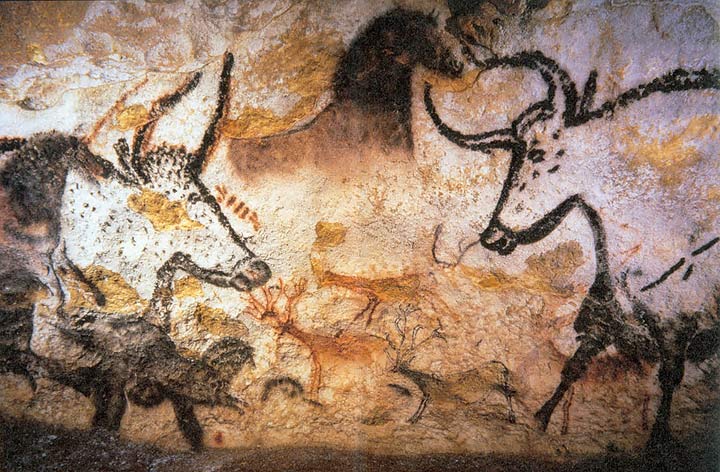
Lascaux is a cave in the commune of Montignac-Lascaux, in the Dordogne department of southwestern France's Périgord region, home to one of the richest collections of Ice Age art ever found. It sits in the Vézère valley, an area dense with prehistoric sites, but Lascaux stands out for the sheer number and quality of its painted animals.
How was the cave found?
The story starts with a dog. On 8 September 1940, seventeen-year-old Marcel Ravidat was out walking near Montignac when his dog, Robot, disappeared into a hole left by an uprooted tree. Ravidat came back four days later, on 12 September, with three friends — Georges Agniel, Simon Coencas and Jacques Marsal, all teenagers themselves. Armed with makeshift lamps, the four climbed down and became the first people in millennia to see the painted walls. Word spread fast, and the French state soon took control of the site.
What do the paintings show?
Across a series of connected chambers, more than 600 animal figures were painted or engraved — horses, bison, deer, aurochs, and a scattering of rarer subjects, including a single human figure in a scene known as the Shaft. Horses and cattle dominate, rendered with striking movement and often using the natural curves of the rock to suggest volume. The paintings are generally dated to somewhere between roughly 17,000 and 21,000 years old, placing them late in the Upper Paleolithic. Because of the scale, variety, and condition of the artwork, Lascaux has become something of a benchmark for prehistoric cave art across Europe.
Why is the original cave off-limits?
The cave opened to visitors after the war, and by the 1950s it was drawing crowds large enough to change its internal climate. Lighting, humidity from thousands of visiting bodies, and carbon dioxide encouraged algae to spread across the walls — a problem nicknamed the "green sickness" — followed later by white patches of calcite and mold. In 1963, French authorities closed the cave to the public entirely. Since then, access has been restricted to a small number of scientists for conservation work. The closure halted further damage, but it also means no visitor to Montignac today walks through the actual painted chamber.
What can visitors see instead?
The response to the closure was to build faithful copies nearby. Lascaux II opened in 1983, reproducing part of the cave close to the original entrance. In December 2016, after years of construction, Lascaux IV — the Centre International de l'Art Pariétal — opened at the foot of the hill in Montignac: a large, partly below-ground building housing an almost complete facsimile of the cave, matched to the original's humidity, temperature, and even acoustics. Visits run with a guide or a handheld tablet, and the site also includes workshops, a theatre, and exhibits on the discovery and on Paleolithic painting techniques.
FAQ
Can you visit the real Lascaux cave? No. The original has been closed to the public since 1963 and remains closed; only researchers get limited access for conservation purposes. Visitors tour an exact replica instead.
What's the difference between Lascaux II and Lascaux IV? Lascaux II (1983) reproduces only part of the cave near the original entrance. Lascaux IV (2016) is a much larger, purpose-built centre with a near-complete replica of the whole cave plus additional exhibition spaces.
Who discovered Lascaux? Four teenagers from Montignac — Marcel Ravidat, Georges Agniel, Simon Coencas, and Jacques Marsal — in September 1940.
How old are the paintings? Estimates place them roughly 17,000 to 21,000 years old, in the Upper Paleolithic period.
Where exactly is Lascaux? In the commune of Montignac-Lascaux, Dordogne department, Nouvelle-Aquitaine region, in the Vézère valley in the Périgord.
Nearby places

Earn badges for the places you visit
Download NextOnTrip, discover new places and check off your trails.