About this place
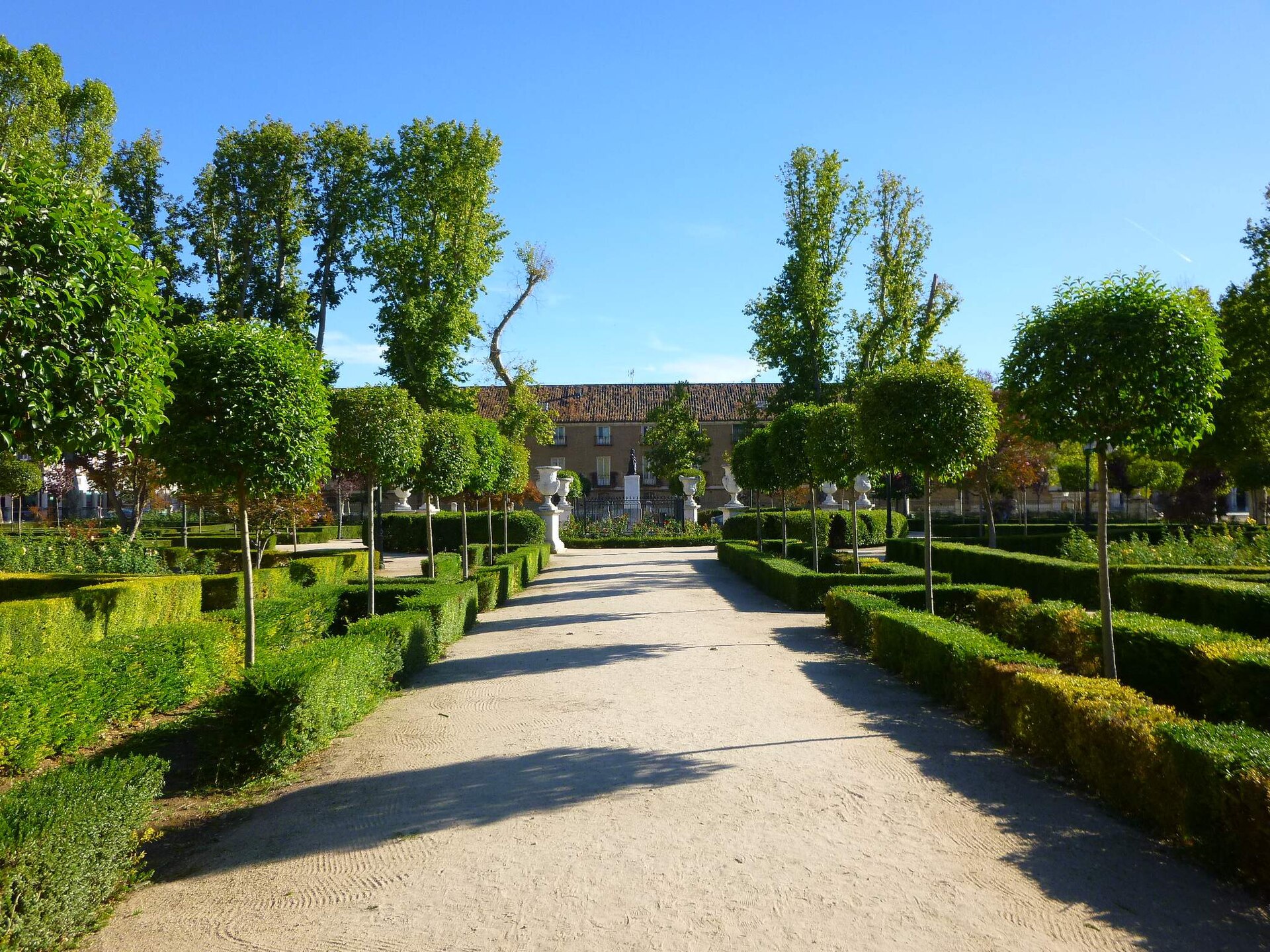
Jardín del Rey is a small but historically significant garden tucked beside the southern wing of the Royal Palace of Aranjuez, in the Madrid region of Spain. Completely hidden from view behind the palace's main façade, it ranks among the oldest and most notable garden compositions in the country. Laid out in the second half of the 16th century, it stands as one of the few surviving examples of Italian Renaissance landscaping in Spain, blending in elements drawn from Hispano-Muslim garden tradition.
Who designed the Jardín del Rey?
The garden's original concept dates to 1561 and is credited to Juan Bautista de Toledo, an architect closely tied to the construction of the Royal Palace. Its execution was completed between 1577 and 1582 by Juan de Herrera, one of the leading figures of Spanish Renaissance architecture and the mind behind the monastery of El Escorial. Herrera's involvement gave the garden its final, ordered layout.
Why is it called a "secret garden"?
Jardín del Rey is classified as a giardino segreto — a "secret garden" — a typology borrowed directly from Italian Renaissance garden tradition. The idea was to create an intimate, enclosed space set apart from the rest of the palace grounds, meant for private rest and contemplation rather than formal court gatherings or public promenades. Concealing the garden behind the palace façade reinforced this sense of seclusion and privacy.
What is the layout of the garden?
The composition follows a cruciform plan: two perpendicular axes intersect at a central point, dividing the space into eight distinct sections. These sections were planted with boxwood and fruit trees, giving the garden both a decorative and a practical function — combining ornamental design with the cultivation traditions typical of old palace gardens.
What is the garden's main highlight?
At the heart of the garden stands a fountain carved from green jasper, designed in 1580 by Roque Solario. Positioned at the central crossing point of the two axes, it serves as the visual and compositional focal point of the entire garden — a rare use of this particular stone in Spanish garden art of the period.
What heritage protection does the Jardín del Rey have?
The garden holds the highest levels of heritage protection. It has been listed as a Bien de Interés Cultural (Cultural Heritage Site) since 1931, and since 2001 it has formed part of the UNESCO World Heritage Site covering the cultural landscape of Aranjuez — one of the world's few examples of a landscape shaped by centuries of harmonious interaction between nature, architecture and urban planning.
Frequently asked questions
Is Jardín del Rey open to visitors? The garden sits within the palace grounds in Aranjuez and forms part of the visitor route around the Royal Palace, alongside the adjacent Jardín del Parterre.
How does it differ from other gardens in Aranjuez? Unlike the sprawling landscaped gardens such as Jardín de la Isla or Jardín del Príncipe, Jardín del Rey is small, geometric and intimate — representing an earlier, Renaissance phase of garden design in Aranjuez.
What style does the garden represent? It is an example of Italian Renaissance design combined with elements of Hispano-Muslim tradition, making it a rare national example of these two influences merged into a single composition.
Nearby places

Earn badges for the places you visit
Download NextOnTrip, discover new places and check off your trails.