About this place
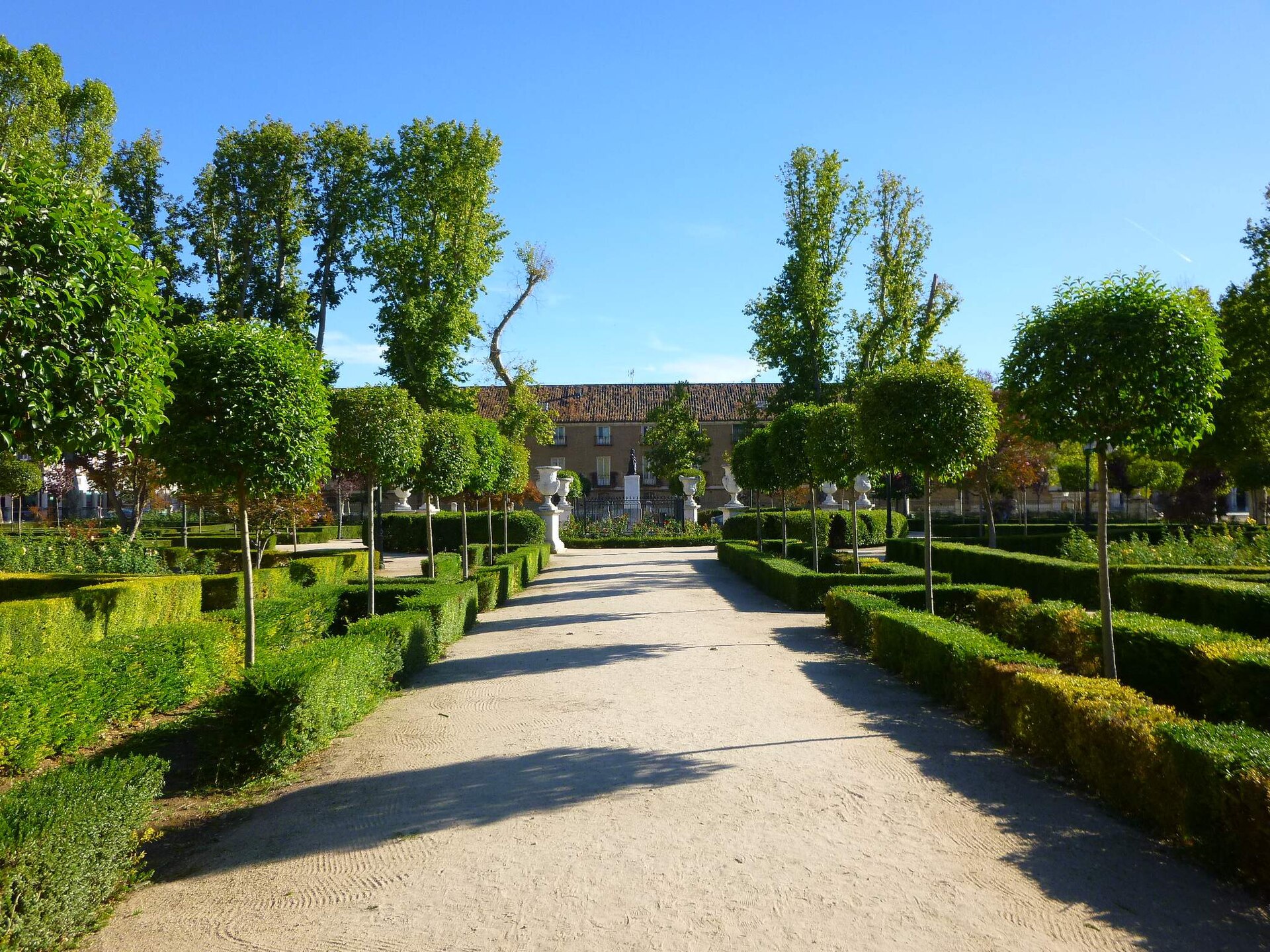
Jardín de Isabel II is a small historic urban garden at the heart of Aranjuez, the Spanish town famed for its royal residences on the banks of the Tagus river. Unlike the sprawling palace gardens Aranjuez is known for, this green square is modest in scale — yet it holds a distinctive place in the town's urban history.
Where does the name come from and when was it built?
The garden takes its name from Queen Isabel II, who was still a child when the space was created. Trees were first planted on the plot in 1830, and four years later, in 1834, a statue of the infanta Isabel — then only four years old — was placed at its center. The garden dates from the period of her minority, when the Crown oversaw the regency. Historians consider it the first landscaped space in Aranjuez designed for the town's residents rather than the royal court, and quite possibly one of the earliest public gardens of its kind anywhere in Spain.
Where exactly is it, and how does it fit into the town plan?
The garden occupies a plot originally earmarked for a building block next to the Casa de Infantes, closing off one side of the Plaza de San Antonio. Its closeness to the Royal Palace meant the neglected corner it once was could not be left as an eyesore, so the site was turned into a representative green enclave befitting its royal neighbor.
What will you see walking through it?
The square shape of the plot dictated a geometric, almost cloister-like layout: paths cross at a central point, forming a cruciform plan. The four arms of that cross align with the four street entrances around the perimeter, so the garden can be crossed easily from any direction. At the very center stands the statue of the young infanta Isabel — the feature that gives the garden its identity and serves as a natural landmark for anyone strolling through. Mature trees, shaded paths and a symmetrical layout give the space the feel of a 19th-century urban garden, a deliberate contrast to the grand scale of Aranjuez's nearby palace gardens.
Why does it hold heritage status?
Jardín de Isabel II has been listed as a Bien de Interés Cultural — Spain's highest category of protected heritage — since 1931. Since 2001 it has also formed part of the area inscribed on the UNESCO World Heritage List as the "Aranjuez Cultural Landscape," a designation covering the town's entire historic palace-and-garden ensemble.
How do you get there, and when is the best time to visit?
Aranjuez lies about 50 km south of Madrid and is well connected by rail — Cercanías line C-3 trains reach it from the capital in under an hour. The garden itself sits within the historic center of town, close to the Royal Palace, so the easiest approach is on foot after visiting the main sights of the Real Sitio. As a public open space, it's free to enter and has no fixed opening hours like a ticketed monument. Spring and autumn are the most comfortable seasons to visit, with milder temperatures than Spain's hot summers and the greenery at its most attractive.
Frequently asked questions
Is there an entrance fee? No, it's an open public urban space, free to enter at any time of day.
How long does a visit take? It's a small square, so a walk-through typically takes 10–15 minutes — best combined with a visit to the Royal Palace or the other gardens of Aranjuez nearby.
What does the statue at the center represent? It depicts Queen Isabel II as a four-year-old girl. It was placed in 1834, during her minority, and has given the garden its name ever since.
Is the garden part of a larger tourist complex? Yes, it lies within the Real Sitio de Aranjuez, listed by UNESCO as the Aranjuez Cultural Landscape, alongside the Royal Palace and the town's other historic gardens.
Nearby places

Earn badges for the places you visit
Download NextOnTrip, discover new places and check off your trails.