About this place
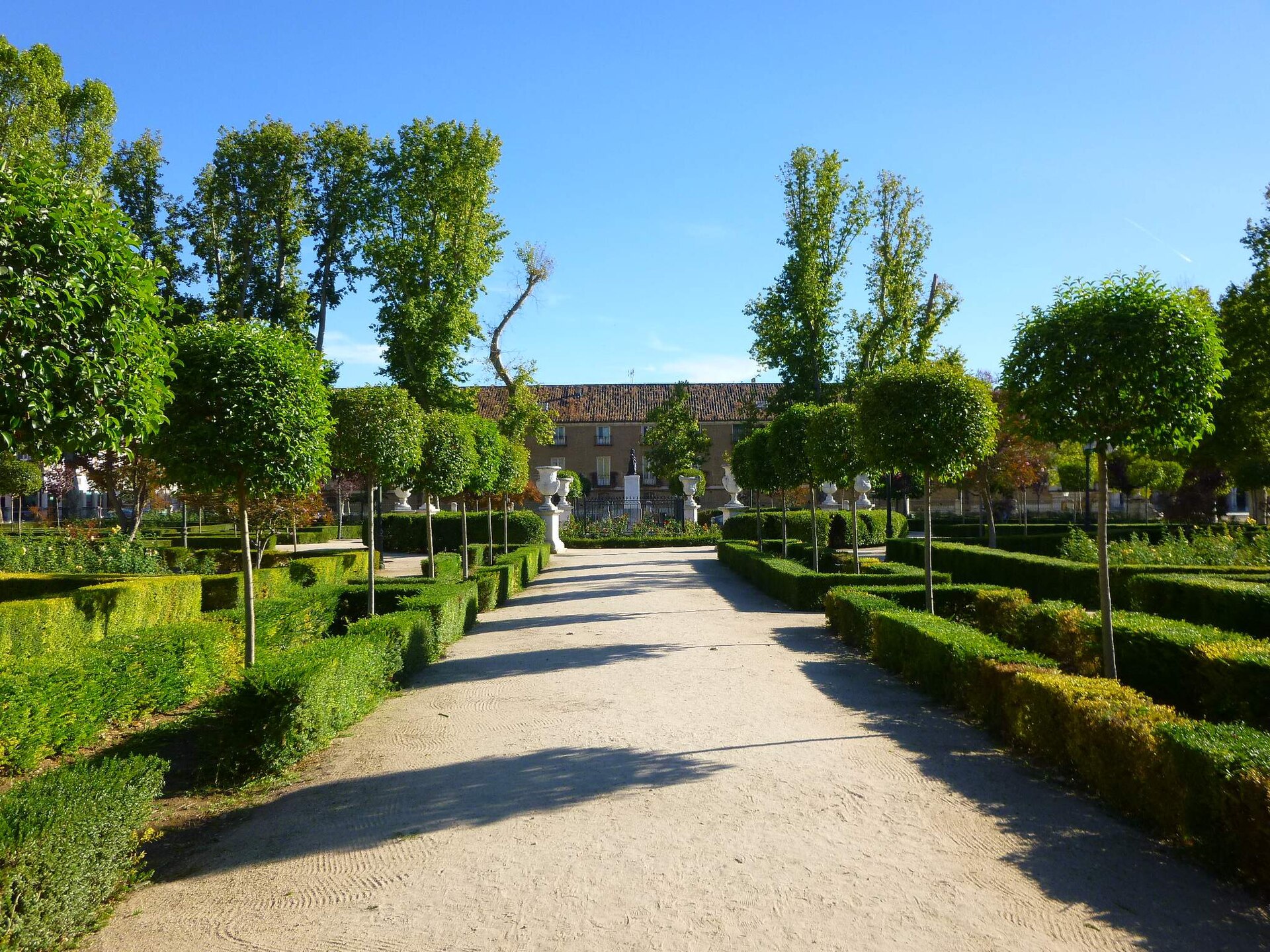
Jardín de la Reina is a small but charming historic garden in Aranjuez, tucked away right behind the northern wing of the Royal Palace. Together with its mirror-image counterpart, Jardín del Rey, it forms a pair of intimate green spaces that many visitors miss entirely as they head straight for the sprawling Jardín del Príncipe. That quiet, out-of-the-way character is precisely what makes it worth a detour — walking through it feels like discovering a corner of Aranjuez that rarely makes it into guidebooks.
Why was the garden built so late?
Although the plan to develop this plot beside the palace's northern wing, mirroring the Jardín del Rey, dates from an earlier stage of the palace's expansion, the Jardín de la Reina itself wasn't actually laid out until the very end of the 19th century. The trigger was the 1889 relocation of a sculptural group depicting Ceres from the Jardín del Príncipe to the Jardín del Parterre. That move freed up three small fountains that had previously stood in the Parterre's central pool — two of them were then installed in the gardens of the King and the Queen respectively. This event helps date the planting of the Jardín de la Reina to the closing years of the 19th century, decades after the neighboring, better-known gardens of Aranjuez had already reached their peak.
How was the space designed?
The layout of the Jardín de la Reina echoes its twin, the Jardín del Rey, though on a smaller scale. The garden follows a cruciform plan, with its main axes crossing at a central point to form a small square. At the heart of that square sits the garden's focal feature: a fountain carved from Colmenar stone, with an irregular, mixed-outline basin. It is crowned by a sculptural group of two winged cherubs holding a fish — a light, playful motif typical of garden fountain decoration from this period, standing in gentle contrast to the palace's more solemn architecture just steps away.
What significance does this garden hold today?
Small as it is, the Jardín de la Reina is an integral part of Aranjuez's exceptional green heritage. It has been protected as a Bien de Interés Cultural (Spain's equivalent of a listed heritage site) since 1931, and since 2001 it has formed part of the Cultural Landscape of Aranjuez inscribed on the UNESCO World Heritage List. That dual protection underscores that even the smallest, secondary gardens of the palace complex carry historical value comparable to the grand avenues and parterres that draw the crowds.
For visitors exploring Aranjuez, this garden makes an ideal quiet stop for a short walk between touring the palace interiors and heading off to the larger gardens. Its symmetrical pairing with the Jardín del Rey also helps make sense of the site's broader urban logic — the way Spanish monarchs planned the grounds around their summer residence as a coherent system of green spaces, even though it was built up in stages over more than a century.
Frequently asked questions
Is the Jardín de la Reina part of the palace or a separate site? It's a palace garden located directly beside the northern wing of the Royal Palace of Aranjuez, functionally and visually tied to the rest of the complex.
When was the garden created? The original plan dates back to an earlier phase of the palace's expansion, but the actual planting and shaping of the garden is dated to the end of the 19th century, likely in the years just after 1889.
What is there to see inside? The central fountain carved from Colmenar stone, featuring a sculpture of two cherubs holding a fish, set where the garden's cross-shaped paths intersect.
Is the garden protected as heritage? Yes — as part of the Aranjuez gardens ensemble, it has been a Bien de Interés Cultural since 1931 and is included in the UNESCO World Heritage listing (Cultural Landscape of Aranjuez) since 2001.
Nearby places

Earn badges for the places you visit
Download NextOnTrip, discover new places and check off your trails.