About this place
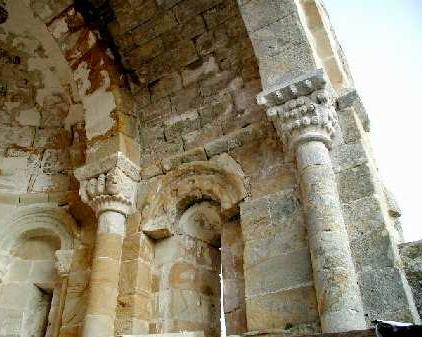
The Hermitage of Bárcena de Pienza (Spanish: Iglesia de Nuestra Señora de la Asunción) is the Romanesque ruin of a former parish church standing at the edge of Bárcena de Pienza, a small village within the municipality of Merindad de Montija, in the province of Burgos, in the Las Merindades region of northern Castile and León. Of the church that once served this settlement of roughly 45 residents, only part of the nave walls and a single, richly carved apse have survived — and it's that apse, dated to the close of the 12th century, that draws visitors interested in Romanesque stonework.
Where exactly does the ruin stand?
The remains sit in a quiet, somewhat isolated spot surrounded by farmland on the outskirts of Bárcena de Pienza, a village belonging to the municipality of Merindad de Montija, within the Las Merindades comarca in the northern reaches of Burgos province, close to the border with Cantabria. The ground around the ruin now serves as the village cemetery, so access is straightforward and unhurried, much like visiting any small rural churchyard.
Why did a parish church end up abandoned?
The building was originally the civic and religious heart of the settlement, before the village itself relocated further southeast — local tradition points to repeated flooding from the nearby Trueba river as the reason people moved. Left behind, the church, dedicated to Nuestra Señora de la Asunción (Our Lady of the Assumption), gradually lost its parish status and came to be known locally as a hermitage, a lasting marker of where the original village once stood. The name Bárcena de Pienza is itself said to echo an early medieval settlement called Pienza, which reportedly also lent its name to two nearby villages, Quintanilla and Revilla.
What actually survives of the original building?
What remains today is a stretch of the nave walls together with a semicircular apse, built from dressed sandstone ashlar toward the end of the 12th century. The exterior of the apse is divided into five bays separated by four engaged columns, each bay pierced by a window. The central window stands out for its archivolt, carved with a band of anthropomorphic heads — a decorative touch found in other Romanesque churches across Las Merindades, suggesting the same workshop of stonemasons was active in the wider area at the time.
What do the carved capitals show?
The most valuable surviving feature is the set of limestone capitals inside the apse, still legible after eight centuries. They depict unicorns, armed soldiers, and a scene identified as "the departure of the knight," a motif that turns up in other Romanesque churches of the region. Other capitals are carved with scrollwork and human heads wearing a variety of headgear, all consistent in style with the apse's late-12th-century date.
Has anything been done to protect the ruin?
During the 1990s the site underwent restoration work, funded largely through private contributions, with the local community chipping in toward a new roof to help shield the remaining structure from further decay. The building is still, by any definition, a ruin — but its most valuable part, the apse with its full set of carved capitals, has been preserved well enough to keep the site relevant for anyone tracing the Romanesque art of Las Merindades.
Frequently asked questions
Is it a hermitage or a church? It was built as the parish church of Bárcena de Pienza, dedicated to Nuestra Señora de la Asunción; once it lost its parish role, locals began calling it a hermitage.
How old is the apse? It dates from the late 12th century and is built in the Romanesque style, using dressed sandstone ashlar.
What can visitors see on site today? Sections of the nave walls and a semicircular apse with windows and carved capitals showing unicorns, soldiers, and a knight's departure scene; the surrounding ground now functions as the village cemetery.
Why did the original village move away? Local tradition attributes the move to repeated flooding from the Trueba river, which pushed residents to resettle further southeast.
Nearby places

Earn badges for the places you visit
Download NextOnTrip, discover new places and check off your trails.