About this place
Iglesia de San Román is an abandoned Romanesque church standing on the site of the former village of Fuente Humorera, within the municipality of Valle de Manzanedo, in the province of Burgos, Castile and León. Only fragments of its walls and a distinctive bell gable survive today, marking the spot where a small rural parish once stood.
Where exactly is it?
The ruins sit on the former village grounds of Fuente Humorera, in the northeastern corner of Burgos province, in the Las Merindades district, close to the neighboring hamlet of Rioseco. Valle de Manzanedo itself stretches near the Ebro reservoir, bordering the Campoo area, and is known locally for a scattering of other Romanesque churches across the valley.
What did it look like, and what survives?
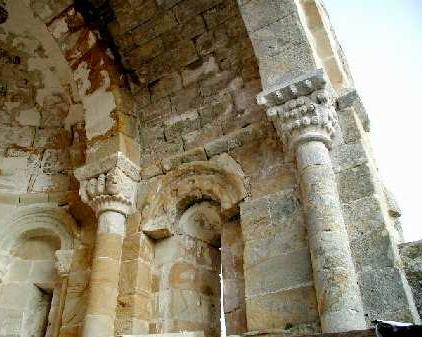
The church was built between the 12th and 13th centuries following Romanesque construction methods, then partly reworked during the Gothic period. Today only four incomplete walls remain standing, along with the espadaña — a wall-mounted bell gable typical of the region — still visible from a distance as a marker of the site. The carved capitals that once topped the church's columns were removed long ago and relocated: some went to the nearby church of San Martín del Rojo, also in Valle de Manzanedo, while others were taken to the Faculty of Theology in Burgos.
Why did Fuente Humorera disappear?
The village emptied out in the mid-19th century — the last entry in the church's parish records dates to 1851. Once residents left, the building fell out of use and decayed for decades without upkeep, leaving only the fragments described above. The church no longer holds any legal or canonical status as a place of worship, and its remains now sit on private land, inside a fenced hunting estate.
Can you visit it?
Access is limited because the site lies on private property behind fencing, so it isn't formally open to visitors, though the bell gable can be seen from a distance. In 2011, the heritage watchdog Hispania Nostra added the church to its Red List of Heritage at Risk. Local officials note that the structure has deteriorated to the point where any restoration would effectively mean rebuilding from scratch rather than repairing the original fabric.
Other Romanesque churches in the valley
Visitors interested in Romanesque architecture in Valle de Manzanedo have several more accessible options nearby: the Church of the Immaculate Conception in Crespos, dating to the first half of the 12th century; San Miguel de Cornezuelo, often called the valley's Romanesque "jewel"; the aforementioned San Martín del Rojo; and the church at Ailanes, with its semicircular apse. All share a similar architectural language — modest volumes, sturdy ashlar apses with wide buttresses, and expressive, somewhat rough-hewn stone carving typical of this corner of Burgos province.
Frequently asked questions
Where is the Iglesia de San Román located? On the site of the former village of Fuente Humorera, in the municipality of Valle de Manzanedo, Burgos province, in the Las Merindades district.
How much of the original church still stands? Four incomplete walls and the espadaña, a wall-mounted bell gable — the rest of the structure did not survive the long abandonment.
Why did the village of Fuente Humorera disappear? It was depopulated by the mid-19th century; the last parish record is dated 1851.
What happened to the church's carved capitals? They were relocated to the church of San Martín del Rojo in the same municipality and to the Faculty of Theology in Burgos.
Can the ruins be freely visited? No — they stand on private property with restricted access, and the church has been listed on Hispania Nostra's Red List of Heritage at Risk since 2011.
Nearby places

Earn badges for the places you visit
Download NextOnTrip, discover new places and check off your trails.