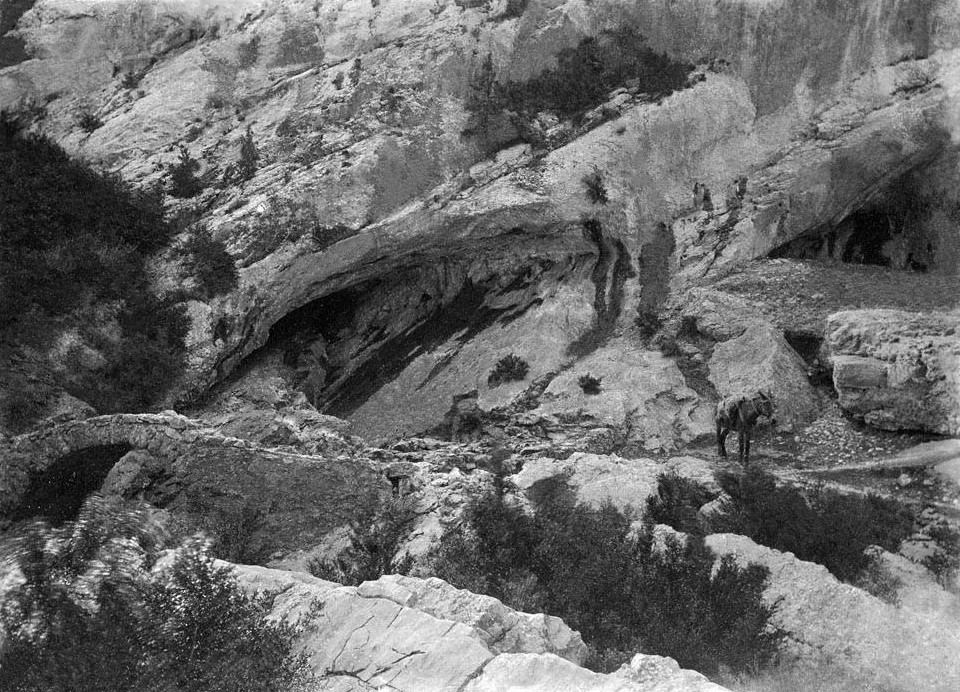
About this place
Forat de l'Or is a cave in Camarasa, in the province of Lleida, recognized as the longest known cavity in the municipality with more than 2,190 metres of passages. It lies within the Terradets Gorge (Congost de Terradets), on the left bank of the Noguera Pallaresa river, surrounded by the limestone formations typical of this part of Catalonia. This is a destination for people interested in speleology and regional geology rather than a conventional sightseeing stop — entering the cave calls for basic caving preparation and gear.
How do you get there?
The cave's entrance sits alongside the C-13 road, near kilometre 71, where the highway runs along the Terradets Gorge. The easiest approach is to stop at the roadside picnic area just before that point and follow the old path running along the gorge. The route passes near an old stone bridge, where visitors cross to the opposite side of the road to reach the right-hand mouth of the cave — one of its two known entrances. By car, it's roughly a 45-minute drive from Lleida, or about 20 minutes from Balaguer.
What will you see?
Forat de l'Or has two entrances set on an inclined bedding plane, linked to each other by a low passage 37 metres apart. The main system of galleries descends to a depth of 93 metres below the entrance level, giving the cave a distinctly vertical character that requires rope techniques on most sections. In 2012, cavers from the Grup Espeleològic de Barcelona (GEB) resumed exploration of the cave's flooded sumps, pushing the known endpoint to a depth of 73 metres below entrance level — exploration is still ongoing, and the full extent of the system remains unmapped.
Inside, the cave shows the features typical of limestone cavities: dripstone formations, narrow squeezes and wider chambers that shift in appearance depending on groundwater levels. During wetter periods, sections of the passages can be partially flooded, adding difficulty — and interest for experienced cavers — to the exploration.
A bit of history
The cave appears in written sources as far back as the early 17th century, mentioned in a 1609 text by Jeroni Pujades, making it one of the earliest documented caves in the region. It was later listed in speleological catalogues from the late 19th and early 20th centuries. The first recorded scientific survey was carried out on 31 August 1910 by biospeleologists René Jeannel and Emil Racovitza, who measured around 200 metres of passage at the time — roughly a tenth of what is known today. Subsequent decades of exploration, including the GEB team's 2012 work on the sumps, gradually revealed the rest of the system.
When should you visit?
Spring and autumn are the best times to visit, when outdoor temperatures are moderate and water levels inside the cave are usually lower than after winter rains. Summers in the Lleida area can get very hot, making the approach along the sun-exposed gorge uncomfortable, while heavy rainfall can raise water levels enough to close off parts of the passages. Whatever the season, exploring the cave properly requires adequate lighting, preparation, and ideally the company of someone familiar with the terrain.
Frequently asked questions
Can you enter Forat de l'Or without caving experience? Reaching the first few metres of the cave is possible without special training, but exploring the full system — particularly the vertical sections reaching 93 metres in depth — requires technical caving equipment and skills. Visitors without experience should contact a local caving club or hire a guide.
How long does it take to explore the whole cave? The main system stretches over 2,190 metres, but covering it all in a single day is essentially out of reach for amateurs — even experienced survey teams have mapped it gradually over many years of work.
Are there other attractions near the cave? The Terradets Gorge, where the cave is located, is popular among climbers, canyoners and hikers following the Noguera Pallaresa river, and the Camarasa area holds several other caves worth exploring.
Is the cave lit or set up for tourists? No — Forat de l'Or is a natural cave with no tourist infrastructure, lighting, or marked trails. Visitors need their own equipment, including headlamps and clothing suited to underground conditions.
Nearby places

Earn badges for the places you visit
Download NextOnTrip, discover new places and check off your trails.