About this place
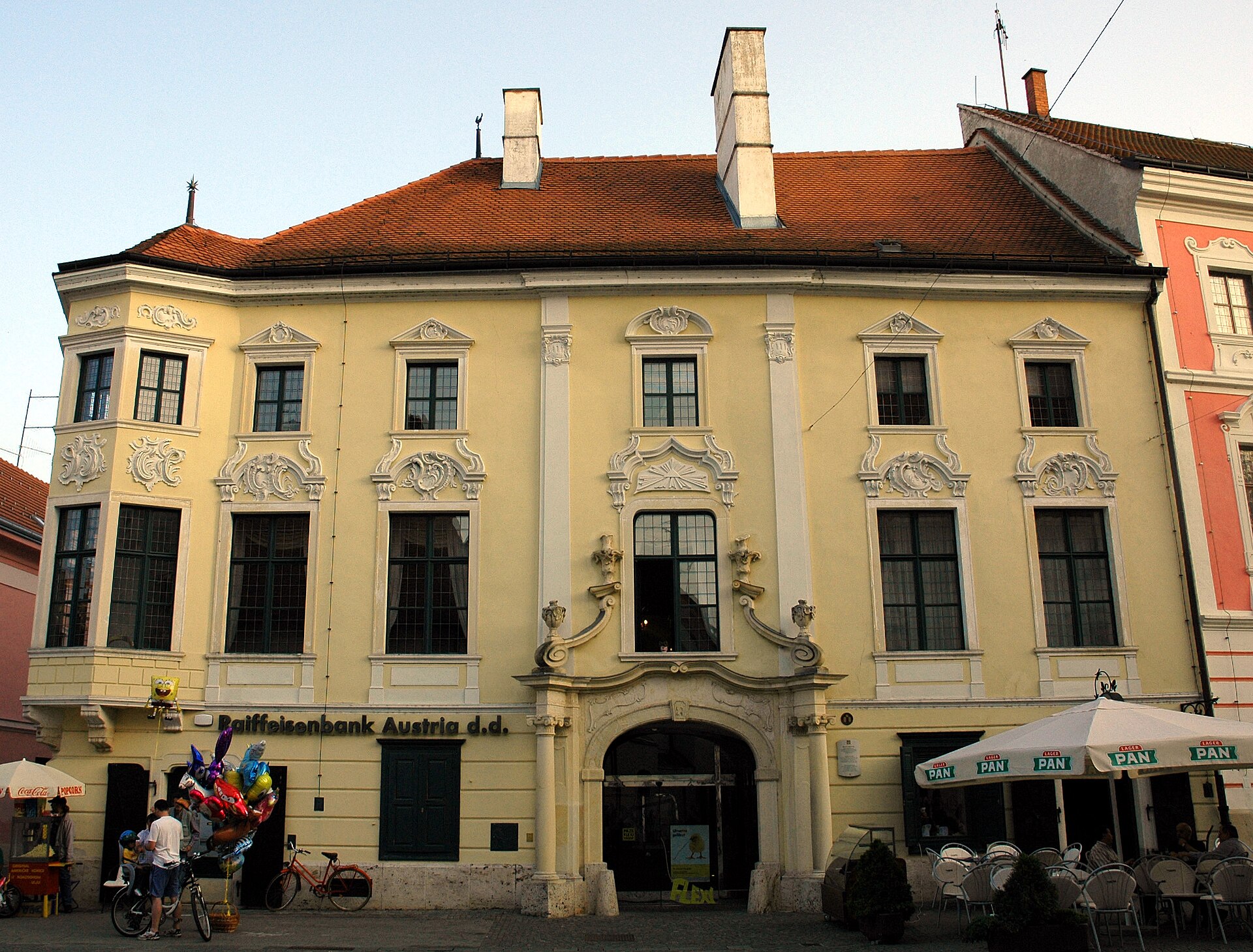
Erdödy-Patačić Palace is one of the baroque noble palaces that give Varaždin, a Croatian town famed for its dense cluster of 18th-century aristocratic residences, its distinctive character. The corner building stands just outside the line of the old city walls and has spent more than two centuries changing owners and purposes — from a family's status symbol, to an army barracks, to today's active music school.
How to get there?
The palace sits in Varaždin's historic center, within easy walking distance of the main square and the town's other noble palaces. Its coordinates are 46.305594, 16.333981, easy to drop straight into a map app. Varaždin is well connected by road and rail to Zagreb, making it a convenient day-trip base for exploring the town's baroque architecture on foot.
What will you see?
Erdödy-Patačić Palace is a single-story corner building erected around 1762 by Count Erdödy in the Austro-Bavarian style then favored by Croatian nobility building residences beyond the old town walls. It was originally a representative townhouse for the Erdödy family, at a time when owning a city residence alongside a country estate was a mark of status.
The ownership history is almost as interesting as the architecture itself. In 1810, Count Ivan Erdödy sold the building for 16,000 florins to nobleman Franjo Bedekovich and Count Fridrik Patačić. It was Patačić who actually took possession, and since he was the last member of his line, the property passed permanently into the estate of the Patačić family foundation — which is why the palace still carries both family names today.
The next major turning point came in 1860, when the whole estate — including two palaces in Varaždin and part of the foundation's holdings — was sold at public auction. The Varaždin municipality bought the palace with the intention of housing troops. From 1860 to 1945, the building served as an army barracks, known as the Zrinski barracks, a role that kept it in purely functional use for nearly a century.
The building's modern chapter began in 1994, when the Music School in Varaždin was granted the right to use it, and by 1997 the school had become its full owner. Today the complex covers roughly 3,200 square meters and houses two concert halls, thirteen piano classrooms, ten wind instrument classrooms, six string instrument classrooms, and a range of additional teaching spaces. The baroque shell of the palace is therefore very much alive with music today — a rare case of a historic interior that was never turned into a museum but instead kept serving its city as a working educational institution.
When to visit?
Because the palace functions as an active music school, its interior isn't open the way a typical museum would be — the best chance to see inside comes from concerts and events the school hosts. The corner facade and overall exterior, however, can be admired from the street year-round, making the palace an easy stop on any walk through Varaždin's historic center regardless of season.
Frequently asked questions
Who built Erdödy-Patačić Palace? Count Erdödy built it around 1762 as a representative family residence, in the Austro-Bavarian style typical of Croatian nobility at the time.
Why does the palace carry two family names? The name combines its original owners, the Erdödy family, with Count Fridrik Patačić, who took possession in 1810 and folded the palace into his family's foundation estate.
What was the palace used for in the 19th and 20th centuries? From 1860 to 1945 the building served as an army barracks, known as the Zrinski barracks, after the Varaždin municipality purchased it at a public auction.
Can the palace be visited today? The building has belonged to the Music School in Varaždin since 1997 and operates as an educational institution with concert halls, so its interior is mainly accessible during concerts and school events rather than through regular museum-style visits.
Nearby places

Earn badges for the places you visit
Download NextOnTrip, discover new places and check off your trails.