About this place
Keglević Palace is a Baroque-Rococo residence in Varaždin, tucked right against the old ramparts of the historic centre, on grounds that once belonged to a manor estate just outside the city walls. It's one of a handful of surviving noble palaces that give Varaždin its reputation as a small-scale showcase of northern Croatian Baroque.
Where did the palace come from?
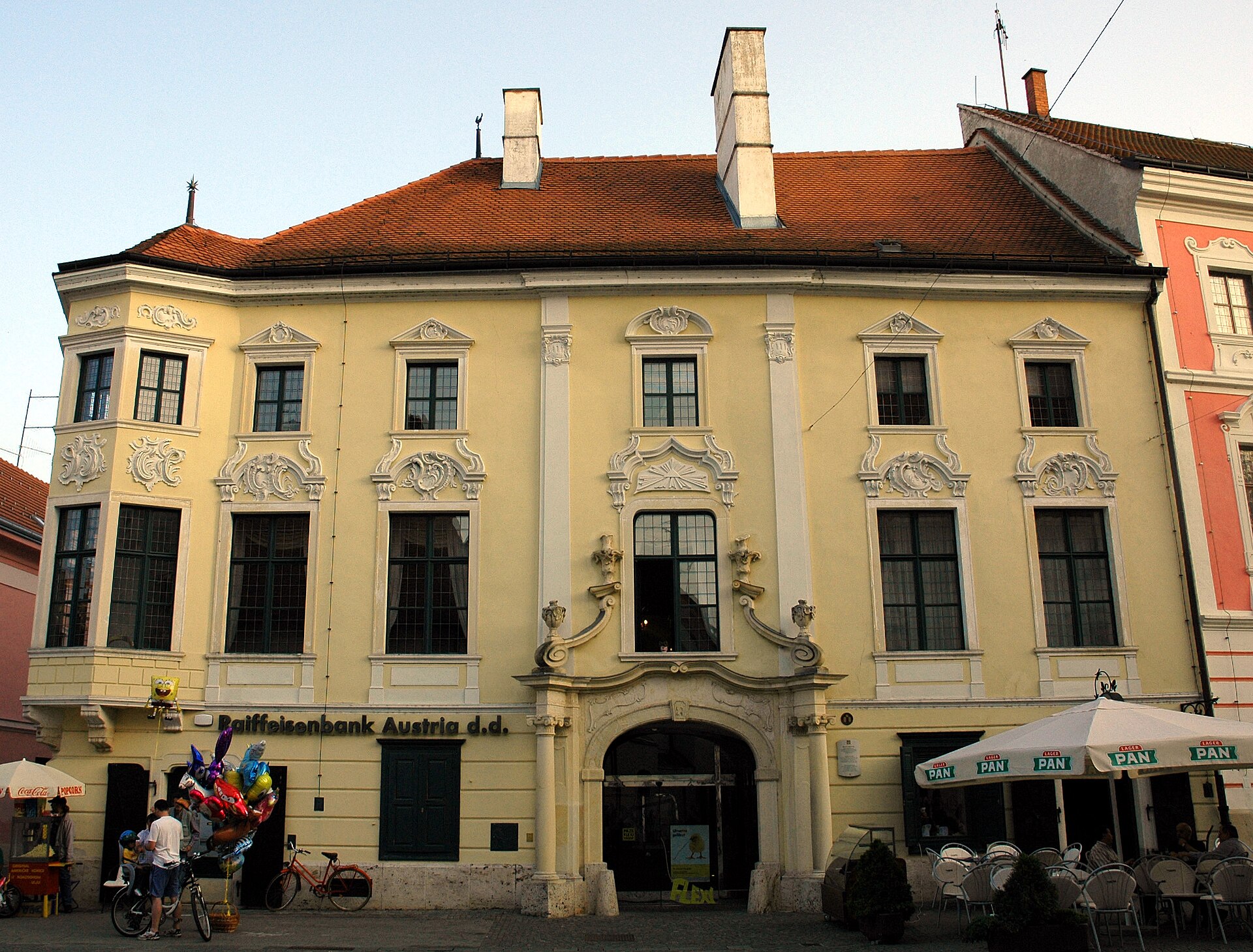
A building already stood on this spot in the 17th century, forming part of a farm estate outside the town fortifications. Its present, far more ornamental appearance dates from 1774–1775, when Count Josip III Keglević commissioned a rebuild. The work was carried out by Jakob Erber, a Varaždin master builder well known in the city at the time, who reshaped both the interior and the façade in the Rococo taste fashionable among the local nobility.
What does the architecture look like?
The palace is a free-standing, single-storey building on a rectangular plan, topped with a tall, four-sided roof. A garden surrounds it, which is why the whole property feels more like a small country manor than a townhouse — even though it sits inside the city. The façade carries unusually rich decoration: three projecting bays (risalits), stone and stucco ornament, an elaborate portal, and a balcony. It was originally finished in the pale white-pink tone typical of Rococo façades.
Inside, the room layout follows a High Baroque logic — spaces on each floor are grouped around a central axis, reflecting the comfortable representative living standard expected of 18th-century nobility.
The building is registered as a protected cultural monument of the Republic of Croatia. Over the last decade it went through a two-phase conservation programme: structural repairs, restoration of the historic room layout, replacement of the roof structure, and renewal of the main façade.
How do you get there, and what can you actually see?
Keglević Palace stands right against the Old Town walls in Varaždin, an easy walk from the main square and the town's other landmarks, so it fits naturally into a walking route that also takes in the Old Town and the nearby castle. The palace isn't run as a museum and has no regular visiting hours — today it houses a scientific department of the Croatian Academy of Sciences and Arts (HAZU) in Varaždin, so the interior isn't open to the public. Visitors mostly experience it from the outside: the façade, the surrounding garden, and the distinctive roofline and Rococo detailing, best seen while walking along the ramparts.
When's the best time to visit?
Spring and summer suit it best, when the garden around the palace is green and the evening light picks out the façade's stone detail. Varaždin also hosts its Baroque music festival (Varaždinske barokne večeri) in autumn — a good excuse to pair a walk past the palace with an event that fits the same architectural mood.
Frequently asked questions
Can you go inside Keglević Palace? No — the building is used by a scientific department of the Croatian Academy of Sciences and Arts, so the interior isn't open to visitors. You can freely view the façade and garden from outside.
Who built the palace, and when? The original structure dates to the 17th century, built as part of an estate outside the town walls. Its current Rococo form comes from a 1774–1775 rebuild directed by master builder Jakob Erber, commissioned by Count Josip III Keglević.
What makes the architecture distinctive? A single-storey rectangular building under a tall four-sided roof, three projecting risalits, stone-and-stucco ornament, a decorative portal and balcony, all set within a garden — a layout closer to a country manor than a city palace.
How does it fit into a visit to Varaždin? Since it sits right on the Old Town ramparts, it's a natural stop on a walking route that also covers the main square, the cathedral, and Varaždin Castle, all within a few minutes on foot.
Nearby places

Earn badges for the places you visit
Download NextOnTrip, discover new places and check off your trails.