About this place
Varaždin County Palace is a monumental 18th-century administrative building standing on Franciscan Square in Varaždin, northern Croatia. For more than 250 years it has served as the seat of the region's local government, and it remains one of the town's most recognizable baroque-era landmarks.
How did the palace come to be?
The building was constructed between 1768 and 1770 to a design by architect Jacobus Erber. It rose on the site of a smaller, ruined structure that had previously belonged to the Varaždin military generalate. Its construction was part of the broader administrative reforms of Empress Maria Theresa, who in the 18th century restructured the Habsburg monarchy into counties (županije). As the seat of one such county, Varaždin needed a representative building to house its administrative offices.
The palace's original form followed the late-baroque style of the period, topped with a distinctive trefoil gable. That appearance, however, did not last long: a major fire swept through the town in 1776, seriously damaging the building.
What will you see today?
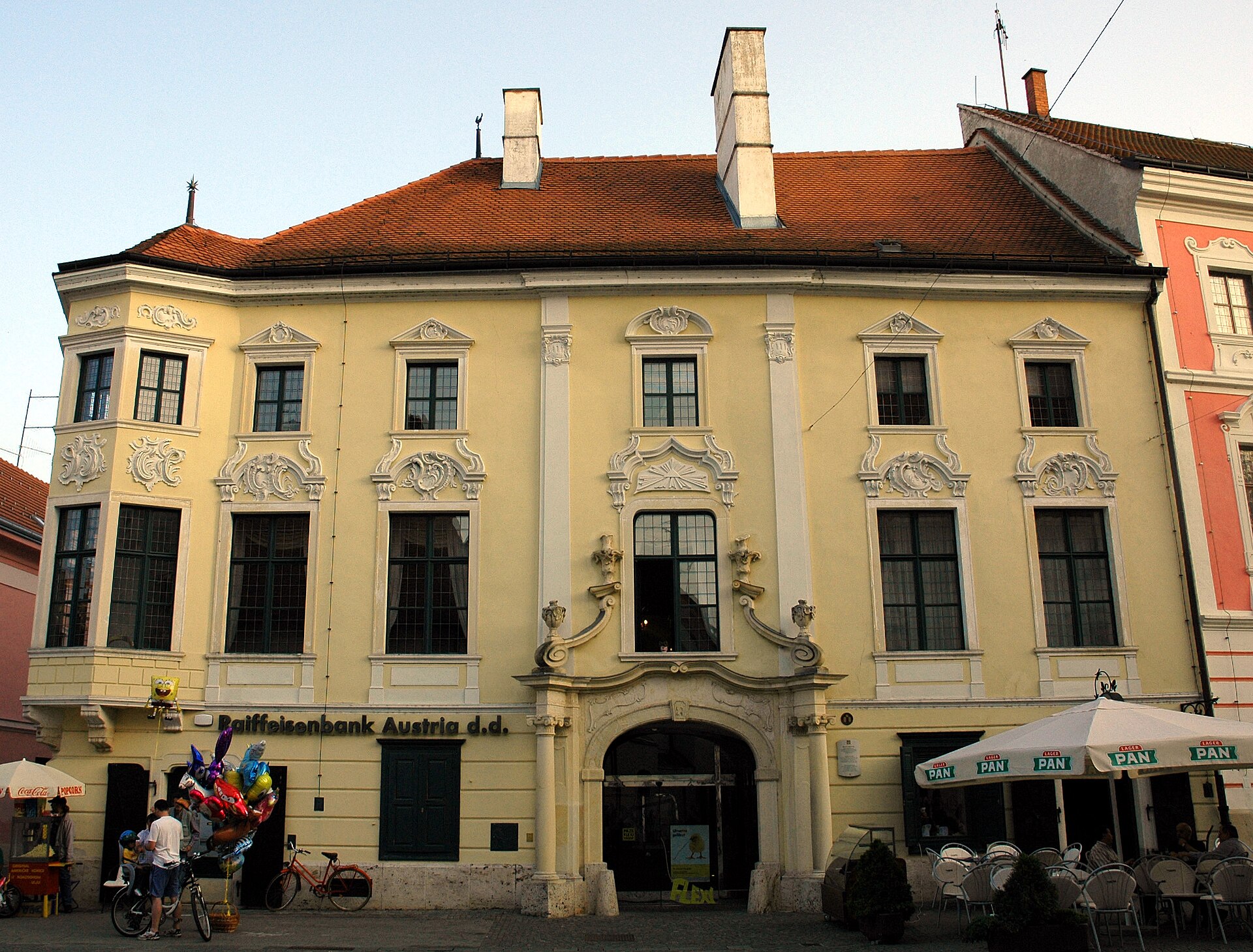
Following the fire, the palace was rebuilt in a more classicist spirit. Its façade was given a triangular pediment set within a central projecting bay, while the main entrance was framed by a stone portal topped with a first-floor balcony. This blend of baroque proportions and classicist detailing is what visitors see today when they approach the palace across Franciscan Square.
The building itself is two storeys tall and laid out as an elongated rectangle. On the square's southern side it forms a compact block that, together with three connected wings, encloses an inner courtyard — a layout typical of official residences of the period across Central Europe. It is worth pausing to appreciate the façade's proportions and the stonework around the portal, evidence of the craftsmanship of the era.
Over the centuries the building has served more than a purely administrative role — one of its rooms is known to have also functioned as a prison, a reminder of how multifunctional such civic buildings once were within local governance.
At the start of the 21st century, between 2001 and 2004, the palace underwent a thorough renovation during which its baroque façade elements were restored. Thanks to this work, the building retains its historic character while continuing to serve as a fully functioning seat of local administration.
How do you get there?
The County Palace sits in the very heart of Varaždin's old town, on Franciscan Square, right next to the Franciscan church and monastery. It's an easy stop on foot: most of the historic centre's landmarks, including Stari Grad Castle and the cathedral, lie within a few hundred metres. Varaždin is well connected by road and rail to Zagreb, making it a straightforward day trip from the capital.
When is the best time to visit?
The façade is at its most photogenic in the afternoon light, when the stonework and the classicist pediment catch the warm tones of the setting sun. Since the building remains in active administrative use, the interior is not generally open to visitors — the main draw is the exterior architecture and the historical context of the square it anchors. It's worth pairing a visit with a walk through Varaždin's baroque old town, often nicknamed "Little Vienna".
Frequently asked questions
When was Varaždin County Palace built? It was built between 1768 and 1770, as part of Maria Theresa's administrative reforms that introduced the county system.
Who designed the palace? The architect was Jacobus Erber, who designed its original late-baroque form.
Why does the palace look different from its original design? A fire in 1776 destroyed much of the original decoration, after which the building was rebuilt in a classicist style with a triangular pediment.
Can visitors go inside the palace? The building still serves as the seat of Varaždin County's administration, so the interior is not routinely open to tourists — the main appeal lies in its exterior architecture.
Nearby places

Earn badges for the places you visit
Download NextOnTrip, discover new places and check off your trails.