About this place
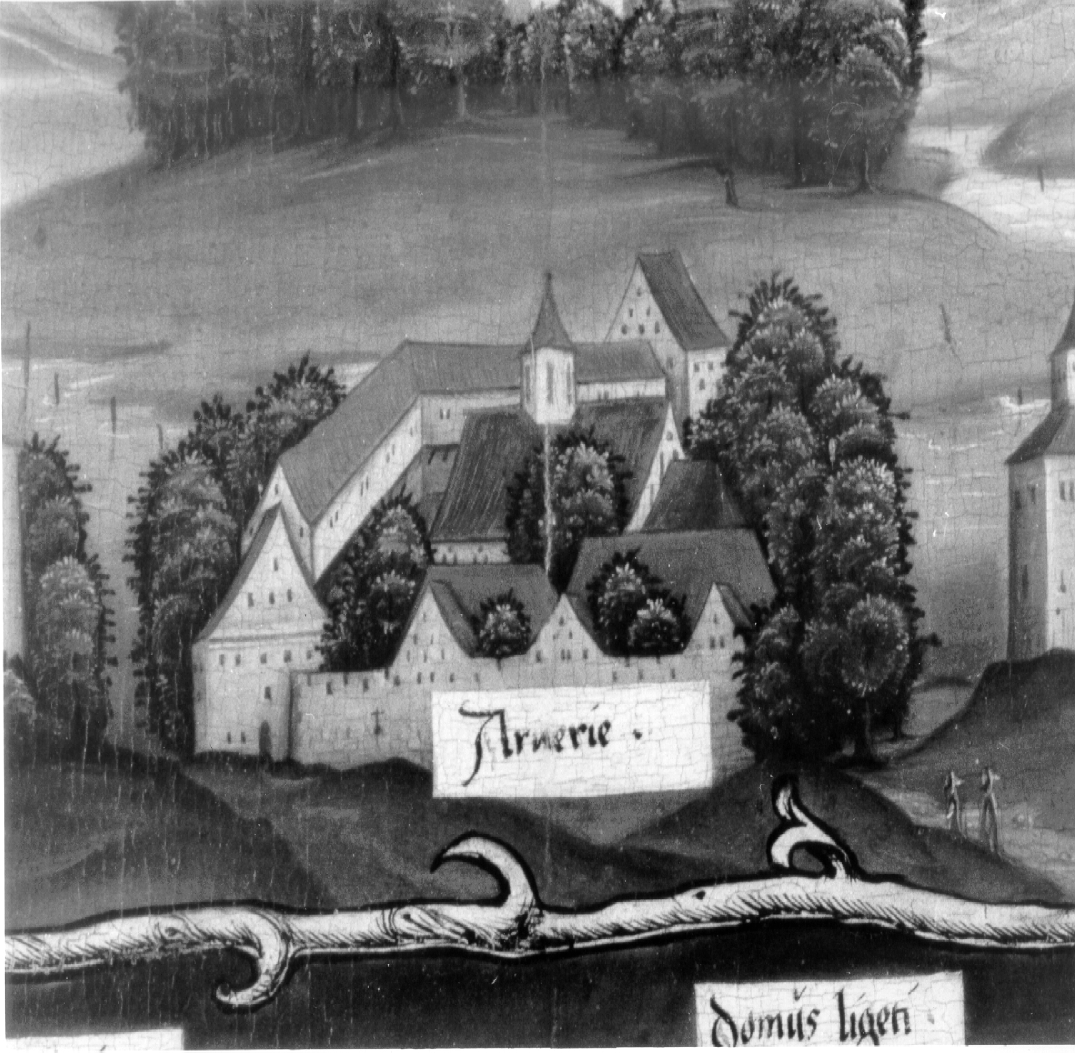
Chartreuse d'Arvières is the ruined site of a former Carthusian monastery tucked inside the Arvière state forest, on the slopes of the Grand Colombier massif in the Valromey area of Ain, France. Sitting at roughly 1,200 metres above sea level and reachable only on foot, the location matches the Carthusian ideal of a "desert" — remote enough to support a life of silence and contemplation.
Who founded the monastery, and when?
The first monastic buildings went up in 1122 at a spot known as "les Cimetières." About a dozen years later, in 1135, the community relocated to the site visitors find today, closer to water and better sheltered from the wind. The founder was Count Amadeus III of Savoy, who granted the monks extensive fir forests — the woodland still known as the Arvière forest — along with grazing rights across Valromey. The first monks were led by Arthaud, son of the lord of Sothonod, who became the community's first prior and was later canonised as Saint Arthaud, eventually serving as bishop of Belley.
How did the charterhouse grow in influence?
Over the following centuries, a succession of popes confirmed privileges for the monastery, among them Lucius II, Alexander III, Lucius III, Gregory VIII, Celestine III, Innocent IV, Alexander IV, Gregory X, John XXI, and Boniface VIII. The counts, and later the dukes, of Savoy — who ruled this territory before it passed to France — renewed similar grants. These privileges let the Carthusians manage the surrounding forests and pastures with considerable autonomy for well over six centuries.
What happened after the French Revolution?
Carthusian monks lived at Arvières continuously until the Revolution. In 1791, the National Convention expelled the last monks and seized the monastery's property. Left without upkeep, the buildings gradually collapsed, and stone from the site was reportedly reused by people in the surrounding villages. Today, of the former church — dedicated to Notre-Dame — and the monastic quarters, only foundations and scattered wall fragments remain visible.
What can visitors see on site today?
The site is managed by the French National Forestry Office (ONF), which oversees the surrounding forest. Next to the ruins, an ethnobotanical garden run by the association "Les amis du jardin d'Arvière" displays plants once used by the monks alongside the local mountain flora. The archaeological remains, dating to the 12th century, were officially listed as a historic monument by decree on 6 August 1995.
How do you get to Chartreuse d'Arvières?
The ruins lie within the commune of Arvière-en-Valromey, at the heart of the Arvière forest, and serve as a stop or starting point on several walking routes through Valromey, including the trail known locally as the "Circuit des Chartreux." Since there is no on-site tourist infrastructure and the approach runs entirely through forest, visitors should plan the trip as a hike and bring a trail map of the Bugey area.
Frequently asked questions
Who founded Chartreuse d'Arvières? Count Amadeus III of Savoy founded the monastery in 1122; its first prior was the future Saint Arthaud.
Is the monastery still active? No. The Carthusian monks were expelled in 1791 during the French Revolution, and the site has stood abandoned ever since.
What remains of the original buildings? Mainly the foundations of the church and monastic buildings — the standing structures no longer exist.
Is the site protected? Yes, it was listed as a historic monument in 1995 and is managed by the National Forestry Office.
Is there anything to see besides the ruins? An ethnobotanical garden maintained by a local association, plus the surrounding Arvière state forest, which is popular with hikers.
Nearby places

Earn badges for the places you visit
Download NextOnTrip, discover new places and check off your trails.