About this place
Castillo de los Bobadilla stands guard over Moya, an abandoned medieval town in the Cuenca province, deep within the Serranía de Cuenca in Castilla-La Mancha, Spain. The fortress and its surrounding walls form one of the most extensive defensive complexes in the region, and the entire settlement has held the status of Conjunto Histórico-Artístico — a protected historic ensemble — since 1982.
How do you get to the castle in Moya?
Moya sits on a hill of considerable strategic value, one that was already in use during Roman times — archaeologists have found coins from the 2nd century BC on site, along with traces of settlement going back to the Bronze Age. The easiest way to reach the town is by car, via local roads connecting it to nearby Landete, the village where Moya's last residents resettled during the 19th century. The drive itself, followed by the climb up to the castle hill, is part of the experience: the views over the surrounding gorges and forests of the Serranía de Cuenca make the effort worthwhile.
What will you see on site?
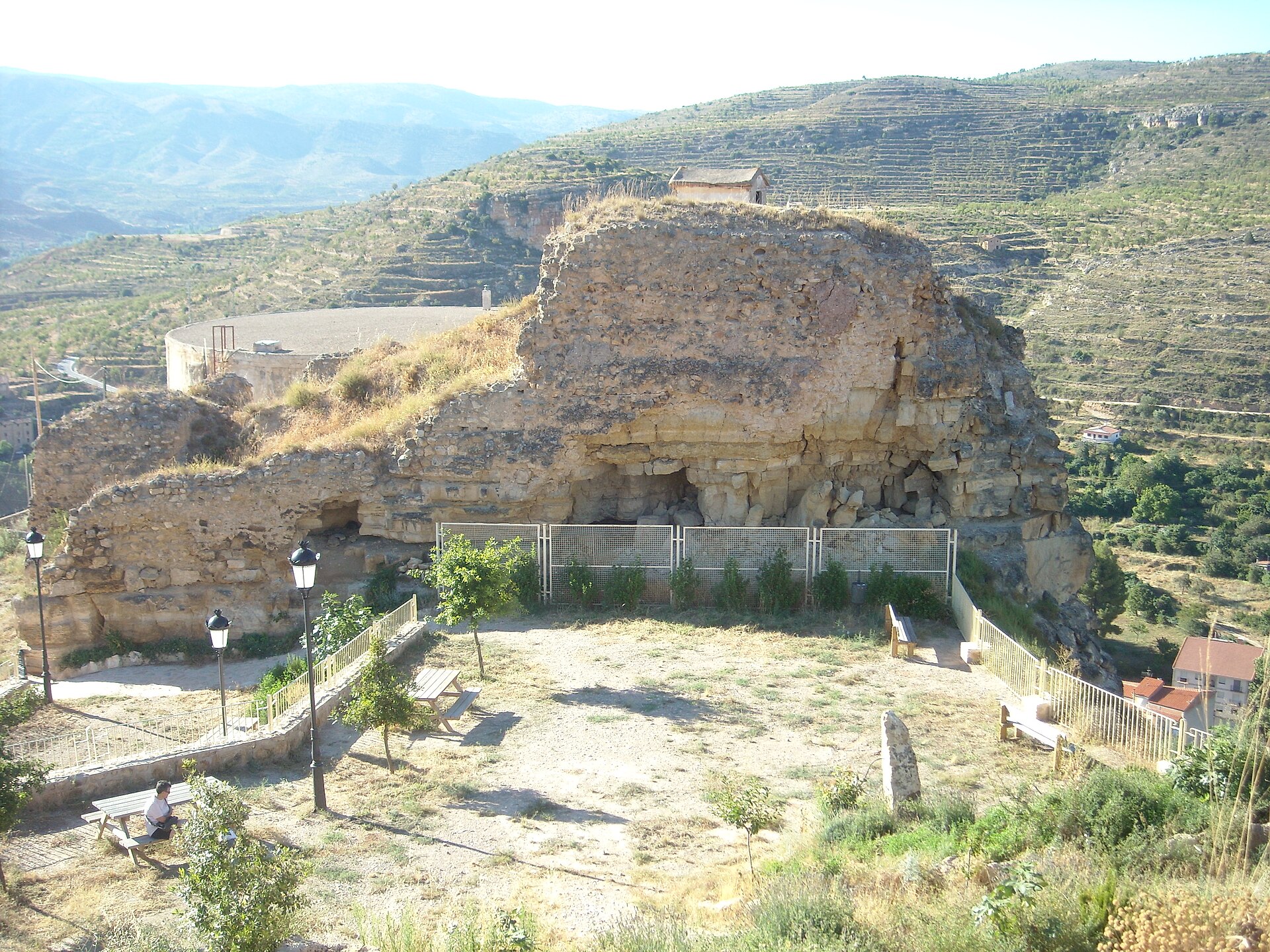
The castle, also known as Castillo de Moya, closes off the southern end of the town's wall circuit, separated from the rest of the settlement by a deep moat and a formidable outer wall studded with towers up to four meters thick. The whole defensive complex is built around three concentric wall lines: one protecting the town itself, and two more shielding the castle proper. Inside, the stone walls of the keep (torre del homenaje) and a central parade ground still survive.
The fortress traces its origins to the 13th century, although the hill had already served defensive purposes earlier, under both Roman and Muslim control. Christian forces took the town in 1183; by 1215 it had passed under the administration of the Order of Santiago, and in 1319 it was granted royal town status. The town's golden age arrived in 1480, when Moya became the capital of the Marquesado de Moya under Andrés de Cabrera, steward of the Royal Household, and his wife Beatriz de Bobadilla — whose family name the castle carries to this day. Before that, in the mid-15th century, the land had belonged to the Marquis of Villena, Juan Pacheco, until Andrés de Cabrera took possession of it in 1475.
Beyond the castle itself, the walled town preserves the remains of a town hall, the Convent of the Conceptionists, and traces of six churches — including Santa María, Trinidad, and San Miguel — as well as the ruins of former hospitals and charitable institutions. It's this combination — a vast, largely deserted walled town dominated by its castle — that makes Moya such a striking place on the map of Spain, sometimes described as a genuine ghost town.
When is the best time to visit?
Spring and autumn are the best seasons to explore Moya, when temperatures across the Serranía de Cuenca are mild and the terrain around the ruins is easier to cover on foot. Summers can bring intense heat, while winter's altitude means cold conditions and occasionally difficult access roads. The castle is under ongoing restoration work, so visitors should expect that some sections of the walls may be temporarily closed or fenced off.
Frequently asked questions
Is the Castillo de los Bobadilla open to visitors? The ruins and town walls are generally accessible, but ongoing conservation work means some structures may be temporarily closed or secured.
Where does the name Castillo de los Bobadilla come from? It comes from Beatriz de Bobadilla, wife of Andrés de Cabrera, who together took control of the town and castle in 1475 when Moya became the seat of the marquisate.
What sets Moya apart from other castles in Castilla-La Mancha? The scale and state of preservation of its entire defensive system — three lines of walls, a moat, and towers up to four meters thick — combined with the near-total depopulation of the town since the 19th century.
Are there other attractions nearby? Yes — the Serranía de Cuenca offers numerous hiking trails and scenic gorges, along with the nearby village of Landete, where Moya's last inhabitants eventually settled.
Nearby places

Earn badges for the places you visit
Download NextOnTrip, discover new places and check off your trails.