About this place
Can Alomar de Muro is a historic townhouse on Carrer de Sant Bernat in Palma, Mallorca, tucked into La Calatrava, the oldest quarter of the city.
How do you get there?
The building stands at number 4, Carrer de Sant Bernat, a narrow lane inside La Calatrava — the district that grew up around the old Almudaina fortress and is considered the oldest part of Palma. It's only a few minutes' walk from La Seu Cathedral and the Royal Palace of La Almudaina, so the easiest way to reach it is on foot, folding the visit into a wider stroll through the old town. Use the cathedral as your reference point and head into the tangle of streets north-east of it, toward the edge of the historic centre. Driving straight to the door isn't practical: central Palma is a maze of narrow one-way streets with restricted traffic zones, so it's far more comfortable to park on the fringe of the old town and cover the last stretch on foot.
What will you see?
Can Alomar de Muro is a casal — the type of townhouse-mansion that wealthy merchant and noble families built across old Palma for centuries. The building is listed in the city's Heritage Catalogue (Catàleg de Patrimoni, entry 07/08), meaning its façade and overall structure are protected as evidence of the historic fabric of La Calatrava. It's a private residence, not a museum, so visiting means admiring the stonework of the façade from the street rather than stepping inside.
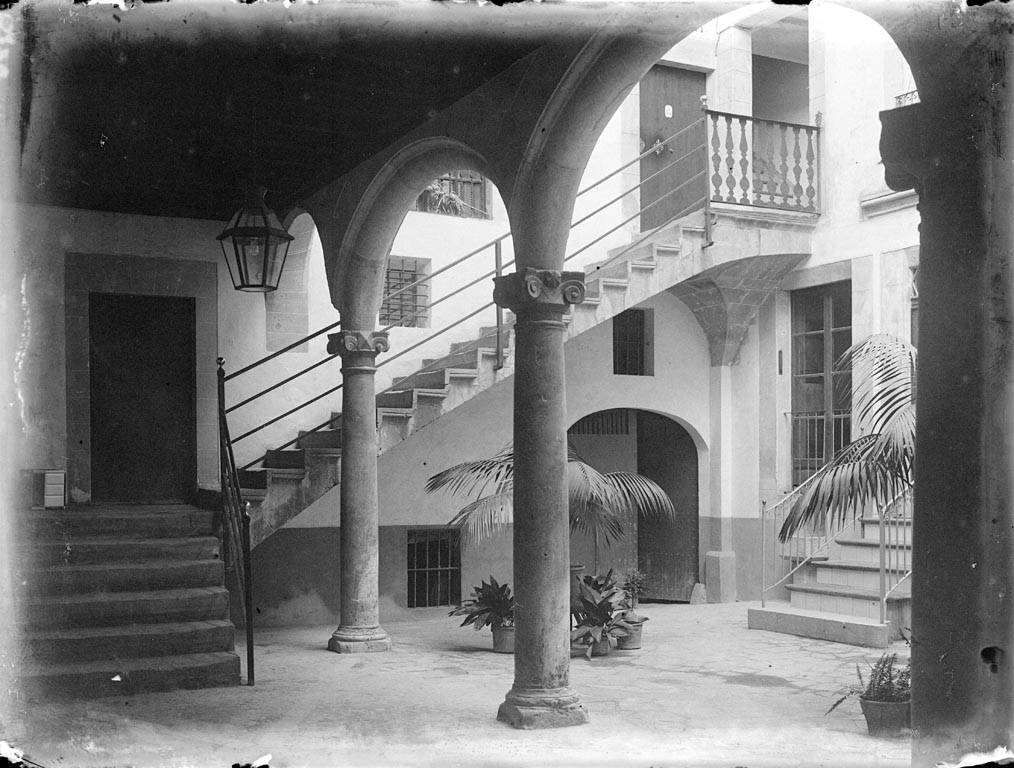
It helps to know how these Palma casals were laid out. Almost all of them were built around an interior courtyard, which had a very practical role: it was where landowners collected rent paid in kind by tenants working their rural estates, unloading crops and produce brought in from the countryside. That contrast — a plain, solid stone front facing the street, and a more elaborate courtyard hidden behind it — is typical of old Palma architecture, and keeping it in mind makes a walk through La Calatrava's streets far more rewarding.
Carrer de Sant Bernat itself holds more than one landmark. At number 1 stands the former Hospital of Sant Pere i Sant Bernat, an 18th-century building designed by architect Antoni Mesquida, notable for its lowered arches, Ionic-style columns, barrel vaults, and a grand staircase. Seeing the two buildings side by side is a good way to grasp how mixed the uses were in this part of the city — private residences standing next to charitable institutions, often just steps apart.
When should you visit?
La Calatrava rewards exploring on foot, so aim for a season with mild temperatures — spring (April to June) or early autumn (September and October), when the heat is more forgiving than in high summer and the old-town lanes are quieter. Morning light works best for photographing the stone façades of Calatrava, before the sun climbs too high above the narrow streets. Since Can Alomar de Muro is a private home, treat it as one stop along a longer walk through Palma's oldest quarter rather than a standalone destination.
Frequently asked questions
What is Can Alomar de Muro? It's a historic townhouse (casal) at Carrer de Sant Bernat 4 in Palma, listed in the city's Heritage Catalogue as an example of the traditional merchant-class architecture of La Calatrava.
Can you go inside the building? No — it's a private residence. You can only view it from the outside while walking along Carrer de Sant Bernat.
Where exactly is it located? In La Calatrava, Palma's oldest district, a few minutes' walk from La Seu Cathedral and the Royal Palace of La Almudaina.
What else is worth seeing nearby? On the same street, at number 1, stands the 18th-century former Hospital of Sant Pere i Sant Bernat, designed by Antoni Mesquida, and just a short walk away are La Seu Cathedral and the Almudaina Palace.
Nearby places

Earn badges for the places you visit
Download NextOnTrip, discover new places and check off your trails.