About this place
Bombroekmolen is a former watermill standing on the Mombeek stream, in the hamlet of Daaleinde, in the Winterbeek valley near Hasselt, in Belgian Limburg. The mill's history reaches back to the Middle Ages — the first records of a mill on this spot date from as early as 1293, making it one of the older milling sites in the region.
Where the name comes from
The mill's name refers to the old fief of Bombroek, historically tied to the Duchy of Loon (Looz). Bombroekmolen was a so-called banmolen, a compulsory mill: farmers in the surrounding area were legally required to have their grain ground here rather than anywhere else. This arrangement guaranteed the owners a steady income regardless of the harvest or the market. The mill was held in shared ownership by the lord of Kortessem and the provincial commander of the Teutonic Order (the German Order) in the Low Countries — an unusual pairing of secular and religious authority over a single economic asset.
Design and operation
Bombroekmolen was an undershot watermill, meaning the water struck the lower part of the wheel to drive the grinding mechanism. This design was typical for the low-gradient streams of the region, such as the Mombeek. Around Kortessem, two dismantled undershot grain watermills have survived in this form, and Bombroekmolen is one of them.
The mill remained in continuous operation until 1955, when flour production finally stopped — a period when many traditional watermills across Western Europe were being retired in favor of modern, industrial grain processing.
What remains today
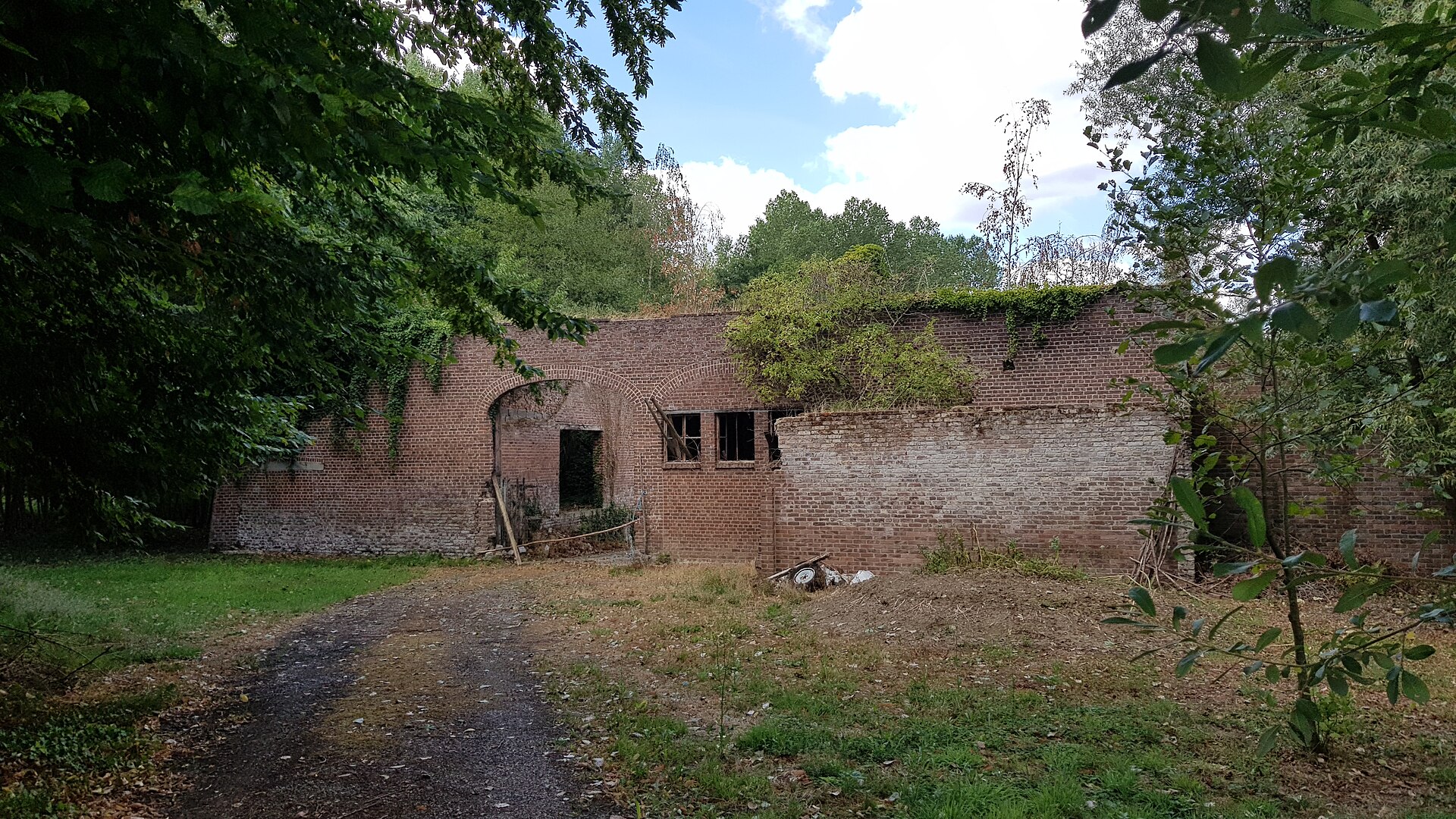
The present-day complex consists of whitewashed brick buildings arranged in two parts. The northern wing has an L-shaped floor plan and includes the miller's house set directly against the stream, with a service wing perpendicular to it containing former stables and storage rooms. That service wing was restored in the 1990s and converted into a restaurant open on weekends. The original mill building itself is now used as a private residence; no historic grinding machinery, wheel, or technical fittings have survived inside.
Right next to the former mill lie two small water gardens, an additional landscape feature that hints at the old system of channels once used to feed water to the mill wheel.
Why it's worth a stop
Bombroekmolen is a good example of a historic watermill that, despite losing its original industrial function, has kept its distinctive, picturesque cluster of buildings and still reads clearly as a trace of the old water-powered economy around Kortessem and Hasselt. It's a quiet, low-key spot, appreciated more by fans of local history and rural architecture than by mass tourism — a worthwhile stop for anyone exploring the Winterbeek valley on foot or by bike.
Frequently asked questions
Is the mill still operating? No, milling stopped in 1955. The mill building now serves as a private home.
Can you eat here? Yes, the restored service wing houses a restaurant that opens on weekends.
Has the original milling machinery survived? No, the interior no longer contains any historic technical equipment.
Where does the mill's name come from? From the old Bombroek fief, historically linked to the Duchy of Loon.
Nearby places

Earn badges for the places you visit
Download NextOnTrip, discover new places and check off your trails.