About this place
Zelený vrch is a 967-metre hill in the Jizera Mountains, rising just southeast of Hejnice, a small pilgrimage town famous for its baroque basilica. It suits travellers who want a quiet, uncrowded summit surrounded by dense spruce forest — and a direct link to one of the region's most striking historical stories, the 1916 dam-burst disaster on the Bílá Desná.
Where is Zelený vrch and how do you get there?
The hill sits between two well-known landmarks of the Jizera Mountains. Jizera peak (1,122 m) — the second-highest summit in the Czech part of the range — rises to the northwest, while the Souš reservoir spreads out to the southeast. The Černá Desná stream runs along the hill's eastern slope, followed by road II/290, which makes for the most convenient approach on foot. The western slope drops into the valley of the Bílá Desná, home to the area's best-known landmark: the ruins of the burst dam.
Most visitors start from Hejnice itself, where marked trails head deeper into the Jizera Mountains toward Jizera peak, Smrk, and the Bílá Desná valley. The town has good road connections to Liberec and Frýdlant, and the spa town of Lázně Libverda lies about a kilometre to the north.
What is there to see around Zelený vrch?
The burst dam on the Bílá Desná
The area's most significant historical site is the ruin of a dam that collapsed on 18 September 1916. The flood killed 65 people within half an hour and destroyed dozens of houses in the nearby town of Desná — the worst dam failure in Czech history. The remains were declared a protected cultural monument in 1996 and are now one of the most visited memorial sites in the Jizera Mountains: a quiet but sobering stop on any hike through the area.
Mountain views and the Černá Desná valley
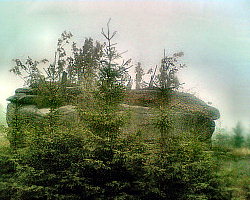
Trails around Zelený vrch open up onto views of the Jizera massif and the forested valley of the Černá Desná. The landscape is typical of the Jizera Mountains — gentle, rounded ridges blanketed in spruce forest, without the crowds that gather on the range's more famous peaks such as Smrk or Ještěd.
Hejnice and the Basilica of the Visitation of the Virgin Mary
It's worth combining the hill with a visit to Hejnice itself. The twin-towered basilica, built between 1722 and 1729 on the site of a 14th-century chapel, is one of the most important pilgrimage sites in Bohemia and has earned the town its nickname, "the pearl of the Jizera Mountains."
When is the best time to visit?
Late spring through summer (May to September) is the best window: forest trails are dry, and long days make it easy to combine the summit with the Bílá Desná valley and Hejnice itself. Autumn adds colour where deciduous trees mix into the spruce forest, and winter is suited to quiet snowshoe walks, though the trails here aren't groomed for cross-country skiing the way higher parts of the Jizera Mountains are.
Frequently asked questions
How high is Zelený vrch? The hill reaches 967 metres above sea level.
Can I combine a hike to Zelený vrch with the burst dam site? Yes — the dam ruins on the Bílá Desná lie on the hill's western side and make a natural extension of the same walk, especially starting from Hejnice or Desná.
Is there anything nearby for visitors not interested in hiking? Yes, the town of Hejnice itself, with its baroque pilgrimage basilica, is a popular destination on its own, independent of any hiking plans.
How do I reach the starting point? The easiest way is by car or bus to Hejnice, from where marked footpaths lead toward Zelený vrch, Jizera peak, and the Černá/Bílá Desná valley.
Nearby places

Earn badges for the places you visit
Download NextOnTrip, discover new places and check off your trails.