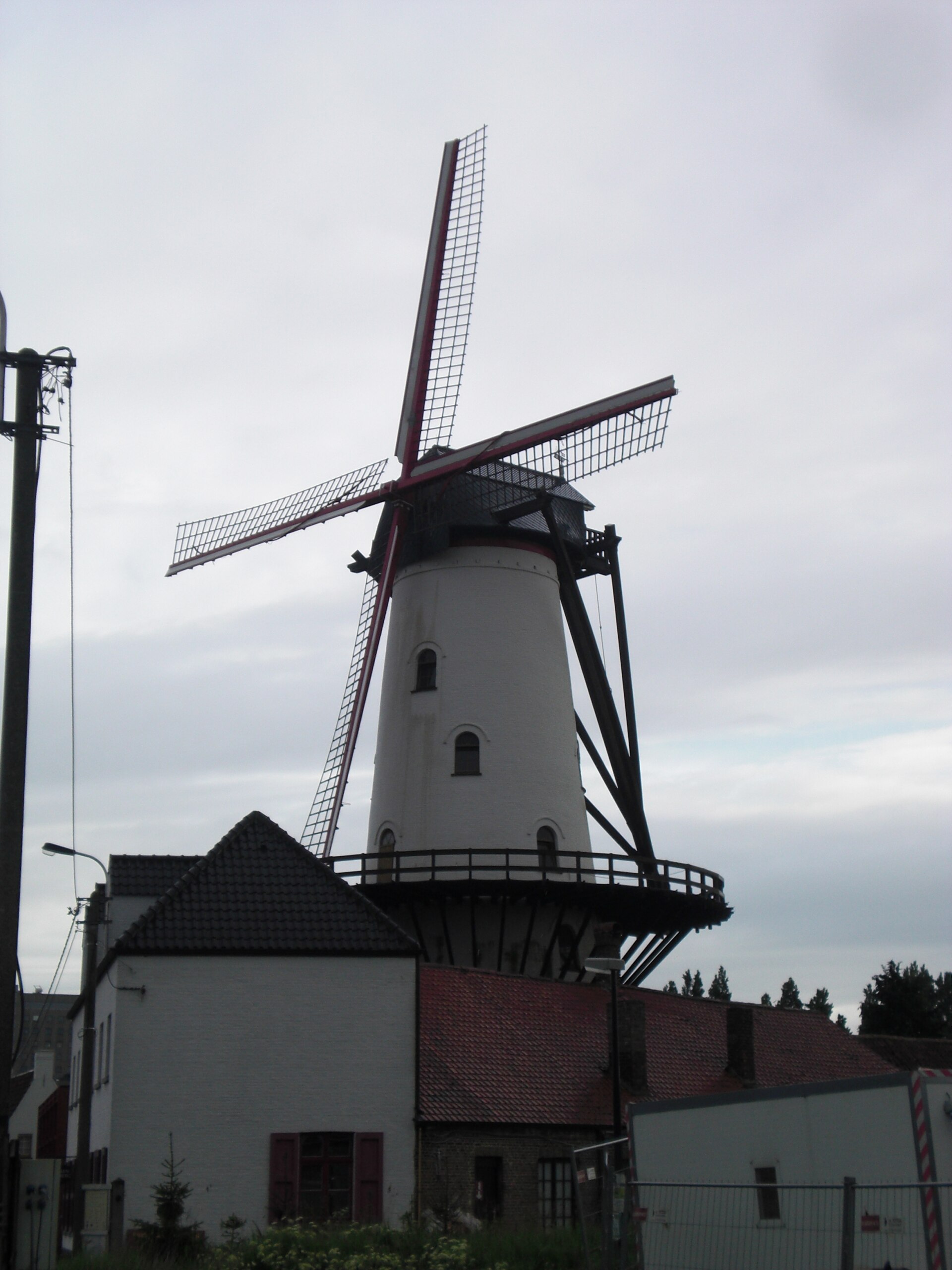
About this place
Zandwegemolen is a brick stellingmill standing in the Sint-Pieters district of Bruges, right next to the former Zandwegherberg inn. It rises close to the spot where an older, wooden windmill had stood since 1610 – the current stone structure only dates from 1860 and combined grain milling with oil pressing from the very start.
Who built the Zandwegemolen?
The mill was built by Louis Matthys, who on 7 February 1860 received permission from the local aldermen's board to erect a windmill on his property along the Zandweg. What went up was a tall, brick stellingmill topped with a sail cap – a construction typical of Flemish windmills of the period, allowing the upper part of the mill to be turned into the wind independently of the rest of the tower.
What changes did the mill go through over the years?
Just five years after it was built, on 16 July 1865, the mill was struck by lightning, which damaged the sails among other parts. Despite this, Zandwegemolen stayed in the Matthys family: after Louis, the mill passed to his son Isidoor Matthys (1838–1901), married to Nathalie Vanhove. In 1894 the municipality of Sint-Pieters-op-den-Dijk granted him a new thirty-year licence to keep operating the mill.
The most significant overhaul came in 1932. The cap was renewed, a new gear mechanism was installed, along with three sets of new millstones – the largest measuring 1.8 metres in diameter. The mill also received a new wind pump, a thrust stone, a new tail beam, and a chain coupling. The scope of this work shows how actively the mill was still being used at the time.
What happened to the building in the second half of the 20th century?
In 1970, Gerard Stevens had a new complex built around the windmill, turning Zandwegemolen into a hospitality venue. This is a common fate for many Flemish windmills, which over time lost their industrial function and became local attractions and meeting points instead. The mill itself, however, kept its historic shape and mechanisms, so its original construction can still be admired today.
Is Zandwegemolen legally protected?
Yes – since 1982 the mill has been listed as a protected monument, which shields it from alterations that would compromise its historic character. This status underlines the value of Zandwegemolen not only as a piece of industrial heritage but also as part of the cultural landscape around Bruges.
Frequently asked questions
Where exactly is Zandwegemolen located? The mill stands in the Sint-Pieters district of Bruges, along the Zandweg road, close to where an older 17th-century mill once stood.
How old is the current windmill? The present brick structure dates from 1860, although an earlier wooden mill had existed on this site since 1610.
What was the mill used for? Zandwegemolen served as a grain mill and oil press; its equipment, including three sets of millstones, allowed it to process different raw materials.
Is the mill still used industrially today? No. Since 1970 a hospitality complex has operated around the windmill, and the mill itself now serves as a protected historic landmark, listed as a monument since 1982.
Is it worth visiting when in Bruges? For anyone interested in windmill history and local industrial architecture, Zandwegemolen is an interesting stop away from the main tourist centre, offering a lesser-known side of the area around Bruges.
Nearby places

Earn badges for the places you visit
Download NextOnTrip, discover new places and check off your trails.