About this place
Sleutelbrug
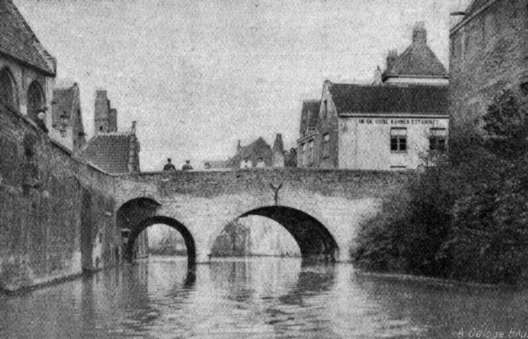
Sleutelbrug is a modest, somewhat hidden bridge in the historic center of Bruges, spanning one of the canals that weave through the city. It doesn't sit on the busiest tourist routes, but it's one of the older elements of the city's waterway network, with roots that reach back to the Middle Ages.
Where does the name Sleutelbrug come from?
The name Sleutelbrug translates literally as "Key Bridge," which is sometimes mistakenly linked to the treble clef used in musical notation. The real origin is different: it dates back to the 15th century and comes from a brewery called "De Sleutels" ("The Keys") that once operated nearby. The bridge took its name from that brewery, not from any musical symbol.
How old is the Sleutelbrug?
A crossing at this spot is documented as far back as 1331, making it one of the older recorded bridge locations in Bruges. This points to how long this particular stretch has served as a connecting point within the city. Like most small bridges in Bruges, the structure has been rebuilt several times over the centuries, but its position and role have stayed the same — linking the two banks of the canal in this part of the old town.
What's near the bridge?
The Sleutelbrug sits close to the Speelmanskapel, the Minstrels' Guild Chapel — one of the last preserved guild chapels in Bruges. This is where the city's musicians, organized into a guild, once gathered to conduct their professional affairs. In old Bruges, only members of this guild were permitted to perform at weddings and civic celebrations, which made the guild an important social institution rather than a purely professional body.
Despite being easy to overlook, the bridge is relatively close to the lively 't Zand square, home to the Concertgebouw, Bruges' contemporary concert hall and one of the symbols of the city's present-day musical life. It's an interesting pairing: a centuries-old bridge whose name is indirectly tied to music and the musicians' guild standing not far from today's temple of music in the city.
Why visit the Sleutelbrug?
The Sleutelbrug isn't a crowd-drawing attraction — it's more of a find for visitors who want to see Bruges away from the well-trodden path along the Dijver canal or Rozenhoedkaai. Walking past it, you get a more authentic, less polished feel of the city while still brushing up against history that goes back to the 14th century. The bridge also makes a good starting point for a short walk toward 't Zand and the Concertgebouw, connecting the medieval and contemporary layers of Bruges in a single route.
Frequently asked questions
Where does the name Sleutelbrug come from? From a former brewery called "De Sleutels," active in the area in the 15th century — not from the musical treble clef it's sometimes confused with.
How old is this bridge? A crossing at this location is recorded as far back as 1331.
What's nearby? The Speelmanskapel, the chapel of Bruges' former musicians' guild, and, a bit farther, 't Zand square with the Concertgebouw concert hall.
Is Sleutelbrug a major tourist attraction? Not a headline attraction, but a historically interesting spot for visitors looking to explore Bruges' quieter corners.
Nearby places

Earn badges for the places you visit
Download NextOnTrip, discover new places and check off your trails.