About this place
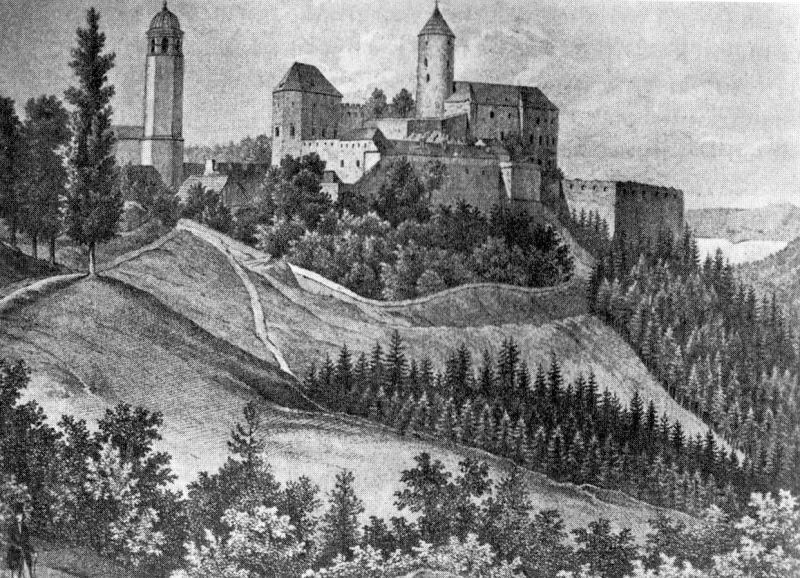
Sovinec Castle is one of the largest castles in Moravia, crowning a cone-shaped hill in the Nízký Jeseník range within the municipality of Jiříkov, in the Bruntál District of the Moravian-Silesian Region of the Czech Republic.
Who built the castle, and when?
Construction ran from 1329 to 1332, commissioned by brothers Vok and Pavel of the Hrutovic family to mark the boundary of their estate. By the 15th century, during the Hussite wars, the stronghold had become one of the movement's notable strongholds in Moravia — its hilltop position and growing fortifications made it a hard target to take.
How did the castle end up owned by the Teutonic Order?
After the Battle of White Mountain, the castle's owner, Jan the Elder Kobylka of Kobylí, was forced to surrender it to Karl I of Liechtenstein on 18 January 1623. Liechtenstein handed Sovinec over to the Teutonic Order that same year, and the Order held onto it without interruption until 1939 — more than three centuries under a single knightly order.
Why did Sovinec survive the Thirty Years' War so well preserved?
The Teutonic Order kept reinforcing the castle's defenses, adding bastions and fortified walls over the years, which is why Sovinec is regarded today as one of the best-preserved examples of Thirty Years' War-era fortification in the region. That didn't spare it from combat, though: Danish troops captured the castle in 1626, and Swedish forces took it in 1643 after a long siege, breaking through defenses that had only recently been strengthened.
What happened at the castle during the Second World War?
After the German occupation of Czechoslovakia in 1939, Nazi authorities seized Sovinec from the Teutonic Order and turned it into a detention site for French prisoners of war and political opponents of the regime, overseen by a dedicated SS unit. In early May 1945, under circumstances that remain unclear, a fire broke out and severely damaged the buildings.
What does the castle look like today?
Restoration of the fire-damaged sections began in 1951 and continued, on and off, over the following decades; by the 1990s the castle chapel, watchtower, and several courtyards had been thoroughly repaired. Sovinec is now state-owned and open to visitors during the summer season, with guides in period costume leading tours through courtyards where the original Gothic core visibly grew outward through the Renaissance and into later Baroque additions.
What can you pair a visit with?
A combined ticket covering Sovinec, the castle in Bruntál, and the scythe-making museum in Karlovice is worth considering, since all three sit within the same district and make for a well-rounded day out around Bruntál.
Frequently asked questions
Who built Sovinec Castle and when? It was built between 1329 and 1332 by brothers Vok and Pavel of the Hrutovic family, originally to mark the boundary of their estate.
How long did the Teutonic Order own the castle? From 1623 to 1939 — over three hundred sixteen years, one of the longest unbroken stretches of ownership by a single knightly order over any castle in the region.
Was the castle involved in fighting during the Thirty Years' War? Yes. Danish troops captured it in 1626, and Swedish forces took it again in 1643 after a lengthy siege, despite the reinforced fortifications the Teutonic Order had built up.
What happened to the castle in the Second World War? After being confiscated by Nazi authorities, it served as a detention site for French POWs and political prisoners under SS oversight, then burned in a fire of unclear origin in May 1945.
Can visitors tour the castle today? Yes, Sovinec is open to the public in the summer season, with guides in period costume; it pairs well with a combined ticket for Bruntál castle and the scythe museum in Karlovice.
Nearby places

Earn badges for the places you visit
Download NextOnTrip, discover new places and check off your trails.