About this place
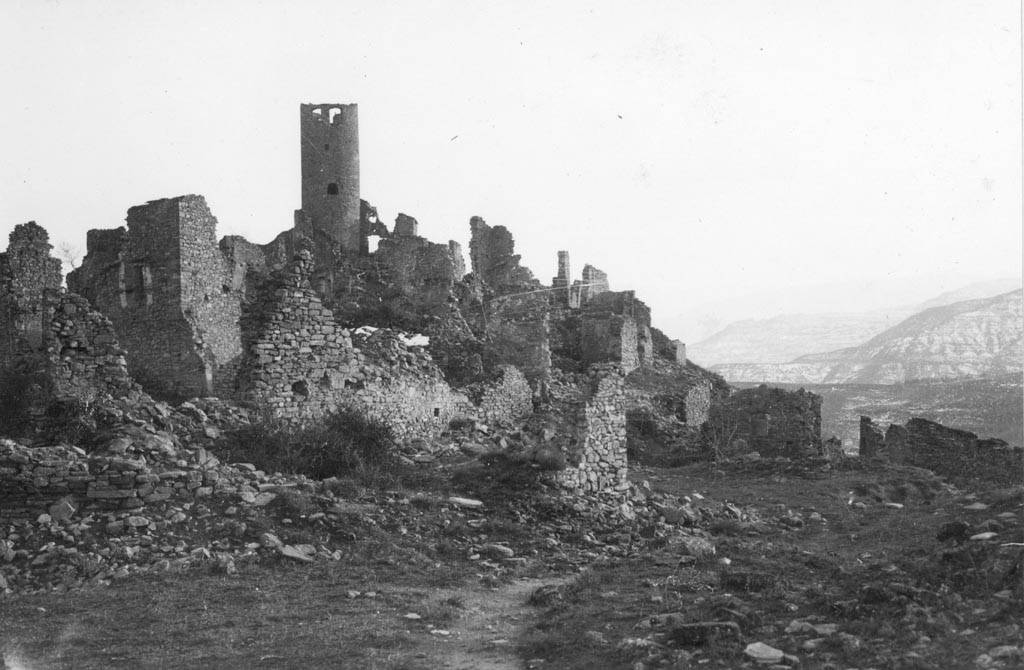
Sant Martí de Puigcercós is a former Romanesque parish church in the municipality of Tremp, in the Pallars Jussà region of Lleida province, Catalonia. Perched on a hilltop, it marks the spot where the old village of Puigcercós once stood — a place whose story is less about the building itself than about the landslide that erased the community around it.
Where was the old church of Puigcercós located?
The remains sit on top of a hill that once carried the entire settlement of old Puigcercós, an enclave that belonged to the former term of Palau de Noguera and today forms part of the Tremp municipality. The church shared this high ground with the medieval castle that once defended the village, making the hilltop the historic core of the community.
What did the Romanesque church look like?
Sant Martí was a single-nave building covered by a barrel vault reinforced with transverse arches, closed off by a semicircular apse facing east — a layout typical of rural Romanesque churches across Pallars Jussà. Among the surviving fragments, visitors could once make out carved details such as beveled corbels supporting the structure. Today the ruins are heavily overgrown and difficult to spot, so tracking them down takes patience and a good sense of the terrain.
Why did the village have to be abandoned?
The story of Puigcercós is really a story of a losing battle against unstable ground. Starting in 1863, a new village began to be built in a safer spot, as the old hilltop settlement was increasingly threatened by ground movement. The decisive blow came on 13 January 1881, when a major landslide sent most of the old town sliding down the mountainside. Residents lost their homes, and with them, the centuries-old role the hilltop church had played for the community.
What replaced the destroyed parish church?
In response to the disaster, a new church was built at the relocated village and consecrated in 1891, taking over as the parish's place of worship. The new building is far more modest in scale — a single-nave structure with a raised profile, reinforced by lateral buttresses, with an annex housing a wooden bell tower. The contrast between the original medieval church and its 19th-century successor is a vivid illustration of how much a single natural disaster reshaped both the landscape and the architecture of this corner of Pallars Jussà.
What else is worth seeing nearby?
The hill carrying the ruins of the old church and castle offers wide views over the Pallars Jussà valley, a region known for its rugged pre-Pyrenean landscape, the Terradets reservoir, and its proximity to the celebrated Mont-rebei gorge. The story of Puigcercós — a village forced to relocate after a landslide — is often cited as an example of the dramatic upheavals that reshaped mountain settlements across Catalonia during the 19th century.
Frequently Asked Questions
Can visitors reach the ruins of the old Sant Martí church? The remains stand on the hilltop but are heavily overgrown and hard to see, making this more a destination for those interested in local history than a fully equipped tourist site.
Where is the current parish church of Puigcercós? It stands in the relocated village that residents moved to after the 19th-century landslides, and it was consecrated in 1891.
What caused the disappearance of the old village of Puigcercós? A series of landslides, the most severe of which struck on 13 January 1881 and sent most of the old settlement sliding down the hillside.
Which region is Puigcercós part of? It is an enclave within the municipality of Tremp, in the Pallars Jussà region of Lleida province, in northwestern Catalonia.
Nearby places

Earn badges for the places you visit
Download NextOnTrip, discover new places and check off your trails.