About this place
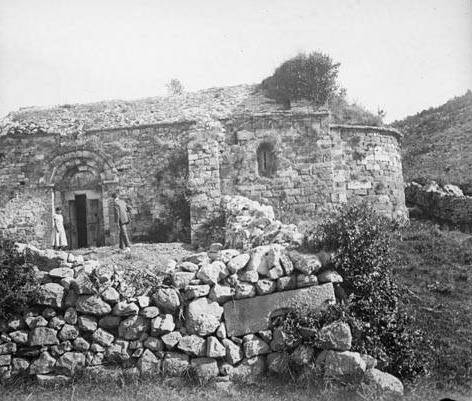
Sant Llorenç del Mont is the ruined Benedictine monastery standing in the municipality of Albanyà, in the Alt Empordà, right where it meets the Alta Garrotxa massif in north-eastern Catalonia.
What exactly are you looking at?
The remains sit on the Pla de Sous plateau, roughly 855 metres above sea level, at the foot of Mont mountain. Officially the monastery of Sant Llorenç de Sous, it was one of the significant religious houses of the old county of Besalú, under the bishopric of Girona. It first appears in writing on 11 April 871, in a charter issued by the Frankish king Charles the Bald in favour of the abbey of Sant Aniol d'Aguja. When that community was abandoned in 922, part of its monks relocated here.
How did the monastery decline?
Its most prosperous period lasted until the early 15th century. The earthquakes of 1427-1429 badly damaged the church, and by 1438 economic hardship had reduced the community to just two monks. In 1592 Pope Clement VIII placed the house under the authority of Sant Pere de Besalú, and monastic life ended for good with the death of the last abbot in 1605. The buildings then passed fully into Besalú's hands. In 1833 the old dormitory and chapter house were converted into a parish church, rectory and cemetery — a date recorded on the lintel above the new entrance — and the parish kept functioning until 1936. In 1983 the site was declared a Bé Cultural d'Interès Nacional, Catalonia's top heritage protection category.
What can you actually see on site?
What survives are sections of an 11th-century Romanesque church with three naves, traces of the monastic cloister gallery, and the outer walls of former outbuildings. Several carved stone capitals from the cloister have since been moved to museum collections. The hamlet of Sous, which grew up around the monastery, is now completely deserted; it belonged to the Garrotxa municipality of Bassegoda until 1988, when it was folded into Albanyà. Above the ruins, on the summit, stands the sanctuary of Mare de Déu del Mont at 1,115 metres, overlooking the Fluvià and Muga river valleys.
How do you get there?
The ruins lie inside the Alta Garrotxa protected natural area (PEIN), managed jointly with the Salines-Bassegoda consortium. Marked hiking trails reach the site from Albanyà and from the Besalú side; either approach involves several hours of walking on mountain terrain, so plan for a full day and bring proper boots. There is no tourist infrastructure at the site itself — the nearest lodging and food options are back in Albanyà.
When should you visit?
Spring and autumn offer the mildest conditions for the climb, avoiding both the summer heat on the exposed slopes and the risk of snow or mud higher up the Alta Garrotxa ridges in winter.
Frequently Asked Questions
Is Sant Llorenç del Mont still an active monastery? No. Monastic life ended in 1605, and the parish chapel that later occupied part of the buildings closed in 1936. What remains today are unoccupied ruins.
Is this the same place as the Sant Llorenç del Munt massif near Terrassa? No — despite the near-identical name, they are two different locations. The Sant Llorenç del Munt i l'Obac massif lies in Barcelona province, while these monastic ruins sit in the municipality of Albanyà, in Girona province.
How long does the hike to the ruins take? Reaching the site means walking through the Alta Garrotxa mountains, and a round trip typically takes several hours depending on the starting point chosen.
Is there anything else worth seeing nearby? Yes — directly above the ruins, on the mountain's summit, stands the sanctuary of Mare de Déu del Mont at 1,115 metres, with views over the Fluvià and Muga valleys.
Nearby places

Earn badges for the places you visit
Download NextOnTrip, discover new places and check off your trails.