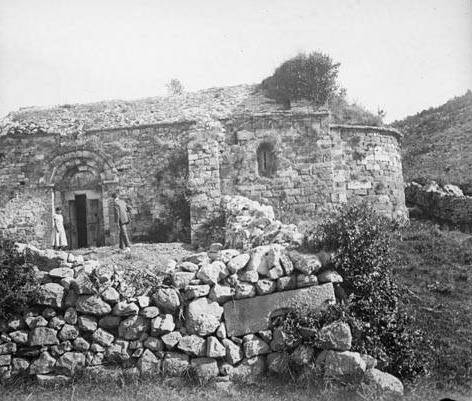
About this place
Sant Cristòfol dels Horts is a medieval church in the municipality of Albanyà, standing within the now-abandoned settlement of Els Horts, in the far northern part of this Catalan municipality (Girona province, Alt Empordà region). Listed in Catalonia's architectural heritage inventory, the building has stood in ruins for decades among the forests of the Pyrenean foothills.
Where is Sant Cristòfol dels Horts located?
The church sits within the old, dispersed settlement of Els Horts, now uninhabited, in a mountainous and sparsely populated corner of Albanyà. Its coordinates are roughly 42.3611 N, 2.67967 E. Access runs along local dirt roads and Pyrenean hiking trails starting from the village centre — this is a destination for visitors prepared for a short trek, not a site reachable directly by paved road.
How do you get there?
The best starting point is Albanyà itself, from where marked trails lead toward Els Horts. The route crosses forested terrain and pastures, partly on mountainous ground, so sturdy footwear and enough water are worth planning for — there is no tourist infrastructure along the way. Visitors unaccustomed to mountain walking should expect a round trip of several hours.
What is the history behind the church?
The name of the Horts settlement already appears in a royal charter from the year 878, pointing to a very old pattern of settlement in this corner of the Pyrenees. The parish of Sant Cristòfol dels Horts itself, however, is only confirmed in written sources from around 990 — a gap between the first mention of a place and the documented existence of a functioning parish that is common across the region. The church building visible today was raised later, most likely at the turn of the 12th and 13th centuries, replacing an earlier and more modest place of worship.
What does the building look like?
The church was designed as a single-nave structure closed to the east by a semicircular apse — a classic layout for Catalan Romanesque architecture of the period. The nave walls were reinforced with buttresses, which allowed the vault to be raised without risking collapse. The vault itself has a pointed profile and is further strengthened by two transverse arches that carry the load onto the side walls — a construction approach typical of the transition from Romanesque to early Gothic in rural Catalan architecture.
What condition is the site in today?
The church is today substantially ruined — parts of the roof and furnishings are missing, and the structure was exposed to weathering for decades. In recent years, however, consolidation work has been carried out: in the autumn of 2019 and again in 2020, the GAT de la Jonquera team stabilised the surviving vault and apse and reinforced the nave roof structure, protecting the building from further deterioration. As a result, the ruin, while incomplete, still shows a clear spatial layout and lets visitors read the original architectural form.
When is the best time to visit?
Given the mountainous nature of the approach and the lack of sheltered rest points along the way, spring and autumn are the best times to visit, when temperatures are moderate and the trails are not baking in summer sun. In winter, access to the higher ground can be complicated by weather, while in summer it is worth setting out early to avoid the midday heat.
Frequently asked questions
Can you drive up to the church? No — the final stretch has to be covered on foot along the trail; a car can only get you to the starting points near Albanyà.
Has the church been rebuilt, and can you go inside? It has not been rebuilt — it remains a stabilised ruin following the 2019–2020 consolidation works, viewable from the outside and partly from within, but without a full roof or furnishings.
Where does the name "dels Horts" come from? The name refers to the former, now-abandoned settlement of Els Horts, within which the church was built and which it served as the parish church.
Are there other heritage sites nearby worth seeing? The Albanyà and Alt Empordà area is rich in similar rural Romanesque churches and Pyrenean trails passing through abandoned settlements, making it easy to combine the visit with a longer hike through the surrounding countryside.
Nearby places

Earn badges for the places you visit
Download NextOnTrip, discover new places and check off your trails.