About this place
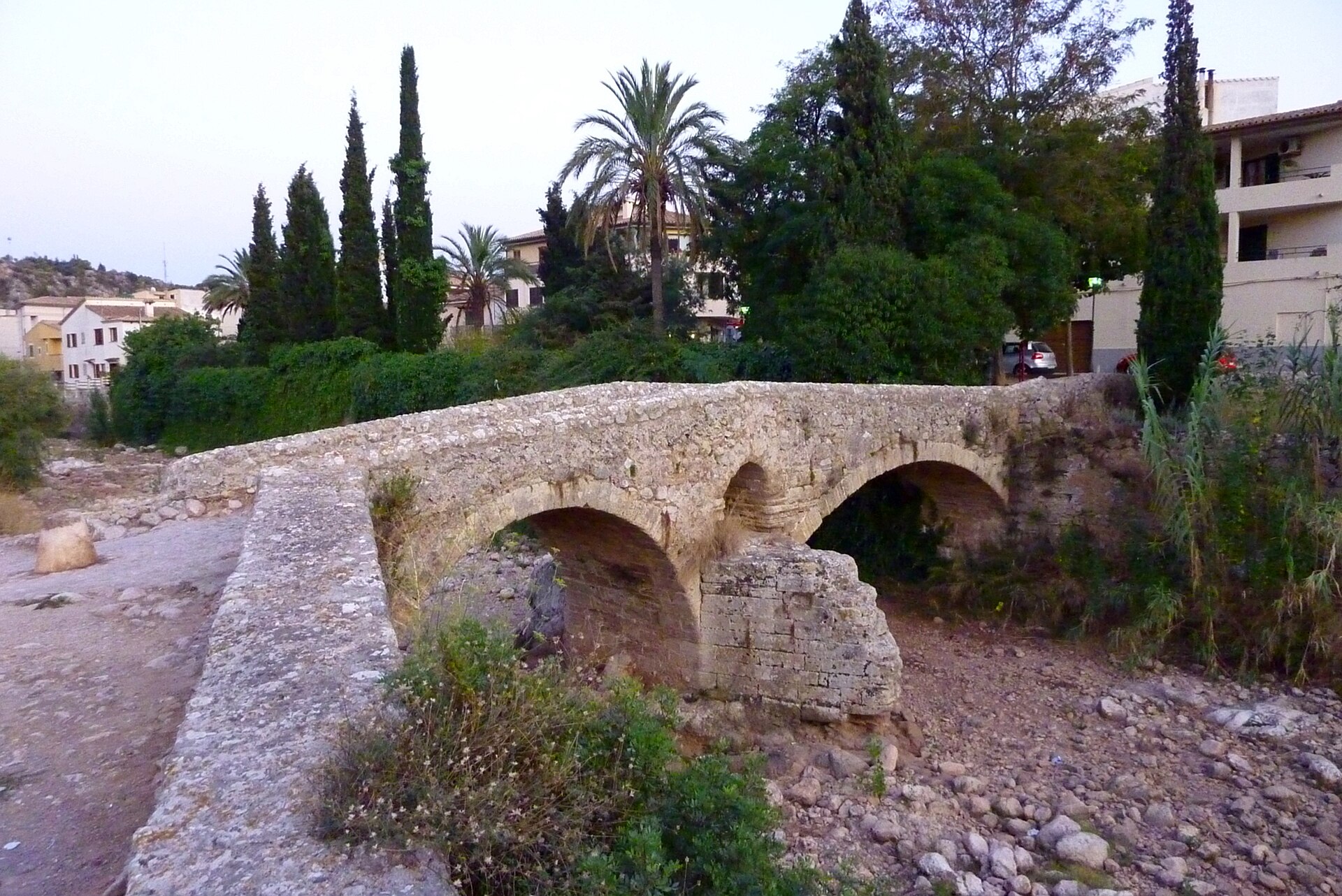
Pont Romà is a historic stone bridge in Pollença, Mallorca, spanning the Torrent de Sant Jordi stream right at the edge of the town's historic centre. It's not a fenced-off monument you visit on a separate detour — the bridge sits along the street that bears its name, Carrer del Pont Romà, and remains woven into everyday town life.
Is the Roman Bridge actually Roman?
This is the question almost everyone asks, and the answer is less straightforward than the name suggests. The bridge only came to be called "Pont Romà" (Roman Bridge) in the 19th century, when locals noted how closely its arches resembled ancient Roman viaducts. Historians remain divided on its true age. One theory points to Roman construction, likely in the 1st century AD. A second theory, backed by more recent architectural analysis, places its construction in medieval times, around the 13th century — after King Jaume I of Aragon conquered Mallorca in 1229, a period when new routes were being built across the island to connect the interior with the port of Alcúdia. The bridge's semicircular arches fit the late-Romanesque building style typical of that era.
How is the bridge built?
The structure rests on two unequal arches separated by a central pillar. That pillar includes a small relief arch designed to ease the pressure of floodwater during sudden surges in the stream. At the base, two triangular buttresses were built to break the force of the current and protect the structure from erosion. This kind of engineering, common on bridges crossing seasonal Mediterranean streams prone to flash floods, has kept the crossing standing for centuries.
Why did this bridge matter so much to Pollença?
Until the 19th century, Pont Romà was the only safe crossing point over the Torrent de Sant Jordi during the flash floods and heavy autumn rains typical of Mallorca. For residents and travellers alike, the bridge wasn't simply a piece of scenery — it was a practical necessity, since crossing the swollen stream without it could be genuinely dangerous.
What else should visitors know about the area?
The bridge sits directly on the GR 221 long-distance trail, better known as the Ruta de Pedra en Sec (Dry Stone Route), one of Mallorca's best-known hiking paths, which runs the length of the Serra de Tramuntana mountains. Right next to the bridge stands the Refugi Pont Romà, a hikers' shelter housed in what used to be the town's municipal slaughterhouse, now serving as a rest stop for walkers on the trail. It's a natural place to pause before continuing on to the centre of Pollença, just a short walk away.
Pont Romà makes an easy addition to a walk through Pollença — no detour required — and offers a tangible piece of the town's history in a form that still does exactly what it was built for: letting people cross the stream.
Frequently Asked Questions
Is Pont Romà really from Roman times? There's no conclusive evidence either way. The name dates from the 19th century, inspired by the bridge's resemblance to Roman viaducts, but most researchers now favour a medieval origin, around the 13th century.
Where exactly is the bridge located? It stands within the town of Pollença, crossing the Torrent de Sant Jordi stream, on Carrer del Pont Romà.
Can hikers stop there along a trail? Yes — the Refugi Pont Romà shelter sits right beside the bridge and forms part of the GR 221 Ruta de Pedra en Sec trail.
What does the bridge's structure look like? It has two unequal arches resting on a central pillar with a small relief arch, plus two triangular buttresses at the base that protect it from the force of the water.
Nearby places

Earn badges for the places you visit
Download NextOnTrip, discover new places and check off your trails.