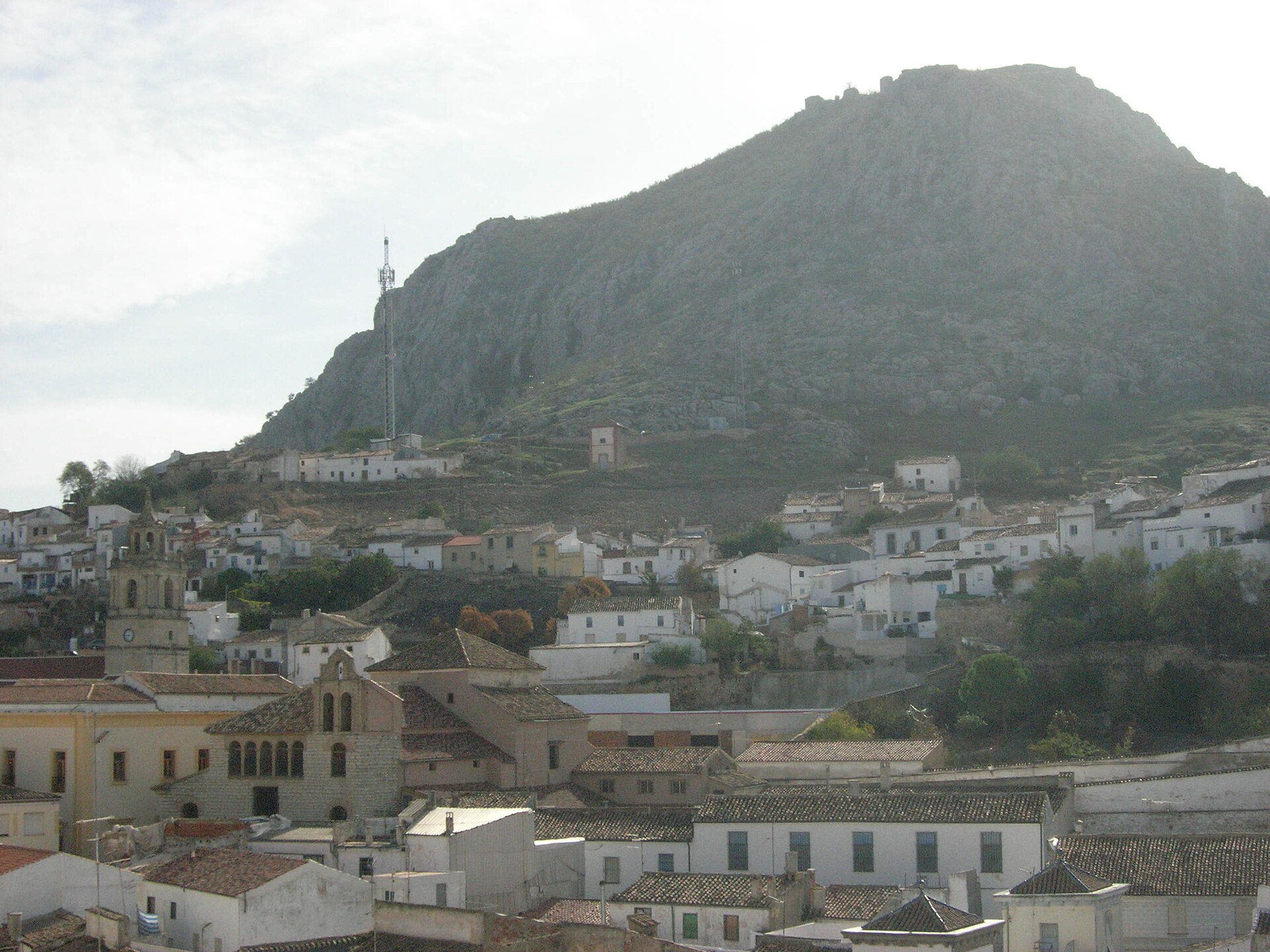
About this place
Peña de Martos is a rocky hill towering over the town of Martos in Jaén province, in Andalusia's Sierra Sur region. Its summit holds the ruins of a medieval castle, and the cliff edge offers one of the best views over some of the oldest olive groves in the entire province.
What can you see on site?
The main draw is the remains of the Castillo de la Peña, Martos's upper fortress, raised in the 14th century by the knights of the Order of Calatrava. They weren't building from scratch: the fortification sits on the site of an earlier Arab castle, which in turn was built over an older Ibero-Roman defensive structure. At its peak the Calatrava stronghold grew to include a keep (tower of homage), a chapel, a cistern, an oven, a mill, and a wine press — the standard toolkit of a self-sufficient frontier fortress. Most of these structures survive today only as ruins, but their layout still lets visitors trace the castle's original plan.
The rock's history stretches far beyond the Middle Ages. Around the 6th century BC the hill already held an important Iberian oppidum, a settlement known as Tucci, mentioned by ancient geographers Ptolemy, Strabo, Mela, and Pliny. Around 14–15 BC, Emperor Augustus founded the Colonia Gemella Tucci here, settling veterans from the III Macedonica and X Gemina legions who had fought in the Cantabrian Wars. This layered past — Iberian, Roman, Muslim, and Christian — makes the rock one of the region's most significant historical sites.
In 1226, control of Martos passed to Alvar Pérez de Castro, and the town became the seat of the Order of Calatrava's commandery in the Kingdom of Jaén, a role it held for centuries and one that drove the castle's later expansion and reinforcement.
How do you get to Peña de Martos?
The hill rises directly above the center of Martos, so walking up from town is the simplest approach — the path climbs steeply but doesn't require any special equipment. Martos itself sits in Jaén province, well connected by road to both the city of Jaén and Córdoba, making it an easy stop on a wider Andalusian itinerary.
When is the best time to visit?
Because the climb is steep and there's little shade along the way, spring and autumn bring the most comfortable temperatures. Andalusian summers can be brutally hot, especially at midday, so early morning or evening visits are worth planning — the low light also flatters the surrounding olive groves.
What will you see from the viewpoint?
From the edge of Peña de Martos, the view stretches over the town below and across a sea of olive trees covering the surrounding hills — one of the oldest olive-growing areas in Jaén province, a region regarded as one of the world's largest olive oil producers.
Frequently asked questions
Can you visit the castle on Peña de Martos? Yes, the ruins are open to explore, though the site is a historical remnant rather than a restored castle — walking along the walls and the keep still gives a clear sense of the fortress's original scale.
How long does the climb and visit take? Given the steep approach, plan on one to two hours for the climb and visit, depending on your pace and how often you stop to take in the views.
What's the difference between Castillo de la Peña and Castillo de la Villa? These are two separate fortresses in Martos: the upper one (de la Peña), on the rock's summit, and the lower one (de la Villa), closer to the town center. Both were declared historical monuments in 1985.
Is the site suitable for children? The steep, uneven path and unguarded cliff edges call for extra caution with young children; older kids generally manage the climb without difficulty.
Nearby places

Earn badges for the places you visit
Download NextOnTrip, discover new places and check off your trails.