About this place
Pazo de los Gago y Montenegro in Pontevedra is a 16th-century Renaissance townhouse standing on one of the old town's most distinctive squares.
Who built this palace, and why does it stand on Plaza de Teucro?
The building dates back to the 16th century, a period when Pontevedra flourished as one of Galicia's most important ports. It was raised by the Gago family, minor nobility whose members held responsibility for guarding the city gate in the town walls and the tower at the Burgo bridge — a role that reflected their standing within the local hierarchy. The pazo occupies the north side of Plaza de Teucro, widely regarded as one of the most characterful squares in historic Pontevedra and lined with several similar noble residences from the same era.
How has the building changed over the centuries?
In the 18th century the pazo underwent a significant renovation commissioned by the nobleman Antonio Félix Tavares, who married Maria Gago de Oca Sarmiento y Montenegro, heiress to the lineage that had owned the property. That marriage, and the remodeling that followed, explain why the building's name carries two family surnames side by side: Gago and Montenegro. The estate has remained with descendants of that line ever since, while the property has kept its original 16th-century floor plan.
What defines the pazo's architecture?
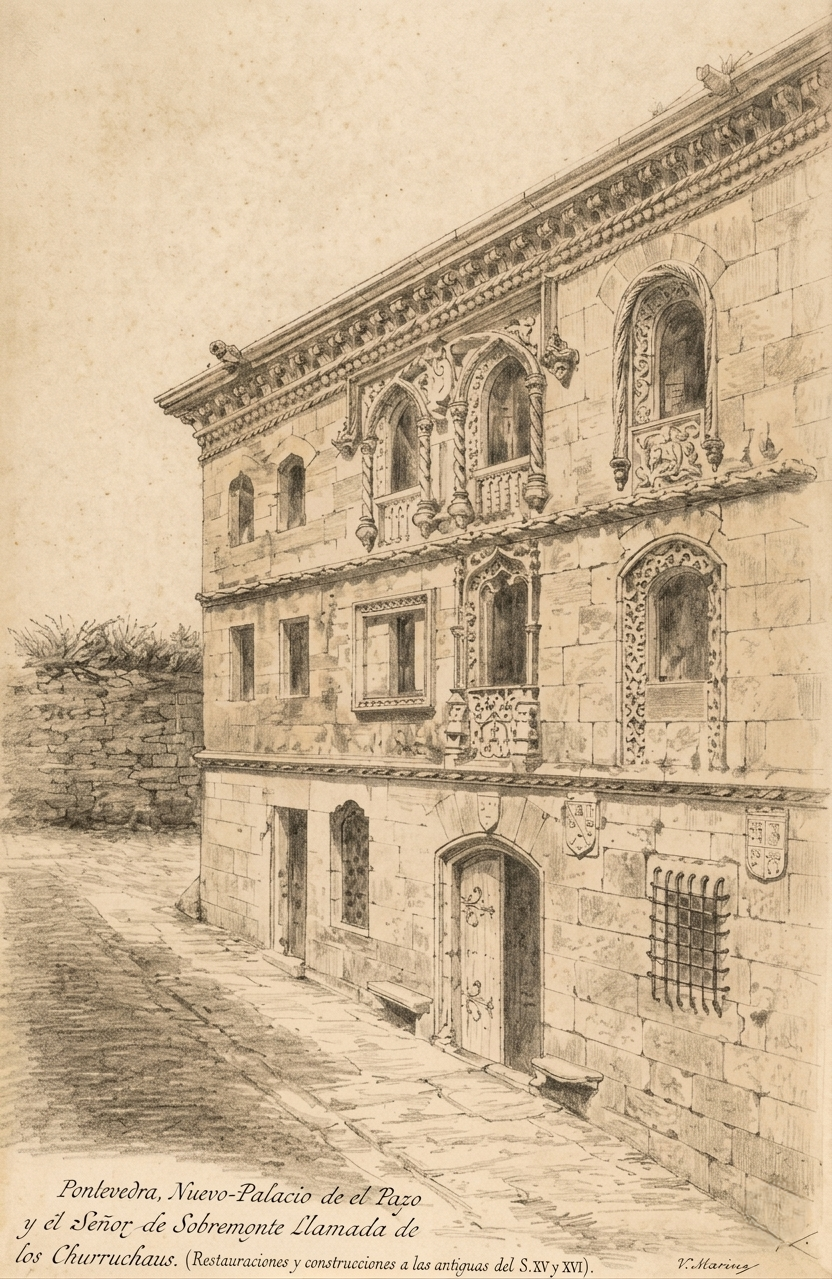
The building rises three stories and keeps the Renaissance symmetry typical of its openings along the facade. The main front, facing the square, is marked by balcony galleries characteristic of 16th-century urban buildings in Galicia. The overall effect is restrained yet elegant — a composition favoring proportion and symmetry over heavy ornamentation, in line with the noble townhouses of the region.
Why do the coats of arms on the facades stand out?
One of the pazo's most distinctive features is the sheer number of heraldic shields decorating its walls — eleven in total. Two sit on the main facade, one marks the corner of the building, six run along the side facade, and two more can be found inside the courtyard. Such a concentration of heraldry in a single building is unusual even in Pontevedra, a city known for its many pazos, and it points to how much importance the Gago family placed on displaying its social standing.
Where exactly is the building, and what else is worth seeing nearby?
The pazo stands in Pontevedra's historic center, on Plaza de Teucro, surrounded by other period townhouses that together form one of the best-preserved clusters of noble architecture in the city. The square itself, with its uniform facades and abundant heraldry on neighboring buildings, is one of the most popular spots for a stroll through the old town. The building's coordinates are approximately 42.4329, -8.6456.
Frequently Asked Questions
Can visitors go inside the pazo? The building remains largely private, though it occasionally opens to the public during cultural events organized in the city, such as local heritage days.
How old is the building? It dates from the 16th century and underwent a major renovation in the 18th century commissioned by the Tavares family.
What sets this pazo apart from others on the same square? Its eleven coats of arms — far more than on neighboring buildings — and its history tied to the Gago family, who once guarded the city gate and the Burgo bridge tower.
How do you get to the pazo from central Pontevedra? Plaza de Teucro sits at the heart of the old town, just a few minutes' walk from the main landmarks of historic Pontevedra.
Nearby places

Earn badges for the places you visit
Download NextOnTrip, discover new places and check off your trails.