About this place
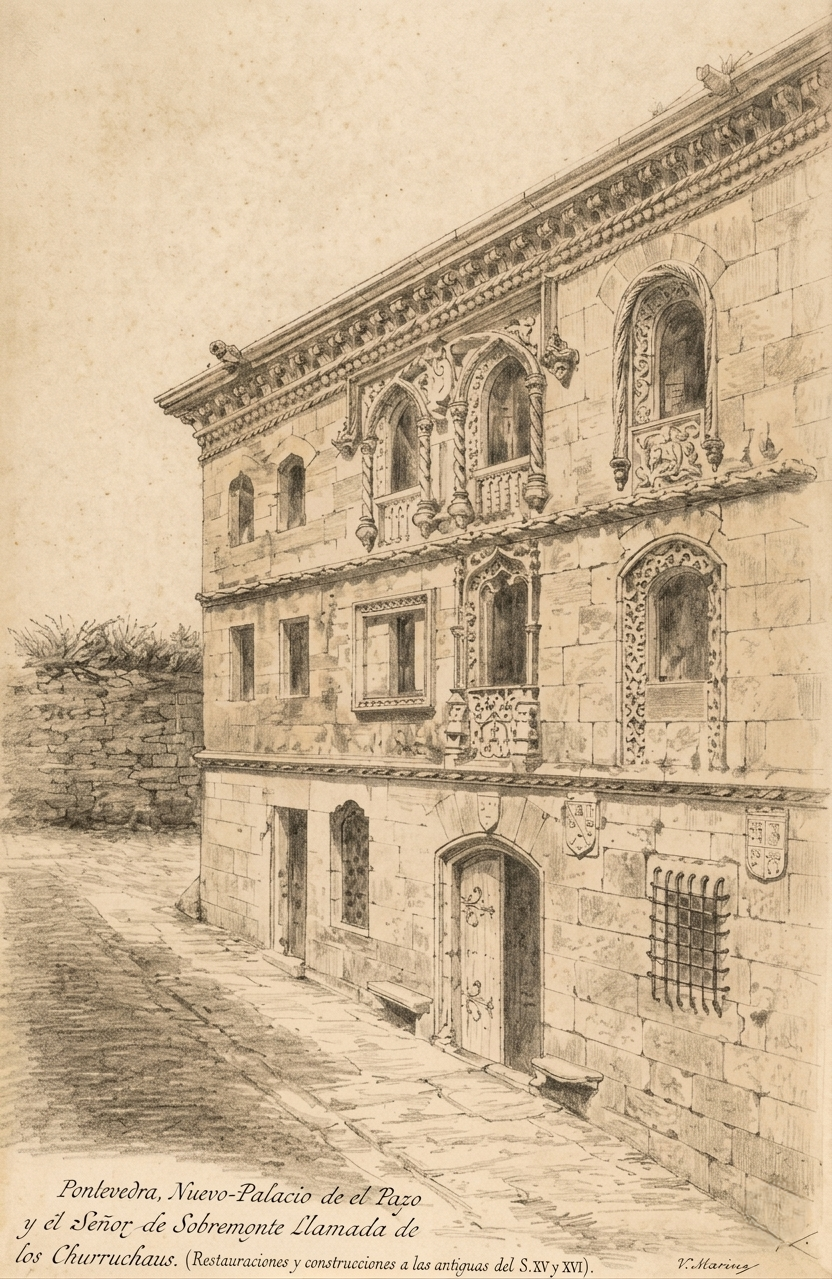
Churruchaos Palace in Pontevedra was a late 15th-century Gothic pazo that no longer stands, though its name still marks a street in the city's old town. Its story is one of the more striking chapters in Pontevedra's medieval past.
Where did the Churruchaos Palace stand?
The building once stood in the heart of old Pontevedra, between Churruchaos Street, Paio Gómez Charino Street, and Santa María Avenue. The street named Churruchaos still exists today, and walking along it means passing the exact spot where one of the grandest urban residences of medieval Galicia once stood.
Who built it, and why did it matter?
The palace was commissioned by Suero Gómez de Soutomaior, a nobleman born around 1417 in Rianxo. He descended from Paio Gómez Charino and was related to Pedro Madruga, two figures central to the region's medieval history. The Churruchaos family belonged to the Sotomayor and Camba lineages, among the most influential noble houses of medieval Galicia.
Contemporaries considered this pazo the most beautiful urban residence in Pontevedra and the richest of the buildings raised by the workshop of masters linked to the Santa María church, possibly including Diego Gil. Its architecture is regarded as a high point of late Gothic civil building in the region, and the palace itself was seen as one of the finest examples of Pontevedra's late Gothic period.
What happened to the palace?
The building remained in good condition until 1719, when English troops attacked Pontevedra and burned several of the city's main buildings, the Churruchaos Palace among them. Its façade was later dismantled, and pieces of it were reused elsewhere: part went into completing a window on the front of the San Francisco church, while other carved stonework was incorporated into the library of a private residence built in Poio by Augusto González Besada.
Can you still see any trace of it today?
The palace itself cannot be visited, since nothing remains standing on the original site. What survives is the street name and scattered architectural fragments built into other structures — the window at San Francisco church and the library in Poio. For anyone tracing Pontevedra's medieval history, that is still reason enough to pause on Churruchaos Street and picture the noble residence that once rose there.
Frequently Asked Questions
What was the Churruchaos Palace? It was a late 15th-century Gothic pazo built in the center of Pontevedra by Suero Gómez de Soutomaior, considered one of the finest urban residences in the city's history.
When did the Churruchaos Palace stop existing? The building was destroyed in 1719, during an attack on Pontevedra by English troops that burned and destroyed several of the city's main buildings.
Is there anything left to see today? The building itself is gone, but the Churruchaos Street name survives, along with facade fragments reused in a window at the San Francisco church and in the library of a residence in Poio.
Which noble family was linked to the palace? The Churruchaos family, descended from the Sotomayor and Camba lineages, two of the most prominent noble houses of medieval Galicia.
Nearby places

Earn badges for the places you visit
Download NextOnTrip, discover new places and check off your trails.