About this place
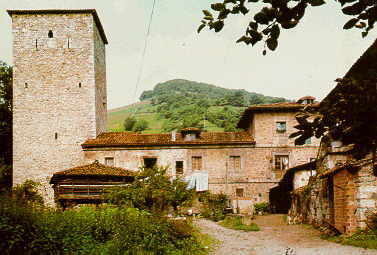
The Palace of Villanueva stands in Grado (Grau in Asturian), a town in the historic region of Asturias in northwestern Spain. The complex brings together a medieval defensive tower, a chapel, and a palace wing added in later centuries, forming one of the region's notable examples of noble residential architecture.
What is the story behind this building?
The oldest part of the ensemble is a stone tower dating back to the 15th century, originally built as part of a feudal stronghold that belonged to the counts of Coalla. The palace itself came later, in the 16th century, commissioned by a branch of the Valdés family — specifically María Alonso de Quirós and Andrés Díaz de Villanueva, who established the Villanueva entailed estate (mayorazgo) and founded the residence on that basis. During the 18th century, further wings were added next to the old tower, and together these additions are now generally referred to as "El Palacio." Ownership shifted over the generations: in the 19th century the estate belonged to the Marquis of San Esteban del Mar, later passing into the hands of the Counts of Revillagigedo.
What will you see on site?
The tower is square in plan, roughly 7.5 meters per side, originally rising through five floors to a total height of about 20 meters. It still displays typical defensive features of medieval military architecture, including loopholes and machicolations — projecting galleries once used to defend the base of the wall. The palace itself follows a roughly square layout, organized into three sections around an inner courtyard shifted toward the north side. The walls were built using rubble masonry, while the corners and window and door openings were finished in ashlar stone, giving the façades a rugged yet precise character typical of Asturian residential architecture.
It's worth knowing before you go that the building is currently in a notably neglected state. This isn't a fully restored tourist attraction with visitor infrastructure — it's an authentic, partly abandoned monument that nonetheless still impresses through its silhouette and layered history.
How do you get there?
The palace sits within the municipality of Grado, in central Asturias, close to the Nalón river. Grado is well connected by road to Oviedo, the regional capital, making it a convenient base for exploring central Asturias. Given the building's current condition, the best way to experience it is from the outside — the tower and palace make an impression even viewed from a distance.
When is the best time to visit?
Spring and early autumn are the most pleasant seasons to explore the area, offering mild temperatures and less rainfall than winter. Summer can also be enjoyable, though it tends to bring more visitors to the Asturian coast nearby. It's worth pairing a stop at the palace with a visit to other historic sites in Grado and the surrounding villages.
Frequently asked questions
Can you visit the inside of the palace? Because of its poor state of conservation, the building is not regularly open for interior visits — check with the local town hall for current access information before planning a trip.
How old is the palace's tower? The tower dates from the 15th century and is a remnant of an earlier feudal stronghold, predating the palace itself, which was added in the 16th century.
Is the site officially protected as heritage? Yes, the complex is listed as a Bien de Interés Cultural (Asset of Cultural Interest) under the Monument category in Spain's heritage register.
How do you reach Grado from Oviedo? Grado lies a short distance from Oviedo and is well served by road, making the drive under half an hour by car.
Nearby places

Earn badges for the places you visit
Download NextOnTrip, discover new places and check off your trails.