About this place
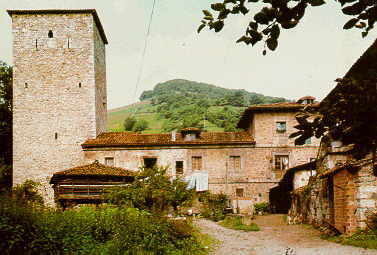
Palacio de Doriga is a fortified stone manor house standing in the hamlet of La Doriga, in the municipality of Salas, Asturias, in northern Spain. The building combines a medieval defensive tower with a later residential wing and an inner courtyard framed by a stone colonnade — a layout typical of the rural Asturian nobility, who used such houses to consolidate their standing in the region over the centuries.
Where does the name come from and who lived here first?
The core of the building is a square defensive tower raised in the 14th century. Its first documented owner was Garcí Fernández de la Doriga, a nobleman who in 1378 represented the council of Salas at the general assembly of Asturian councils. Both the palace and the hamlet around it take their name from him.
How did the palace grow over the centuries?
A cubic structure was added to the tower in the 15th century, and the house reached its fully developed form in the early 16th century, when the central palace wing was built. Work continued in 1600, when the columns supporting the lower gallery of the courtyard were put up — a date recorded in an inscription still visible on one of them — and the main gate onto the patio was opened. The courtyard itself has a slightly rectangular plan, ringed by twelve smooth, Tuscan-style stone columns. Today the estate covers roughly 1,892 square metres of built floor space across five levels, rising to more than 3,100 square metres once the courtyard is included.
What is the palace's connection to Marshal Ney?
During the Napoleonic Wars, the palace served as a temporary residence and headquarters for Marshal Michel Ney, one of Napoleon's most trusted commanders, during the campaign to occupy Asturias. That episode remains one of the most frequently mentioned chapters in the building's history.
Who lived in the palace in the 19th and 20th centuries?
In 1883 the property, along with its entire estate, was bought from the Viscount of Cerro by Juan Fernández Bao, and it stayed in his family's hands for more than a hundred and forty years. Among its later residents was the Asturian economist and writer Valentín Andrés Álvarez (1891–1982), who used it as a summer home. In 1932 the palace welcomed Federico García Lorca and members of the university theatre troupe La Barraca during their tour through Asturias.
Does the palace hold any heritage protection?
Yes. On 30 December 1993, Palacio de Doriga was listed as a Bien de Interés Cultural (Cultural Heritage Asset) in the Monument category, recognising its historical and architectural significance for the region.
Can visitors go inside?
The building is privately owned, and in recent years it has changed hands on the property market, with the heirs of the Fernández Bao family putting it up for sale after more than a century of ownership. Because of this, access to the interior cannot be assumed, and visitors should plan to view the palace mainly from the outside, as part of a walk through the picturesque hamlet of La Doriga and the surrounding Salas countryside.
Frequently Asked Questions
Where is Palacio de Doriga located? In the hamlet of La Doriga, in the municipality of Salas, in western Asturias, northern Spain.
When was the palace built? Its oldest part, a square defensive tower, dates from the 14th century. It was extended in the 15th century, reached its present form in the early 16th century, and saw further work on the courtyard in 1600.
Is the palace linked to any famous historical figure? Yes — it served as a headquarters for Marshal Ney during the Napoleonic Wars, and in 1932 it hosted the poet Federico García Lorca.
Is Palacio de Doriga a protected heritage site? Yes, it has held Bien de Interés Cultural status in the Monument category since 30 December 1993.
Nearby places

Earn badges for the places you visit
Download NextOnTrip, discover new places and check off your trails.