About this place
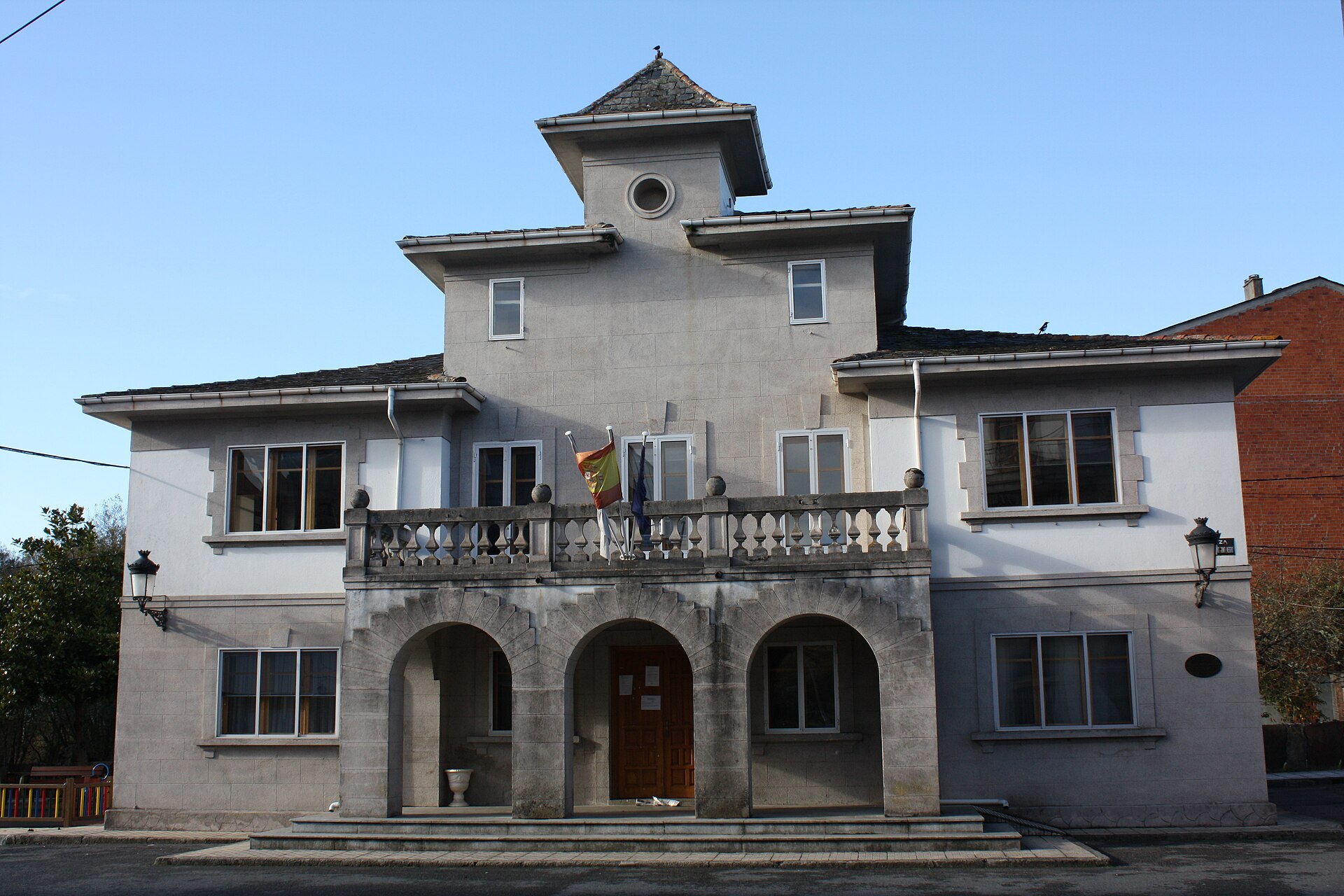
Outeiro de Rei town hall (Casa del Ayuntamiento) sits at the heart of this small municipality in Lugo province, in Galicia, north-western Spain, and has served for decades as the seat of local government.
What does the town hall look like?
The building follows the typical civic style found across small Galician towns: a two-storey structure with an arched ground-floor entrance, an iron balcony on the upper level, and a triangular pediment crowning the façade. The municipal coat of arms sits at the top of the pediment, a common feature on provincial Spanish town halls. The plain, symmetrical façade and stone detailing give the building the restrained, functional look typical of municipal seats in the Lugo area — modest rather than showy, but rooted in local building tradition.
The town hall stands right in the centre of Outeiro de Rei (the parish of San Xoán), making it a natural landmark when exploring the municipal centre. Nearby you'll find other public buildings and the modest streetscape typical of small Galician towns.
How do you get to Outeiro de Rei?
The municipality lies just a few kilometres from Lugo, the provincial capital, along the routes connecting inland Galicia with the coast. Driving is the easiest option — the trip from Lugo usually takes well under half an hour. Travellers without a car can use local bus services running from Lugo toward nearby towns, though it's worth checking timetables in advance since services can be sparse outside weekdays. The closest airport is Lugo–Rozas, but most visitors fly into Santiago de Compostela, roughly ninety minutes away by road.
When is the best time to visit?
Galicia has an oceanic climate — mild summers and wet but rarely freezing winters. Late spring (May–June) and early autumn (September) are the most comfortable seasons for exploring the town centre, with pleasant temperatures and less rain than winter. July and August tend to be warmer and busier with domestic holidaymakers, but they also bring local festivals and municipal celebrations.
A short history of Outeiro de Rei
The area has been settled since Roman times: historical sources link it to the name Octodorum and to Roman road XX, which connected Bracara Augusta (modern Braga) with Asturica Augusta (Astorga). During the Middle Ages, fortifications were built across the territory — the strongholds of Outeiro de Rei, Taboi and Sobrada, tied to the noble house of Lemos. A trace of that past survives today as the Casa-fuerte de Outeiro de Rei, also known as "de la Señorita," founded by Count O'Kelly and considered by many historians to derive from an earlier medieval defensive tower. This Roman and medieval heritage gives the municipality that now houses the town hall a far longer story than the administrative building itself.
Frequently asked questions
Can you visit inside Outeiro de Rei town hall? It's a working municipal office, so access is limited to administrative opening hours — it isn't set up as a tourist attraction.
How far is the town hall from Lugo? Outeiro de Rei borders Lugo directly, and the drive between the two takes only a few minutes by car.
Are there other sights near the town hall? The municipality includes the Casa-fuerte de Outeiro de Rei, a remnant of a medieval defensive tower, which makes a good complement to a stop at the administrative centre.
Is it worth combining with a trip to Lugo? Yes — given how close it sits to the provincial capital and its famous Roman walls, Outeiro de Rei makes an easy short stop on a Lugo itinerary.
Nearby places

Earn badges for the places you visit
Download NextOnTrip, discover new places and check off your trails.