About this place
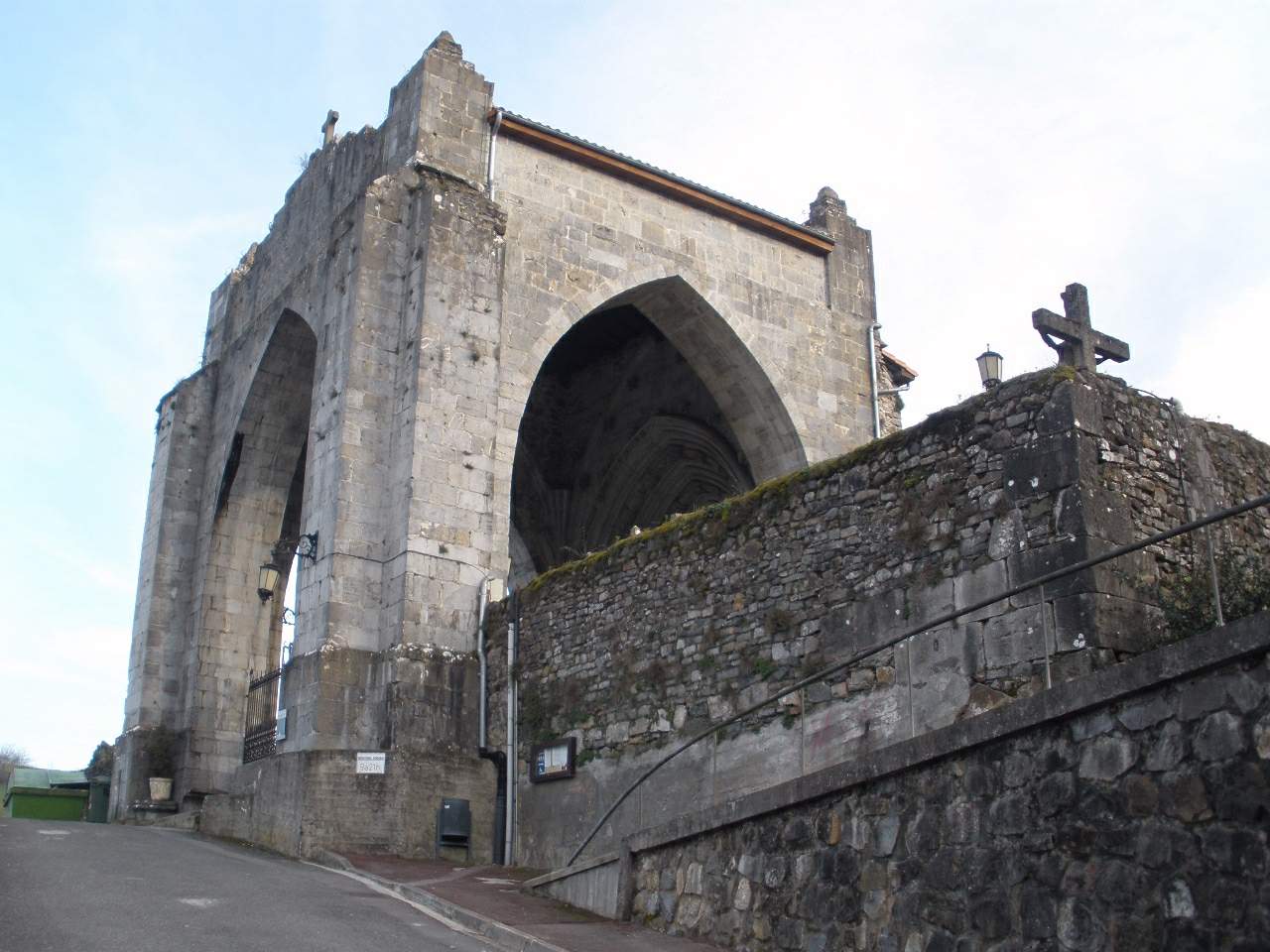
The old portal of San Bartolomé de Olaso is a Gothic gateway and the only surviving fragment of Elgoibar's former parish church, now serving as the entrance to the town's cemetery. It stands on a hillside on the outskirts of Elgoibar, on the very site where the original church once stood.
Where did this portal come from?
The church of San Bartolomé de Olaso was built in the 15th century as a Gothic temple that served as Elgoibar's parish church. The portal itself dates to 1459 and is attributed to the stonemason Martín Sancho. Over time, the church's distance from the town center became increasingly impractical for residents, prompting local authorities to build a new parish church closer to the built-up area. The old church gradually lost its role — it was first converted into a hermitage and later the grounds began to be used as a cemetery. The church's main body did not survive to the present day, but its imposing portal remained standing and was incorporated into the cemetery's entrance, as if it still guarded the threshold of a temple that had long since disappeared.
What does the portal look like?
The portal takes the form of a double doorway divided by a central mullion column (trumeau), a feature typical of Gothic church portals of the period. Carved figures of saints decorate the column and its sides — identifiable are Saint Peter, Saint Paul, Saint Bartholomew (the church's patron), Saint John the Baptist, and Saint Sebastian. These are accompanied by carved representations of choirs of virgins and angels, arranged along the sides of the composition. A defining feature of the portal is its archivolts — the curved bands of stone ornamentation framing the entrance — which carry around twenty small statuettes. The stonework throughout was executed with considerable care, meaning that despite more than five and a half centuries, the sculptural details remain legible.
Why is the portal protected?
Given its artistic and historical value, the portal of San Bartolomé de Olaso was officially recognized as a heritage monument on 17 January 1964, when it was declared a Monumento Histórico-Artístico (Historic-Artistic Monument) — a category of cultural heritage protection used in Spain for structures of particular significance to the region's art and architectural history. This designation confirms that even after the rest of the church vanished, the portal alone was judged valuable enough to merit lasting legal protection.
What should visitors know?
Today the portal stands within Elgoibar's cemetery, functioning as its main entrance gate. It is an unusual pairing — a medieval sacred architectural detail set within the contemporary context of a burial ground — which lends the site a distinctive, reflective atmosphere. For anyone interested in Gothic architecture or the history of the Gipuzkoa region, it offers a striking example of how fragments of older buildings are sometimes carried forward into new uses rather than disappearing from a town's landscape altogether.
Frequently asked questions
Can visitors go inside the original church? No — the church building itself no longer exists; only its entrance portal survived, now built into the cemetery gate.
Who designed the portal? It is attributed to the stonemason Martín Sancho and dated to 1459.
Which figures are depicted on the portal? Saints Peter, Paul, Bartholomew, John the Baptist, and Sebastian, along with choirs of virgins and angels, and small statuettes on the archivolts.
Does the portal have official heritage protection? Yes, it has held Monumento Histórico-Artístico status since 17 January 1964.
Nearby places

Earn badges for the places you visit
Download NextOnTrip, discover new places and check off your trails.