About this place
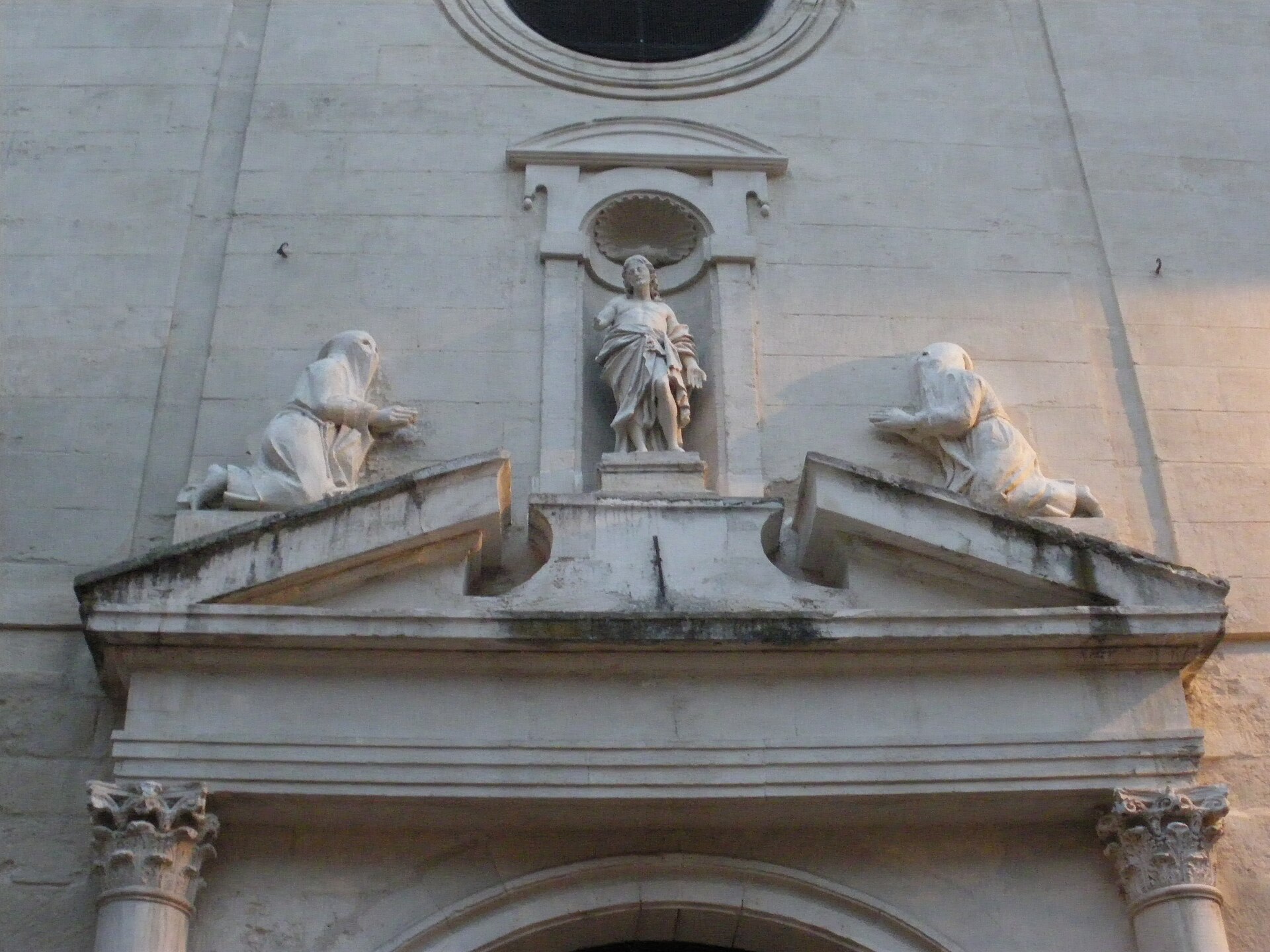
The Jesuit Novitiate of Avignon is a former religious complex built by the Society of Jesus as a training house for its novices. The building now holds the Hôtel Le Cloître Saint-Louis and cultural venues, and its chapel and cloister are listed as a French historic monument.
When was the novitiate founded, and who paid for it?
The Jesuits had run a college in Avignon since 1564 and soon wanted a novitiate attached to it. Early attempts between 1569 and 1582 fizzled out, and the institution only took permanent root in 1589, when a generous gift from Louise d'Ancezune allowed the order to buy a plot with houses on what was then rue des Vieilles Études.
Who designed the chapel, and what does it look like?
A further gift from the same benefactress let the Jesuits start building a chapel in 1601, designed by the lay brother Étienne Martellange; it was consecrated on 23 May 1611. The chapel follows an uncommon Renaissance-derived Greek-cross plan crowned by a dome on a drum. A Martellange signature shows in the window placement: rather than lining up on the building's axes, the openings are grouped in pairs along the diagonals.
How did the wider complex take shape?
The ranges enclosing the central courtyard went up during Martellange's lifetime and were carried on from 1627 by the architect François de Royers de la Valfenière; work on the whole ensemble dragged into the first decades of the eighteenth century.
What happened after the Jesuits were expelled?
In 1768, while Avignon was briefly reattached to the French Crown, Louis XV had the Jesuits driven out of the city. The following year the vacated novitiate was bought by the nuns of Sainte-Praxède, whose own tenure ended with the house's closure in 1790. Between 1801 and 1850 the building served as an annex of the Hôtel des Invalides in Paris. In 1852, following a donation from Louis-Napoléon Bonaparte, it passed into the ownership of the city of Avignon and spent the next four decades as a municipal poorhouse.
How did a novitiate become a hotel?
The site was not properly restored until 1987, when architect Jean Nouvel reworked the north wing, turning the former convent into the Hôtel Le Cloître Saint-Louis alongside spaces used for cultural and tourism events. The buildings and cloister have been listed as a monument historique since 1950. The complex now stands at 20 rue du Portail Boquier in Avignon.
Frequently asked questions
Can visitors tour the Jesuit novitiate in Avignon? The building operates as a hotel, so interior access is mainly reserved for guests; the cloister and outer facades can still be viewed as part of the city's historic fabric.
Who designed the chapel? The original design came from Étienne Martellange, a Jesuit brother who worked as the order's architect across France.
Why did the Jesuits leave Avignon? In 1768 Louis XV used the city's temporary reunion with the French Crown to expel them, part of a broader wave of Jesuit suppressions across French territory at the time.
What was the building used for between the convent's closure and the hotel's opening? In turn: a house for the nuns of Sainte-Praxède, an annex of the Paris Hôtel des Invalides, and from 1852 a municipal poorhouse for Avignon's residents.
Nearby places

Earn badges for the places you visit
Download NextOnTrip, discover new places and check off your trails.