About this place
Abbaye de Saint-Ruf d'Avignon is the ruined remnant of a medieval abbey of regular canons on the southern edge of Avignon's old town, in the Vaucluse department. Little survives beyond fragments of walls and columns, yet for centuries this modest site stood at the center of a religious reform movement that spread across much of medieval Europe, and it gave its name to an entire monastic congregation.
How did the abbey begin?
The story starts in 1039, when four clerics connected to the chapter of Avignon Cathedral received the church of Saint-Ruf-et-Saint-Just from the local bishop, along with some surrounding land. Around this small foundation a community of canons took shape, and it became one of the first in the region to adopt the Rule of Saint Augustine. Through this early choice, Saint-Ruf played a real part in spreading Augustinian observance across the south of France.
Why does an abbey's name belong to an entire order?
The community grew quickly enough that in 1095 Pope Urban II formally approved a distinct congregation, the Regular Canons of Saint-Ruf. Its recognition fit into the wider Gregorian Reform, the church-wide effort to restore discipline and moral standards among clergy. Over the twelfth century the abbey became one of the leading centers of this canonical reform, and its liturgical customs and internal organization were adopted, with local adjustments, by chapters as far afield as the Iberian Peninsula, Scandinavia, and southern Germany.
What is the abbey's connection to a pope?
One of the canons who rose through Saint-Ruf's ranks, and eventually became its abbot, was the Englishman Nicholas Breakspear. After years spent in the Avignon community he advanced within the church hierarchy, served as a papal legate, and in 1154 was elected pope, taking the name Adrian IV. He remains, to this day, the only Englishman ever to have held the papacy, and his early years at Saint-Ruf are one of the details visitors most often ask about.
What happened to the abbey afterward?
In 1158, following disputes with the cathedral chapter of Avignon, the seat of the order — the mother house of the whole congregation — was moved from Avignon to Valence, further along the Rhône. The monastic church in Avignon itself was rebuilt shortly after, at the height of the Romanesque style in the late twelfth century, and it is from that rebuilding that the surviving ruins date. From the fourteenth century onward, the community and the wider order entered a long, gradual decline, and their religious and economic importance eventually faded almost entirely.
What can visitors see today?
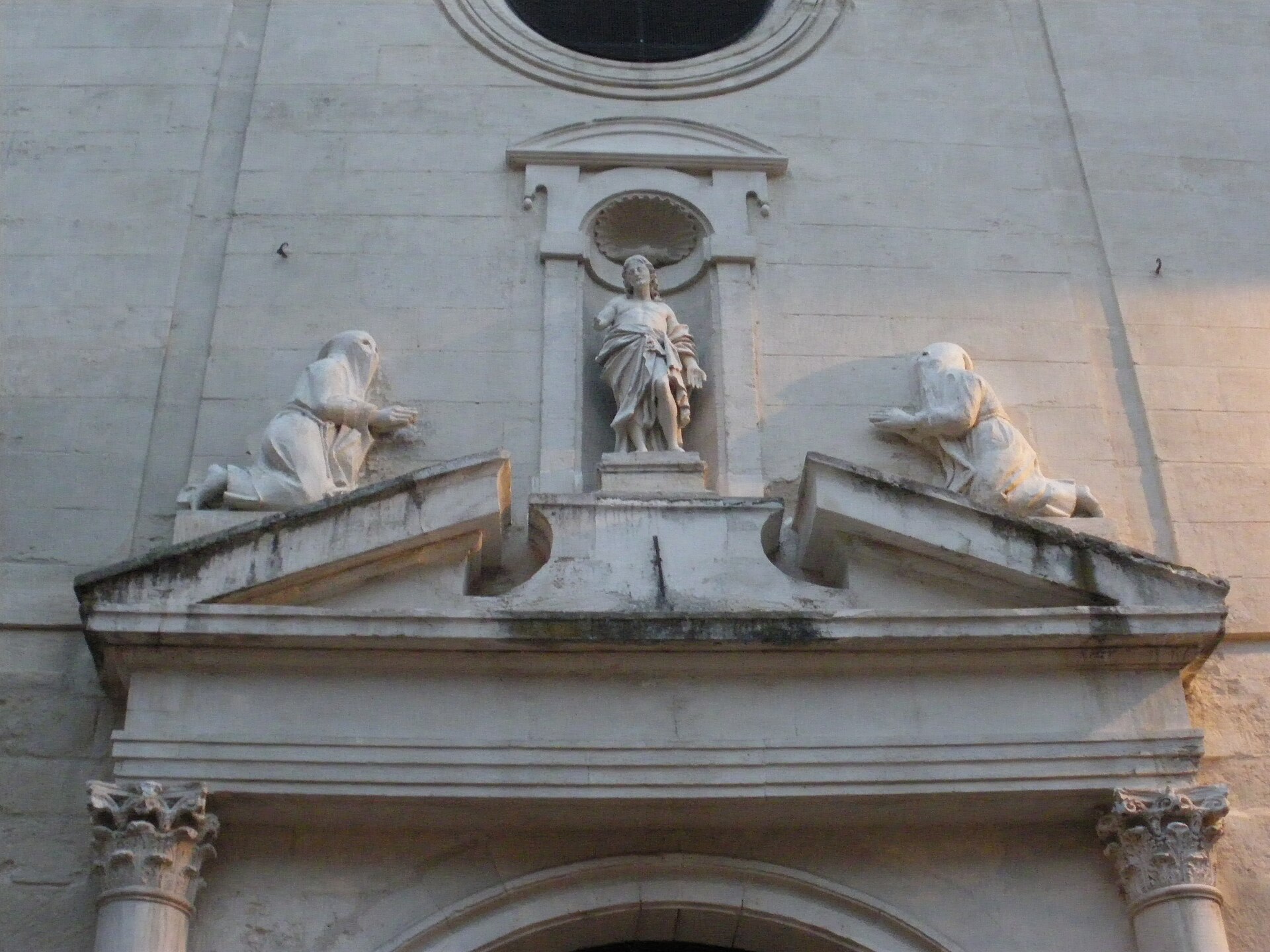
What remains on site are fragmentary but still striking pieces of Romanesque architecture — sections of walls, arcading, and other elements of the former monastic church, standing along avenue du Moulin-Notre-Dame, just outside the perimeter of Avignon's old walls. It is a quiet, low-key site, drawing mainly visitors with an interest in regional history and religious architecture rather than large tourist crowds.
Frequently asked questions
Where exactly are the abbey ruins? Along avenue du Moulin-Notre-Dame in Avignon, just outside the old city walls, in the Vaucluse department.
Is Saint-Ruf the same as Avignon Cathedral? No — it is a separate monastic complex, founded independently, though historically linked to the cathedral's chapter.
Why does the abbey matter historically? It lent its name to an entire order of regular canons, approved by the pope in 1095, whose customs influenced religious communities across medieval Europe.
Can the ruins be visited? The site consists of open-air historical remains — it's worth checking current access conditions locally before a visit.
Nearby places

Earn badges for the places you visit
Download NextOnTrip, discover new places and check off your trails.