About this place
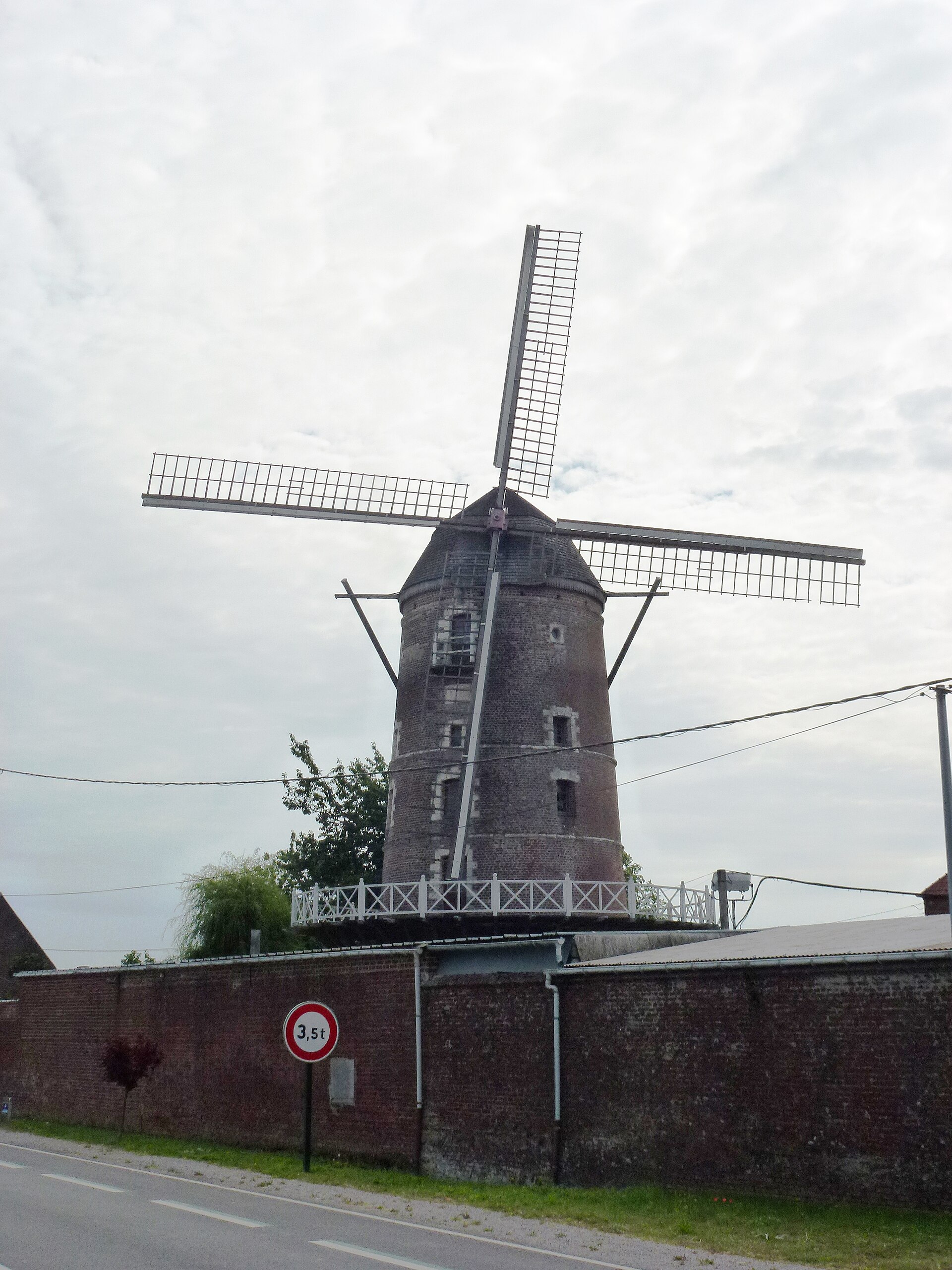
Moulin à vent de Coquelles is a timber windmill standing in Coquelles, a town bordering Calais and sitting right next to the Channel Tunnel terminal. Locally known as Moulin Michel, it is one of the last surviving witnesses to an era when pivot-post windmills dotted the flat plains of French Flanders.
What kind of mill is it?
It is a moulin sur pivot, or Flemish-style windmill — the entire timber body rotates on a central post rather than just the upper cap, as in tower mills. This construction type was common across the strip of land between Calais and the Belgian border and was built for grinding grain for local farms.
How far back does its history go?
A mill has probably stood on this spot since somewhere between the 14th and 16th centuries, as shown on old maps from the period of English rule around Calais. Over the centuries the structure repeatedly fell victim to weather and warfare. A tornado toppled it in September 1800, though it was rebuilt soon after. Through the 19th century it changed hands several times, passing among the Parenty and Rohart-Parenty families.
The most dramatic chapter came during the Second World War. Because the mill served as a highly visible landmark for Allied artillery shelling the coast, German forces destroyed it. When Coquelles resident André Darré returned home after demobilization in 1941, the mill was simply gone.
How did the mill come back?
Rebuilding took years and an unusual solution: in 1951, a windmill from Crochte, in the Nord department, was dismantled and re-erected in Coquelles to replace the lost structure. Misfortune struck again just two years later, when a violent storm knocked the rebuilt mill down once more. That setback triggered a wave of local solidarity, with the state, the department, the towns of Coquelles and Leers, and private donors all contributing to its restoration.
What is its status today?
The mill was listed as a monument historique (historic monument) by decree on 14 November 1977. A major restoration completed in December 1980 brought it back to working order, able to grind grain again. In 1996 it lost one of its sails and fell out of operation. A new restoration campaign, backed by Crédit Agricole Nord de France, the Fondation du Patrimoine, and the region, began in 2006. The final phase, in 2017, saw its sails replaced by a Belgian carpenter specializing in traditional windmill construction.
Why is it worth a visit?
Moulin Michel layers several eras of history in one structure: medieval origins, 19th-century storms, wartime destruction, and a multi-generation community effort to bring it back. It stands as a rare surviving example of a Flemish pivot windmill in a region that once counted dozens of them. For travelers heading to or from the Channel Tunnel or Calais, it makes for an easy landmark to spot along the way, a reminder of the farming past of the Opal Coast.
Frequently asked questions
Can you go inside Moulin à vent de Coquelles? The mill is primarily a landmark and a visual feature of the local landscape; whether the interior is open depends on the town's current arrangements, so it is worth checking on-site conditions before visiting.
Why is it called Moulin Michel? That is the name under which the structure is registered as a historic monument, and it appears under this name in the heritage-protection records for Coquelles.
Did the mill survive the Second World War? Not in its original form — German forces destroyed it because it served as a landmark for Allied artillery. The current structure descends from a mill moved from Crochte in 1951.
Is the mill still mechanically functional? Following restorations in 1980, 2006, and 2017 — including a full replacement of its sails — the mill is in good condition, though today its main role is heritage and landscape value rather than industrial grain milling.
Nearby places

Earn badges for the places you visit
Download NextOnTrip, discover new places and check off your trails.