About this place
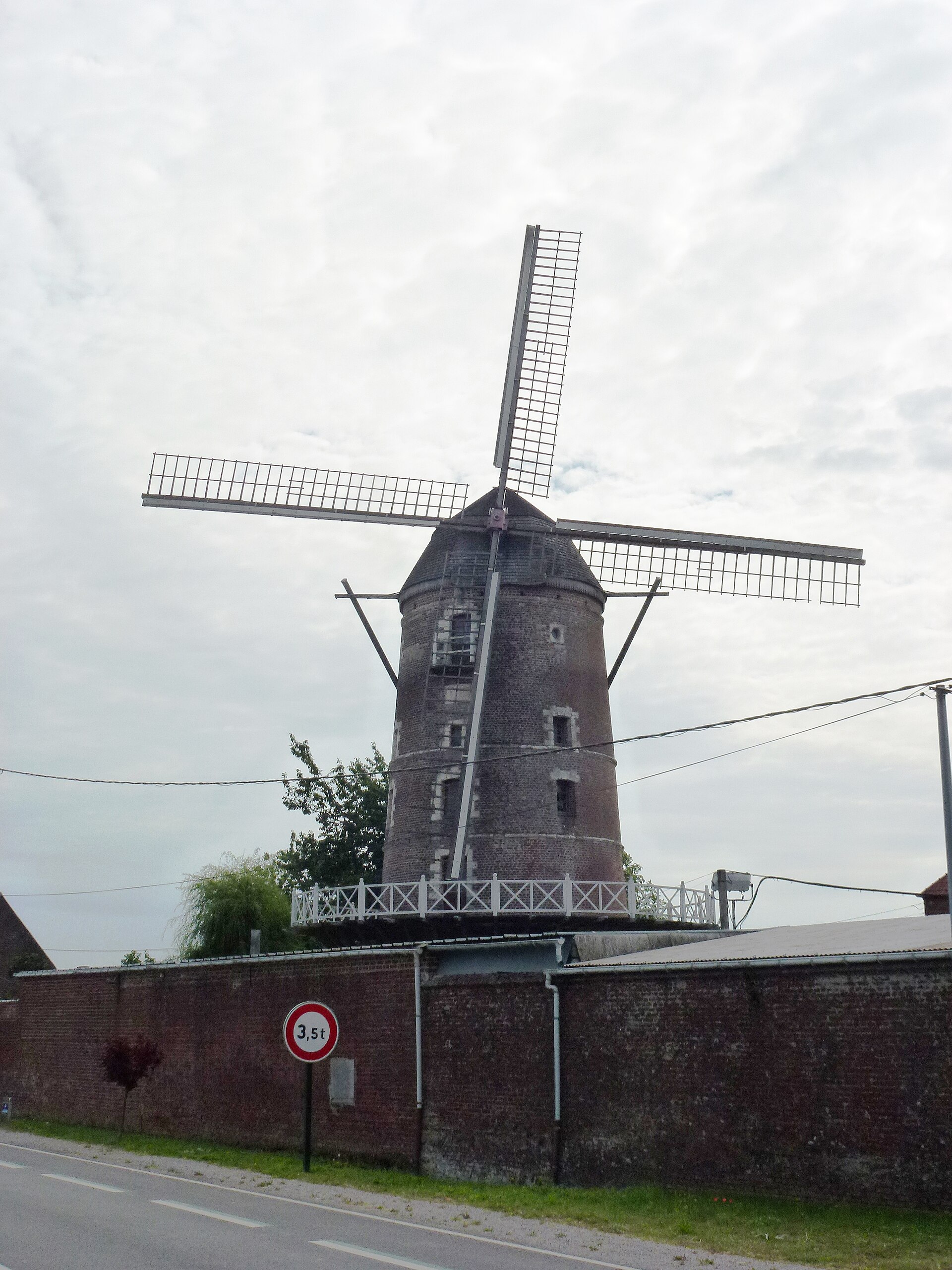
Moulin Lianne is a historic windmill standing in Offekerque, a small commune in the Pas-de-Calais department, in the Hauts-de-France region of northern France. Also referred to as Moulin Blanc, it sits on Rue du Sauve en Temps and remains one of the more distinctive landmarks in this stretch of the French Channel coast countryside.
Why is it called Moulin Lianne?
The name has nothing to do with vines or vegetation — it comes from the family that ran the mill for most of the 20th century. Isidore Lianne first leased the mill in 1910 and became its outright owner in 1919. The property then stayed within the Lianne family across several generations, which is why locals still refer to it by that name, even though older records sometimes use the alternative label Moulin Blanc.
What does the mill look like, and how old is it?
The building has a distinctive truncated, cone-shaped tower built from brick masonry rather than timber, which sets it apart from many of the wooden windmills found elsewhere in the region. Its construction dates back to the late 18th century, and the mill was already recorded in a census taken in 1809 — making it one of the older surviving mills in this part of Pas-de-Calais. That masonry construction is a large part of why the structure has survived in recognizable form to the present day.
What was the mill actually used for?
Originally, Moulin Lianne ground wheat for local bakeries and households, but that use ended back in 1947. The mill's role then shifted: through the 1960s it was employed to grind feed for livestock rather than flour for bread. Inside, two pairs of millstones survive, and from 1935 onward they were powered by a diesel engine rather than relying on wind alone — an adaptation that let the mill keep operating even as its traditional wind-driven mechanism became less reliable.
When did the sails stop turning?
The sails of Moulin Lianne came to a final stop in 1966. That was not, however, the end of milling activity: the semi-diesel engine installed in 1935 continued to drive the grinding stones for customers until 1971. Only at that point did the mill cease production altogether, becoming a structure valued primarily for its history and architecture rather than its working function.
Is Moulin Lianne a protected heritage site?
Yes, the windmill is listed among France's monuments historiques, a status that recognizes its importance to the region's rural and industrial heritage. The protection covers the tower itself, a good example of the brick-built windmill construction typical of northern France around the turn of the 18th and 19th centuries.
How do you get to Moulin Lianne?
The mill stands at 17 Rue du Sauve en Temps, 62370 Offekerque, within easy reach of the coast near Calais and Cap Gris-Nez. Its geographic coordinates are 50.939, 1.9932, which makes it straightforward to locate when planning a route through the Pas-de-Calais countryside.
Frequently asked questions
Is Moulin Lianne the same building as Moulin Blanc? Yes, both names refer to the same windmill; you'll find either used in different records and publications.
How old is the windmill? The structure dates from the late 18th century and was already documented in an 1809 census.
Is the mill still operating today? No. Milling stopped for good in 1971, and the sails themselves had already stopped turning in 1966.
What was the mill grinding in its final decades of use? By the 1960s it mainly ground animal feed rather than wheat for bread — bread-flour production had already ended in 1947.
Is Moulin Lianne worth visiting near Offekerque? It's one of the few brick-built windmills of its kind still standing in the area, officially listed as a historic monument, making it a worthwhile stop for anyone interested in the region's rural heritage.
Nearby places

Earn badges for the places you visit
Download NextOnTrip, discover new places and check off your trails.