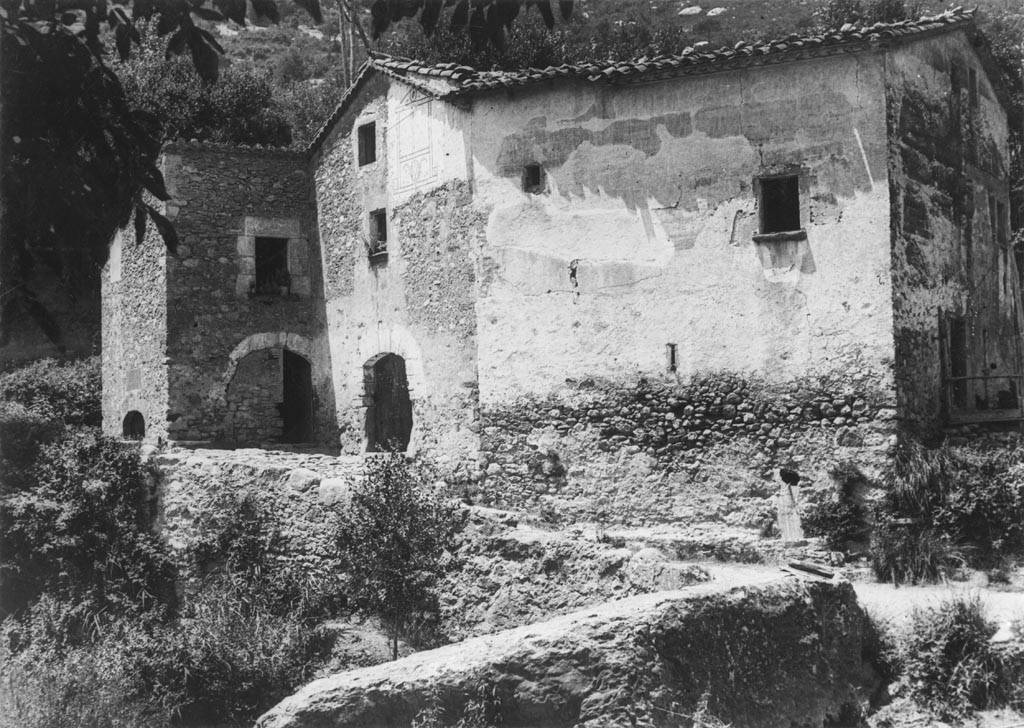
About this place
Molí de les Canes is the ruin of an old water mill standing next to the former Mas de les Canes farmhouse, within the municipality of Centelles, in the Osona region of Catalonia. Set beside the Congost river at roughly 438 metres above sea level, it's not a site you tour in the usual sense, but it's one of the more intriguing stops for anyone following the local trail of historic water mills.
Where exactly is Molí de les Canes?
The ruins sit right along the C-17 road, around kilometre 42.3, close to the Aiguafreda exit — one of the first turnoffs on that road if you're driving from Vic toward Barcelona. Administratively the site falls within Centelles, though geographically it's closer to Aiguafreda than to the Centelles town centre. It lies in the Congost valley, a corridor that has connected the Osona and Vallès areas for centuries.
What's the history behind the mill?
Two mills were once linked to Mas de les Canes: one further upstream near Les Codines, the other downstream, right by the farmhouse itself. Both show up in records as early as 1538, and in 1552 they were leased by Joan Canes — the family whose name the site still carries. Like most mills strung along the Congost, they used the river's flow to turn their grinding wheels.
The most unexpected find at the site, though, wasn't mill machinery at all. Late in the 19th century, Roman milestones (mil·liaria) turned up here, proof that an imperial Roman road once ran through this exact spot, linking Auso (present-day Vic) with Barcino (Barcelona) along the Congost valley. In other words, people were moving through this valley long before anyone built a mill on it.
How do you get there?
By car, the approach is via the Aiguafreda exit off the C-17, followed by local roads into the Congost valley. Worth knowing up front: reaching the ruins themselves is genuinely difficult. The land is privately owned, and there's no maintained path leading straight to the mill. For most visitors, the realistic option is viewing the site from a nearby hiking trail rather than walking right up to the ruins.
What will you actually see?
Conservation is poor. The remains of the lower mill — the one closer to the farmhouse — are barely visible on the ground anymore, worn down by vegetation and erosion over the years. The site is listed on the immovable heritage register (reference 08067-243) and has carried local cultural-asset protection since 1995, but without archaeological work its condition is expected to keep declining; it remains private land with no active use today.
When's the best time to visit?
Spring and autumn make the most sense, when walking the network of mill trails around Centelles is easiest — no summer heat, no winter chill settling into the Congost valley. Treat Molí de les Canes as one stop on a longer walk past the area's other mills rather than a destination on its own.
Frequently Asked Questions
Can you go inside the mill ruins? No. The land is private and the structure is in poor condition, so access is essentially impossible and not safe to attempt.
What's the most interesting fact about this site? The discovery of Roman milestones here, confirming that an ancient road linking Vic and Barcelona once ran straight through the Congost valley at this point.
Is it worth a trip on its own? Not really by itself — it's best combined with a walk covering other mills in Centelles, such as Molí de la Llavina or Molí del Rossell.
What's the easiest way to reach it? Drive to the Aiguafreda exit on the C-17, then continue on local roads and paths along the Congost river toward the site.
Nearby places

Earn badges for the places you visit
Download NextOnTrip, discover new places and check off your trails.