About this place
Loupežnická jeskyně (literally "Robber's Cave" or "Bandit's Cave") is a small karst cave in the former Solvay limestone quarry near the village of Křižany, Liberec District, on the southwestern slope of Lom hill (683 m) along the Ještěd ridge in northern Bohemia.
Where exactly is the cave located?
The cave sits inside the Ještěd Nature Park, on the site of a disused limestone quarry known locally as Solvayův lom (the Solvay quarry). The area is cut by the Lusatian fault zone, one of the region's major tectonic lines separating the Lusatian massif from the Krkonoše-Jizera units. This fault zone is directly responsible for the strong folding and fracturing visible in the local rock.
How did the cave form, and why is it inside a quarry?
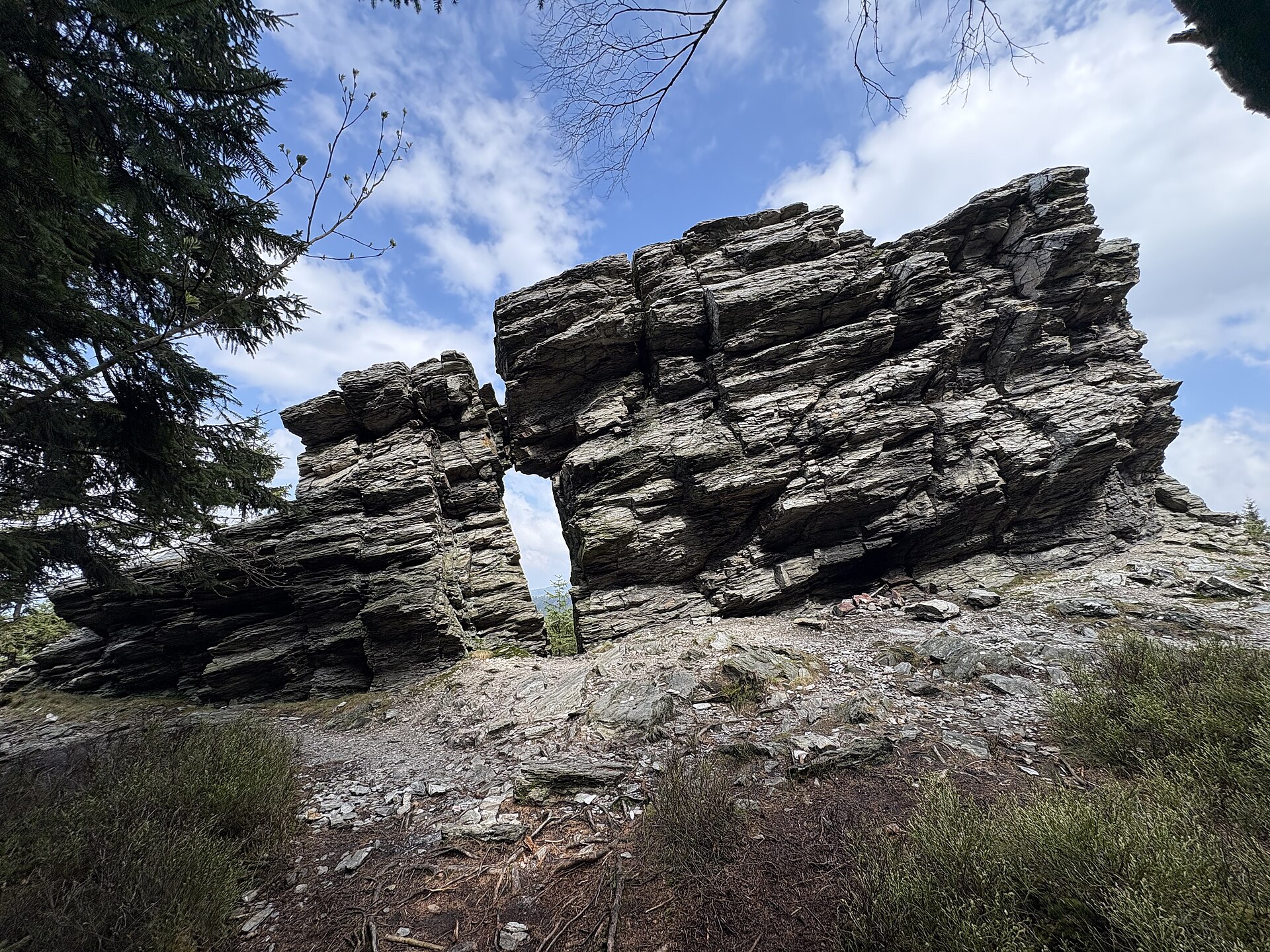
The limestone once worked in the Solvay quarry consists of grey, thin-bedded Devonian limestone containing small crinoid fragments, cited as a textbook example of Devonian facies development within the Ještěd Crystalline Complex. Phyllitic schists and green shale are also exposed in the quarry walls. A recumbent fold visible in the limestone records the intense mountain-building forces of the Variscan orogeny that shaped this part of the Sudetes. The cave itself was carved by an ancient underground stream — the passage walls still show clear water-erosion features, and a remnant of the old streambed measures more than a metre across.
What was mined here, and where did the stone go?
The quarry operated on three levels. Limestone was hauled by a cableway down to the railway station in Křižany and from there onward to the chemical works in Neštěmice, where it was used to manufacture soda ash by the Solvay process — the source of the quarry's name. Extraction ended in the 1920s. It was during that early-20th-century mining that the first sections of the cave were exposed; further passages were explored by researchers as recently as the 2000s.
What does the inside of the cave look like?
The known passage is roughly 14 metres long, 3 metres wide and up to 2.5 metres high. Dripstone decoration is almost entirely absent, apart from a small patch of sinter crust deep inside the passage. Far more striking than any formations are the erosional shapes carved into the walls by running water, which trace out the path of the vanished underground stream with unusual clarity.
Why does the cave matter ecologically, and can visitors go inside?
Loupežnická jeskyně is an important bat hibernation site on the Ještěd ridge. Researchers monitoring winter roosts have recorded several species here, including the greater mouse-eared bat and species considered rare elsewhere on the ridge, while autumn swarming surveys — when bats gather before mating — have logged as many as nine different species at this one site. Scientists suspect bats also use additional, still-undiscovered cavities reachable only through cracks in the rock. Because of the need to protect hibernating bats, preserve the surviving sinter decoration, and manage the instability left behind by quarrying, the cave is closed to the public. No marked trail leads inside, and entry is restricted.
Frequently asked questions
Can you visit Loupežnická jeskyně? No. The cave is closed to visitors to protect hibernating bats, preserve what remains of its sinter decoration, and avoid the rockfall risk left over from quarrying.
Where does the name come from? "Loupežnická" translates to "robber's" or "bandit's." No documented legend behind the name has been confirmed in available sources.
How did the cave come to exist? It was carved naturally by an underground stream flowing through Devonian limestone; quarrying at the Solvay works later exposed its entrance.
What was extracted at the Solvay quarry? Grey, thin-bedded Devonian limestone, moved by cableway to the Křižany railway station and on to the Neštěmice chemical works for soda-ash production via the Solvay process.
Why is the cave ecologically significant? It functions as one of the Ještěd ridge's notable bat hibernation sites, used by several species, including some considered rare in the wider area.
Nearby places

Earn badges for the places you visit
Download NextOnTrip, discover new places and check off your trails.