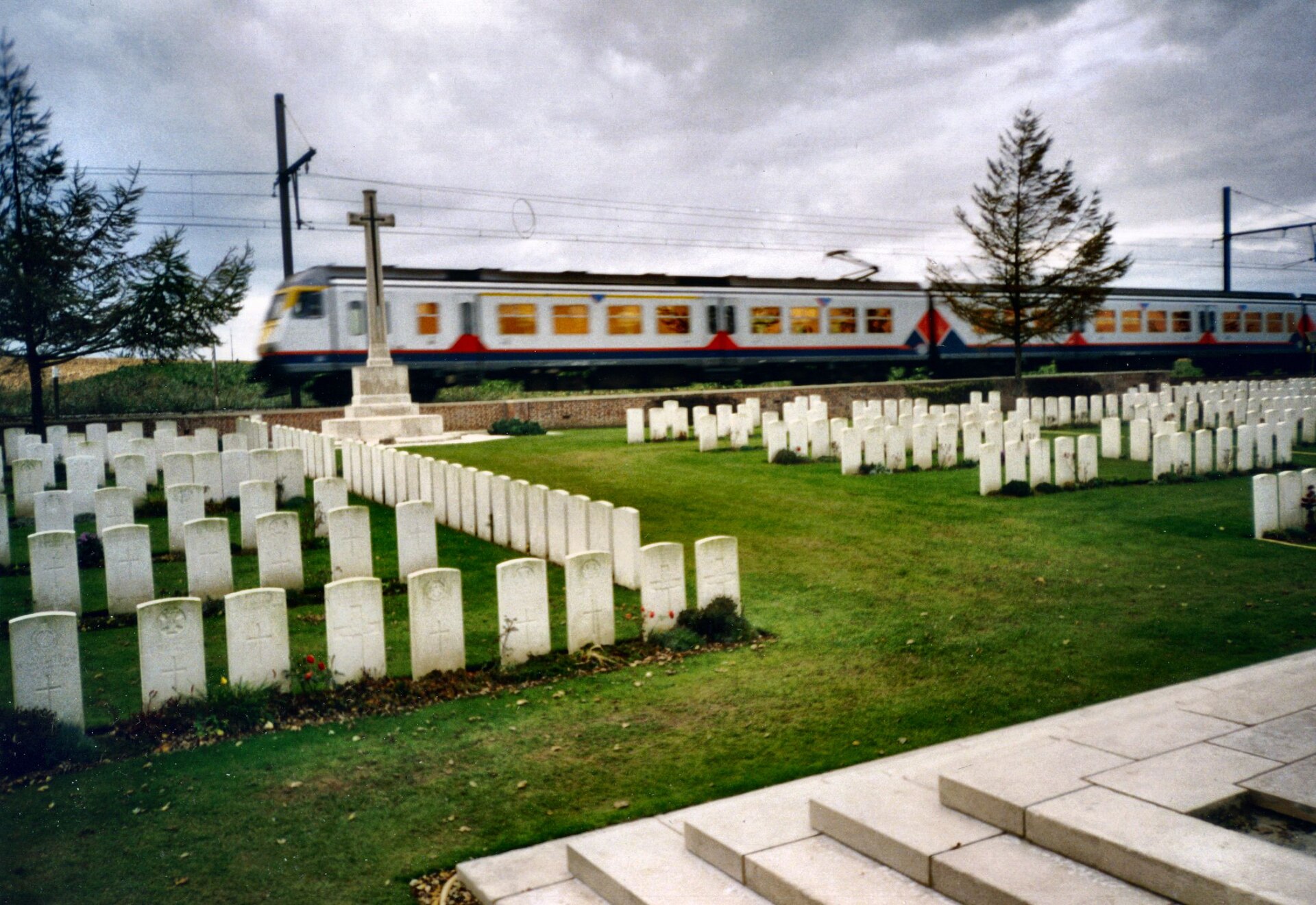
About this place
Larch Wood (Railway Cutting) Cemetery is a Commonwealth War Graves Commission (CWGC) burial ground holding the dead of the First World War, located in the Ypres Salient on the Western Front in Belgium. It is one of many military cemeteries scattered across the fields surrounding Ypres, a town that sat on the front line for almost the entire war and became synonymous with some of the conflict's bloodiest fighting.
Where is the cemetery located?
The cemetery lies within the municipality of Ypres, in the province of West Flanders, right in the heart of what became known as the Ypres Salient — a bulge in the Allied front line that British and Commonwealth forces held for most of the war despite being surrounded by German lines on three sides. Its coordinates place it at roughly 50.828°N, 2.923°E, within the flat, low-lying landscape typical of this stretch of the Flanders battlefields.
What was the Ypres Salient and why are there so many cemeteries here?
The Ypres Salient refers to the section of front line that bulged around the town of Ypres between 1914 and 1918, and it became a byword for the grinding, static warfare that defined much of the First World War. Successive battles fought here drew in hundreds of thousands of soldiers from Commonwealth, French and German forces alike. As a result, the surrounding countryside is dotted with dozens of war cemeteries of every size, ranging from vast national memorials to small, intimate burial grounds such as Larch Wood (Railway Cutting) Cemetery.
Who maintains the cemetery?
The site is cared for by the Commonwealth War Graves Commission, the organisation responsible for commemorating and maintaining the graves of Commonwealth service members who died in the two World Wars. The CWGC looks after hundreds of comparable cemeteries across Belgium and France, ensuring they remain accessible and well kept for visitors, descendants of the fallen, and anyone with an interest in the history of the First World War.
What does the cemetery's name mean?
The name Larch Wood (Railway Cutting) refers to two features of the wartime landscape: a stand of larch trees and a nearby railway cutting, both of which served as landmarks used to identify and name the burial ground at the time. This kind of naming, tying a cemetery to a distinctive local landmark, is common among CWGC sites around Ypres, where soldiers and army engineers named locations after whatever features stood out in the surrounding terrain.
Frequently asked questions
Is the cemetery open to visitors? Cemeteries maintained by the Commonwealth War Graves Commission are generally open to the public year-round, though it is worth checking current access details before planning a visit.
From which period do the burials date? The cemetery is connected to casualties of the First World War, sustained during fighting on the Western Front in the Ypres Salient.
Are there other war cemeteries nearby? Yes — the area around Ypres has one of the highest concentrations of First World War cemeteries anywhere in Europe, a direct result of how intense and prolonged the fighting was in this sector.
Which nationalities are commemorated at the cemetery? As a CWGC site, the cemetery primarily commemorates soldiers of Commonwealth nations who fell during the war.
Nearby places

Earn badges for the places you visit
Download NextOnTrip, discover new places and check off your trails.