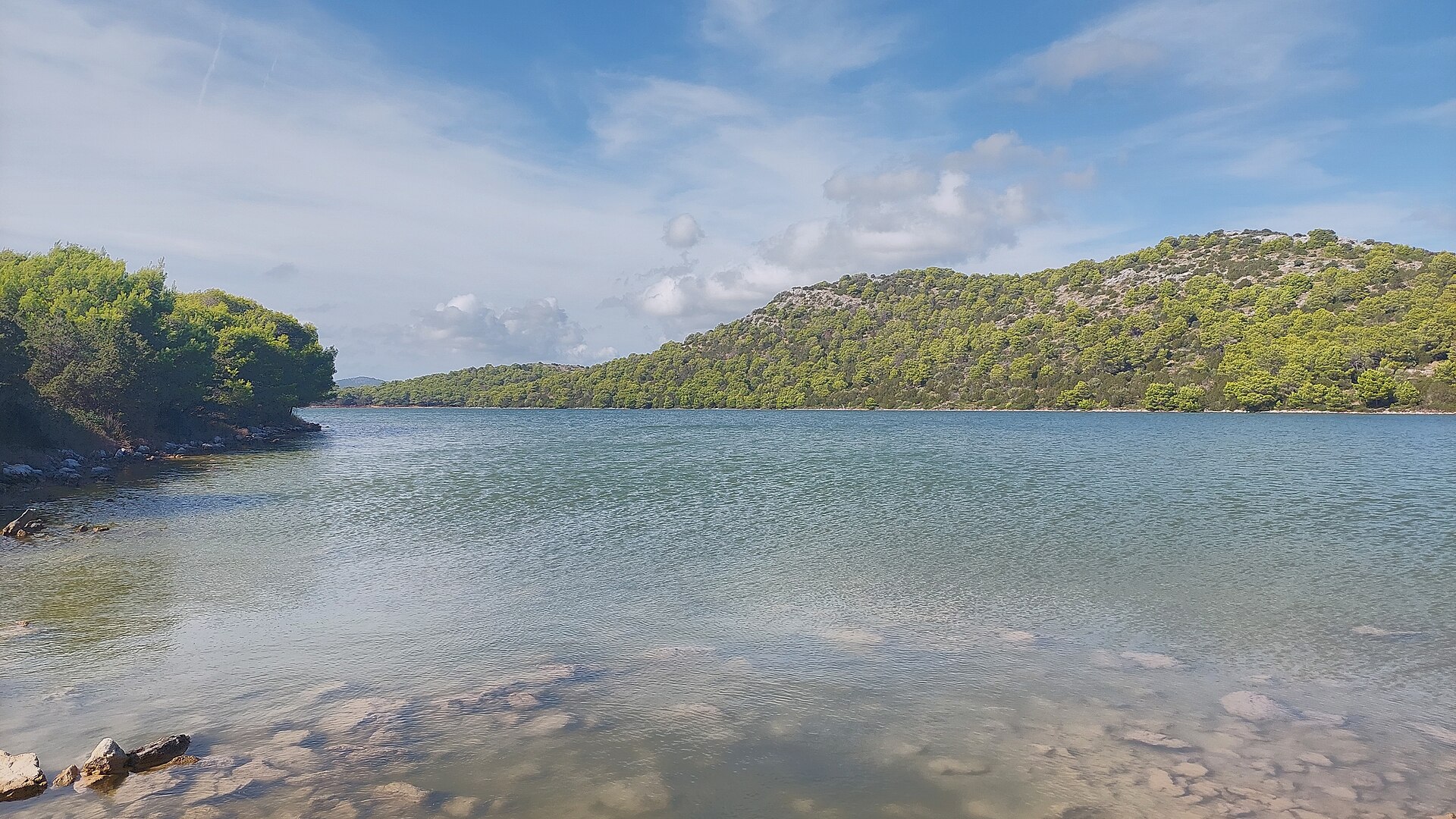
About this place
Lake Mir is a salt karst lake in Telašćica Nature Park, on the southwestern tip of Dugi Otok island on Croatia's Dalmatian coast. A narrow rocky strip called Priseke separates it from the open sea, while on its landward side it borders Telašćica Bay. It's one of the park's most distinctive attractions, popular with sailors and travelers curious about an unusual natural phenomenon.
How did the lake form?
Mir formed through geological processes that unfolded over thousands of years. After the last ice age, global sea levels rose by roughly 120 meters, flooding a previously dry karst depression in the landscape. Seawater still seeps into the lake through countless microscopic pores in the surrounding rock, keeping Mir in slow but constant contact with the sea even though there's no direct surface connection.
What makes Lake Mir unusual?
The lake covers about 0.23 km², stretches close to 900 meters in length, and reaches up to 300 meters at its widest point. Its depth reaches nearly 6 meters. The most striking feature is salinity noticeably higher than the adjacent sea, a result of slow water exchange through the porous rock combined with strong evaporation under the dry Mediterranean sun. In summer, the water inside the lake can run several degrees warmer than the open sea, making it an especially pleasant place to swim.
One section of the lakebed holds a fine, grey therapeutic mud that locals have long used for natural mud treatments. Mir is also home to an endemic eel species known locally as "kajman," a creature adapted to thrive in this unusually salty, enclosed environment.
What else is there to see nearby?
Lake Mir sits within the wider Telašćica Nature Park, home to the famous Stene cliffs that rise up to 200 meters above the sea, the scenic Telašćica Bay dotted with numerous islands and islets, and the peak of Grpašćak. Established in 1988, the park spans roughly 70 km² and also offers dozens of small, secluded beaches perfect for unwinding after a day of exploring.
How do you get there?
Dugi Otok is reachable by ferry from Zadar or Biograd na Moru, and Telašćica Nature Park occupies the island's southern tip, near the village of Sali. A marked hiking trail leads to the lake itself — the walk from the parking area or nearest viewpoint typically takes anywhere from ten to thirty minutes, depending on the route. Many visitors reach the lake as part of a day boat trip, combining a swim in Mir with a look at the Stene cliffs and the surrounding coves.
When is the best time to visit?
June through September is the ideal window, when the water is at its warmest and the trails are dry and easy to navigate. Aim for early morning or late afternoon to avoid the midday heat and the peak-season crowds.
Frequently asked questions
Can you swim in Lake Mir? Yes, swimming is allowed and it's one of the main draws of the site — the warmer, saltier water compared to the open sea attracts visitors looking to relax.
Is the lake connected to the sea? Not directly on the surface, but seawater filters through underground pores in the rock, which is why the lake's salinity and temperature differ from the sea outside.
Is there an entrance fee? The lake lies within Telašćica Nature Park, so a park entrance fee applies, in line with the current rates set by the park management.
How much time should I set aside for a visit? A swim and short walk usually take 1–2 hours, but it's worth planning half a day or a full day to combine the lake with the park's other highlights, including the Stene cliffs.
Nearby places

Earn badges for the places you visit
Download NextOnTrip, discover new places and check off your trails.