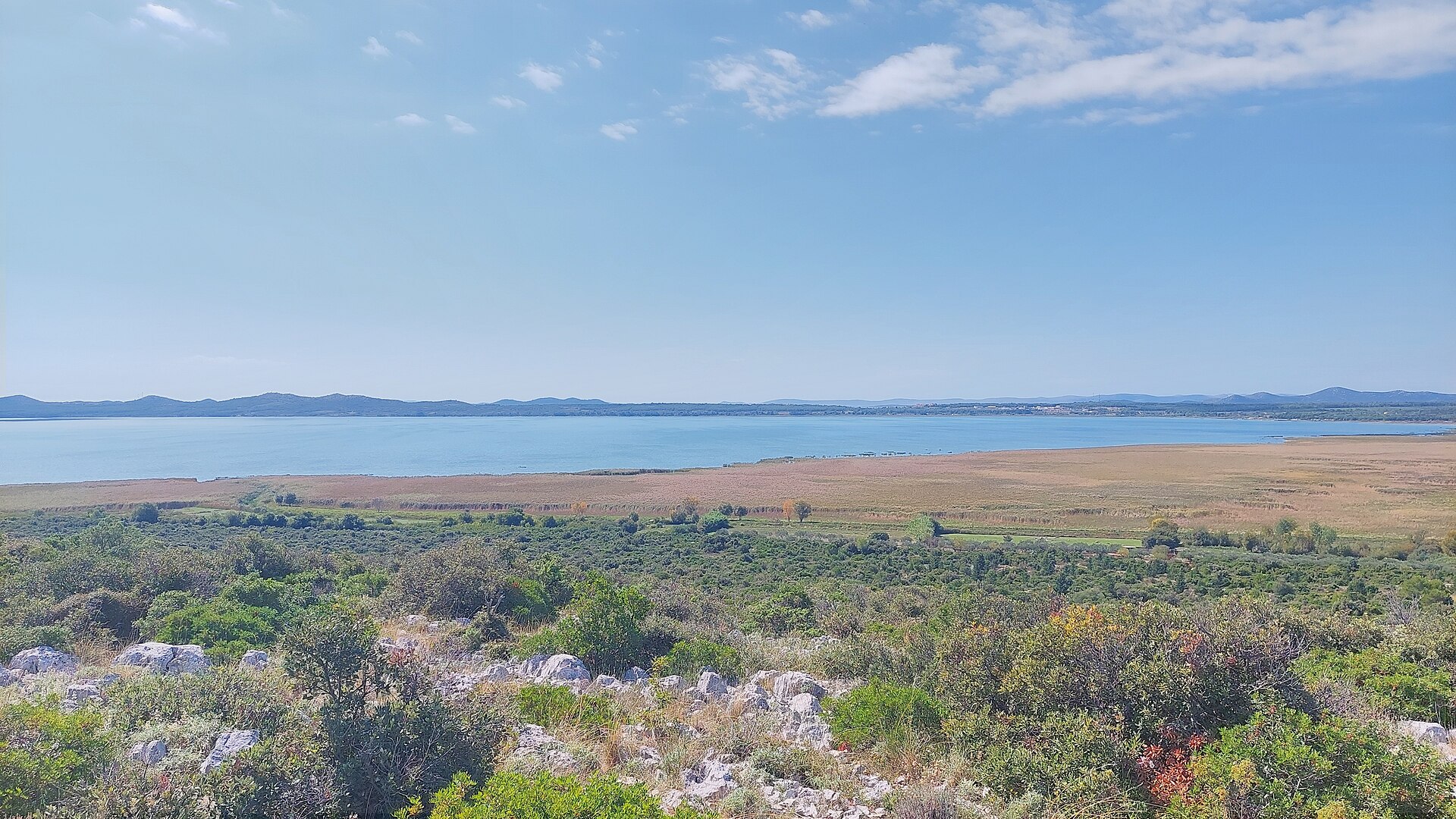
About this place
Vrana Lake (Vransko jezero) is Croatia's largest natural lake, tucked into the Dalmatian coast between Biograd na Moru and Pakoštane. It forms the core of Vrana Lake Nature Park, established in 1999 across 57 km², and ranks among the most important bird reserves on the Adriatic.
What makes this lake unusual?
Vrana Lake is actually a flooded karst field — a rare example of a cryptodepression, meaning its bed sits below sea level even though the water itself is fresh. The lake stretches northwest to southeast for about 13.6 km, is 1.4 to 3.4 km wide, and covers close to 30 km², making up most of the nature park's total surface. Only a narrow strip of land, cut through by the Prosika channel, separates it from the open sea.
What can you see inside the park?
The star attraction is the ornithological reserve in the lake's northwest corner, protected since 1983 and spanning 8.83 km². It's one of the most valuable wetland bird breeding grounds in this part of Europe: more than 100 species nest here, close to 90 more spend the winter, and the park's full species count reaches 235. Wooden boardwalks and an educational trail lead visitors to several observation points. Don't miss the viewpoint near Prosika harbor, which overlooks the entire lake, Jugovir hill, and the Babin Škoj peninsula, or the stone birdwatching tower at Majdan.
How do you get there and get around?
The park spans two counties, Zadar and Šibenik-Knin, covering the town of Benkovac and the municipalities of Pakoštane, Stankovci, Pirovac and Tisno. The easiest approach is from Biograd na Moru or Pakoštane, where signposted roads lead to the park's information points. Once inside, you can explore on two wheels along roughly 50 km of marked cycling trails, or by kayak, rented right at the harbor info point. Gliding along quietly by kayak lets you get far closer to the birds and marsh vegetation than any motorized boat ever could.
When should you visit?
The best season depends on what you're after. Autumn and winter are prime time for birdwatchers, when wintering species arrive in numbers and the crowds thin out. Summer, on the other hand, is better suited to kayaking and cycling around the shoreline — though it's worth remembering this is a nature reserve first and foremost, not a swimming spot, so don't expect a typical beach experience here.
Frequently asked questions
Is this the same Vrana Lake found on the island of Cres? No. They're two separate lakes that happen to share a name. The one described here lies on the Dalmatian mainland near Biograd na Moru and is Croatia's largest natural lake. The other, smaller lake on Cres island serves as a drinking-water reservoir.
Can you kayak on the lake? Yes — kayaks can be rented at the information point by the harbor. It's the best way to approach the birds and reed beds closely without disturbing them.
How many bird species live in the park? The park has recorded 235 bird species overall, with more than 100 nesting here permanently and nearly 90 more spending the winter on the lake.
Is the park good for cycling? Definitely — around 50 km of marked cycling trails wind through the park, including routes along the lakeshore and over the surrounding hills.
Nearby places

Earn badges for the places you visit
Download NextOnTrip, discover new places and check off your trails.