About this place
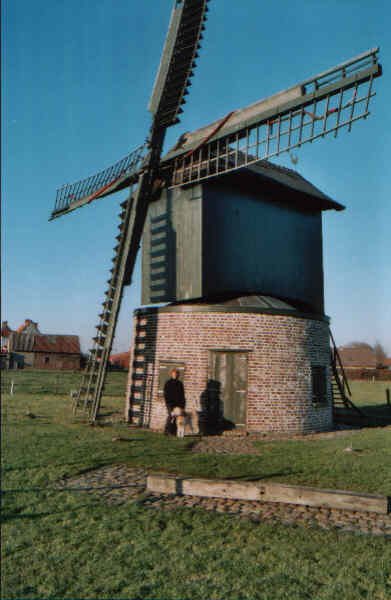
Koutermolen is a wooden post mill that now stands in the De Gavers provincial park in Harelbeke, West Flanders. Its current site is the result of a relocation carried out in the 1980s, but the mill's own story stretches back to the late eighteenth century and is marked by fires, forced demolition, and repeated rebuilding — a history that makes it one of the more compelling relics of the region's rural industry.
Where does the name come from?
The name Koutermolen refers to the site where the mill originally operated: the Veldrijkkouter, also known as Molenkouter, in the Stasegem district of Harelbeke. The mill stood there, with interruptions caused by disaster, until 1981, when it was finally moved to its present location.
Who built the first mill?
The original Koutermolen was erected by Pieter Gheysens sometime between 1775 and 1789. The earliest written reference to it appears on a map from 1789, drawn up by surveyor P.C. Steur in connection with the paving of the road linking Harelbeke and Zwevegem — evidence that from the start the mill was tied into the practical infrastructure of the area, not merely a picturesque landmark.
What disasters struck the mill?
Much of the Koutermolen's history is a record of recovery from calamity. In 1892 the mill burned down completely, forcing the milling family to rebuild the structure from scratch. A second blow came during the First World War: in 1917, German occupying forces tore down the newly rebuilt mill to clear ground for a military airfield. For the owners, this meant losing their livelihood in the middle of wartime hardship.
How did the mill get back on its feet after the war?
In 1919, eager to resume operations quickly rather than rebuild from the ground up, Victor Gheysens went looking for an existing mill he could buy outright. He had a stroke of luck: he found the so-called Statiemolen in nearby Deerlijk for sale, purchased it, and had it hauled by horse and cart to Stasegem. Reassembled there, the mill returned to work and served the local community for decades afterward.
When did the mill stop grinding grain?
The Gheysens family kept the Koutermolen running until 1948. After that, André Gheysens only turned it occasionally, until 1968 — the point at which the mill's productive life effectively came to an end and it began to fall into disrepair.
How did the mill end up in De Gavers?
By 1976, the structure was in a completely derelict state when the municipality of Harelbeke bought it. The province of West Flanders then acquired the mill for the symbolic sum of one franc, and between 1981 and 1986 it underwent a full, careful restoration combined with a move to the De Gavers provincial domain. The mill was set on a six-metre-high mound, which gives it the distinctive, far-visible profile it has today. The restored mill officially reopened in 1987.
What can visitors see there today?
Visitors to De Gavers park can now admire the Koutermolen as a fully restored piece of industrial heritage — a wooden post mill perched on a tall earthen mound, surrounded by the greenery of a recreational area built around water. It's a spot where the history of milling craft meets the present-day role of the park as a leisure destination for Harelbeke residents and tourists exploring the Leiestreek region.
Frequently asked questions
Where does the Koutermolen stand today? In the De Gavers provincial park in Harelbeke, on a six-metre-high mound.
How many times has the mill been rebuilt? Several times — after the fire of 1892, after its demolition in 1917, and again during the major restoration of 1981-1986.
Is this the original eighteenth-century mill? The structure seen today actually descends from the Statiemolen, brought in from Deerlijk in 1919 — the mill's history is a chain of different buildings carrying the same name and serving the same purpose on the same site.
Nearby places

Earn badges for the places you visit
Download NextOnTrip, discover new places and check off your trails.