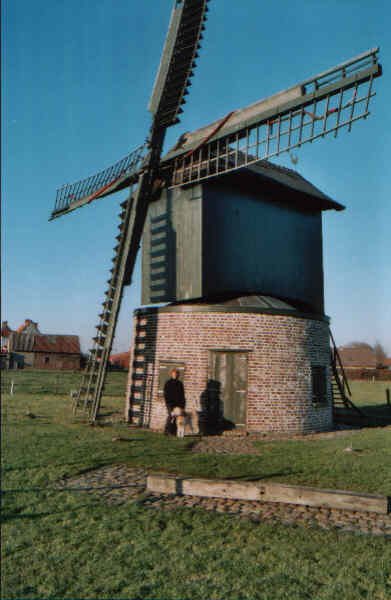
About this place
Preetjesmolen is a historic windmill in Heule, a district of Kortrijk in West Flanders, often described as the last surviving flax-scutching windmill in Europe. Sitting at coordinates 50.845689, 3.247422, it stands as a physical reminder of the flax industry that once made the Kortrijk region famous across the continent.
Who built the mill, and why?
The windmill was constructed in 1866 by Ivo Deprez, who owned the land at the time. Its purpose was purely industrial: mechanically scutching flax, meaning separating the valuable fibers from the woody parts of the stalk after the plant had already been retted and broken. Small, privately built windmills like this one were common across the Kortrijk countryside during the flax boom of the 19th century.
Why was flax processing concentrated around Kortrijk?
From the 1850s onward, the area around Kortrijk developed into one of Europe's most important centers for preparing flax fiber for spinning. The process required several stages — retting the harvested stalks in water, breaking them to loosen the fibers, and finally scutching to remove the remaining woody material. Heule itself became a small hub of this trade: around 1870 the village counted roughly ten scutching windmills. That number collapsed quickly once steam-powered flax engines entered the market, and by 1890 only three mills remained standing in Heule.
What happened to the mill in 1872?
On 20 January 1872, a fire broke out inside the mill. It was caused by friction in the brake wheel during an attempt to stop the sails in the middle of a severe storm — a hazard that frequently destroyed wooden windmills of the era. Rather than abandoning the damaged structure, the owners rebuilt it in 1874, and the mill resumed its industrial role.
How long did the mill actually operate?
Following its reconstruction, Preetjesmolen kept working continuously until the outbreak of the First World War in August 1914. That gives the mill roughly four decades of active industrial use, spanning the period when wind-powered flax processing was gradually being displaced by steam and, later, electric machinery.
How did the mill survive to the present day?
In 1944, the mill was granted protected monument status by royal decree, which shielded it from demolition during the postwar modernization of agriculture and industry. Even so, for decades it remained in private hands and depended on ad hoc efforts to keep its structure intact. The turning point came in 2016, when the City of Kortrijk purchased the mill to secure its long-term future. Since then, Texture, the flax and textile museum of Kortrijk, has managed its operation together with the Friends of Preetjes Molen association, which supports education and outreach around the region's flax heritage.
Is the mill open to visitors today?
A thorough restoration of the windmill began in autumn 2025, aimed at restoring both its mechanical function and its historic appearance. Projects of this kind typically involve replacing worn timber elements, the sails, and parts of the internal gearing mechanism, while preserving as much original material as possible. Once the restoration is complete, the mill is expected to remain accessible to the public as part of Texture's offering, functioning as a working exhibit that tells the story of Heule's industrial past.
Frequently asked questions
Is Preetjesmolen really the only mill of its kind in Europe? It is described as the last preserved flax-scutching windmill on the continent, which makes it a genuinely rare piece of industrial heritage.
Who manages the site today? The City of Kortrijk, which bought the mill in 2016, together with the Texture museum and the Friends of Preetjes Molen association.
Can visitors see the inside of the mill? Yes, the windmill operates as an educational attraction linked to the Texture flax museum in Kortrijk, though access may be limited while restoration work is ongoing.
Nearby places

Earn badges for the places you visit
Download NextOnTrip, discover new places and check off your trails.