About this place
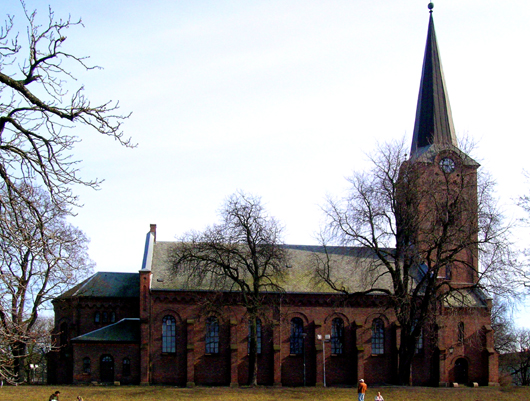
Sofienberg Church (Sofienberg kirke) is a red-brick Lutheran church in Oslo's Sofienberg district, set beside Sofienbergparken. It dates from 1877 and remains one of the recognisable landmarks of this part of the Norwegian capital.
Where is Sofienberg Church?
The church stands in Oslo, Norway, in the Sofienberg neighbourhood, within the Sofienbergparken area. Its green setting makes it an easy stop on a walk through the district. The coordinates are roughly 59.9225 N, 10.7661 E.
Who designed it and when was it built?
The plans were drawn by Danish-born architect Jacob Wilhelm Nordan. The church was built in red brick in 1877. Christiania municipality had bought the plot back in 1857, with construction following some two decades later. The nave holds about 500 people, which is a generous capacity for a neighbourhood congregation.
Why has the church had several names?
The building was first called Paulus kirke. In 1892 it was renamed Petrus kirke, and it received its present name, Sofienberg kirke, in 1962. Older sources may therefore refer to the same building under different names.
What can you see inside?
- Altarpiece – painted in 1879 by Otto Sinding, a well-known Norwegian painter.
- Stained glass – windows by Enevold Thømt (1920) and Maria Vigeland (1951).
- Organ – an instrument from 2013 built by the German firm Eule.
The mix of nineteenth-century architecture and later artworks shows how the interior has been added to over the decades.
Is the church protected, and are there concerts?
Norway's Directorate for Cultural Heritage protects the church as a valuable monument. It also serves as a concert venue, and its acoustics and newer organ attract performers of sacred and classical music. Check the parish's current programme before you go.
Frequently asked questions
Is it a Catholic church? No. It is a Protestant, Lutheran church belonging to the Church of Norway.
When was Sofienberg Church built? In 1877, to designs by Jacob Wilhelm Nordan.
Is there an entrance fee? The available sources describe no standing sightseeing fee. Opening hours and event dates are best confirmed with the parish, as they depend on services and concerts.
Why did the church have different names? It began as Paulus kirke, became Petrus kirke in 1892, and has been called Sofienberg kirke since 1962.
Who painted the altarpiece? Otto Sinding, in 1879.
What else is nearby? Sofienbergparken itself, which surrounds the church, is a pleasant place to rest after your visit and a convenient starting point for exploring other Oslo districts.
Who is it for?
The church suits lovers of nineteenth-century architecture, sacred art and organ music. Even if you do not go inside, the brick building in the park is a worthwhile stop on a stroll through a less touristy corner of the Norwegian capital.
Nearby places

Earn badges for the places you visit
Download NextOnTrip, discover new places and check off your trails.