About this place
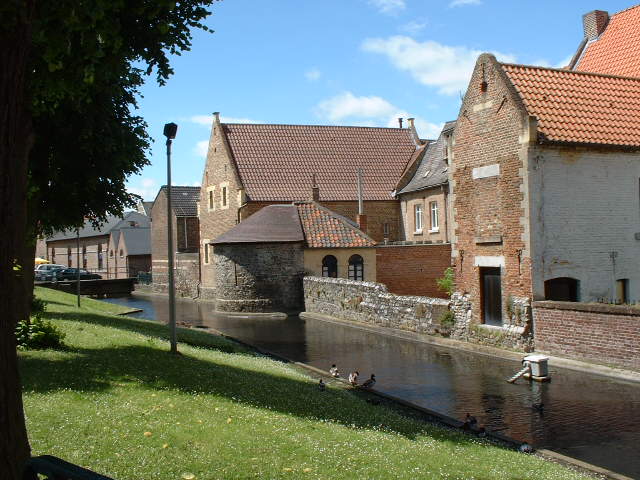
Hogemolen is a historic water mill on the Jeker river in Lauw, a village that today forms part of the municipality of Tongeren-Borgloon in the Belgian province of Limburg. It stands at Klerebroek 43, just upstream from the local church, in a Jeker valley lined with meadows and rows of trees that form a green ribbon following the river through the landscape.
Where does the mill's history begin?
The earliest record of the mill dates back to a 1479 tax register, where it appears as "die meulen van Scalyoun." By 1493 it is referred to as "novum molendinum" — the new mill — suggesting it had already been rebuilt or significantly altered by that point. For centuries afterward, Hogemolen operated as a grain mill, grinding wheat and rye for the surrounding countryside.
The turbulent history of the region left its mark on the building: in 1654 the mill burned down, set on fire during military campaigns (sources point to Lorraine or French troops passing through). It was rebuilt just a year later, in 1655, using brick and natural stone. Further changes followed in the eighteenth century — the residential wing was expanded in 1770, and a barn was added across the street in 1782.
Who ran the mill, and what does the building look like?
For generations, the Baillien family served as millers in Lauw, operating Hogemolen between 1665 and 1820 and later the nearby Dalemolen from 1759 to 1976. The building has an L-shaped layout combining a residence with the mill itself, spanning ten bays across one-and-a-half storeys. Its brick facade features rectangular windows set in limestone frames dating from the late eighteenth century, along with a round-arched doorway bearing the date 1679. The wooden water wheel, 5.6 metres in diameter, represents a transitional type between a center-mounted and an undershot wheel, and the mill still houses three complete sets of grinding machinery inside.
What happened to the mill in the twentieth and twenty-first centuries?
Milling operations continued until 1955, after which the building fell into disrepair — unlike the better-preserved neighboring Dalemolen, Hogemolen suffered years of neglect and additional damage from flooding. In August 1973, city archivist Henry Baillien acquired the property. In 1986, the mill and its surrounding grounds, covering roughly 20,430 square metres, were officially protected as a heritage monument by Flemish culture minister Patrick Dewael.
Subsequent owners carried out restoration work: L. Senden from September 1989, and Georges and Marianne Jacobs from April 1996. The turning point came in July 2009, when Karel Maes and Betinna Proesmans purchased the mill. A comprehensive restoration launched in January 2011 culminated in a milestone moment on 30 October 2012, when the water wheel turned again after sixty years of standstill, followed by a first successful grinding test on 22 November 2012.
Can visitors see Hogemolen today?
The mill remains privately owned but is fully operational, and visits can be arranged by appointment with the owners. There are also plans to install a turbine for electricity generation, which would pair the mill's historic milling function with a modern use of its water power.
Frequently asked questions
Where exactly is Hogemolen located? At Klerebroek 43 in Lauw, a village within the municipality of Tongeren-Borgloon in the province of Limburg, on the Jeker river just upstream from the local church.
How old is the mill? The first written mention dates to 1479, though the current structure largely reflects the 1655 rebuild after a fire and later eighteenth-century additions.
Is the mill still operational? Yes — following a restoration completed in 2012, the water wheel turns again and the mill has successfully ground grain in test runs.
Is Hogemolen a protected monument? Yes, the mill and its surrounding grounds were listed as a protected heritage site in 1986 by the Flemish minister of culture.
Nearby places

Earn badges for the places you visit
Download NextOnTrip, discover new places and check off your trails.