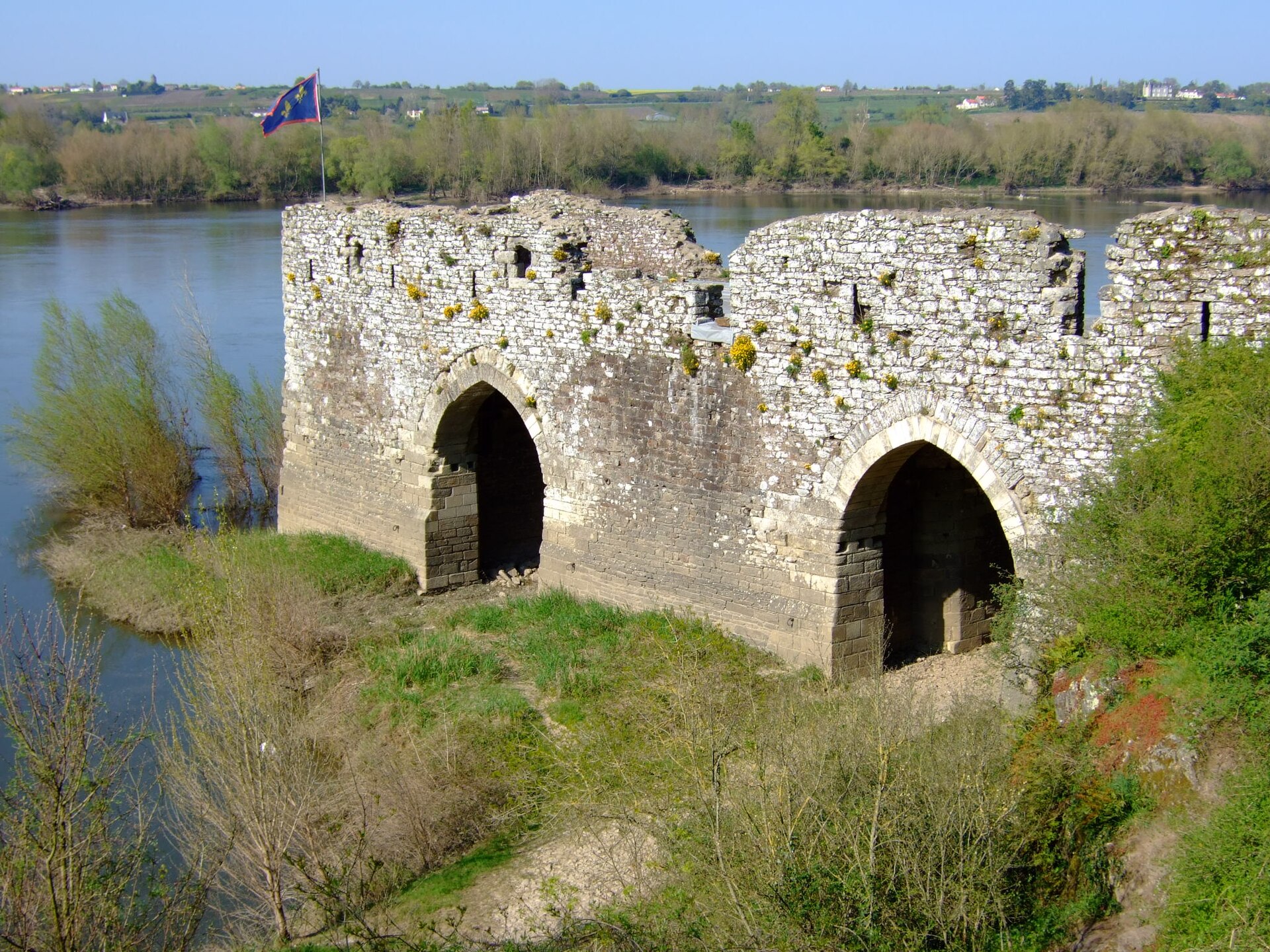
About this place
The Moulin Pendu ("hanging mill") is a historic riverside building on the left bank of the Loire at Champtoceaux, a village within the commune of Orée d'Anjou in the Maine-et-Loire department of western France. It stands at the foot of the hill that once carried the medieval fortress of Champtoceaux, whose remains are still visible about a kilometre away.
Why is it called a "hanging" mill?
The name has nothing to do with executions — it describes how the machinery worked. Underneath two pointed (ogive) stone arches, paddle wheels were suspended so they could be raised or lowered to match the changing water level of the Loire. Because the wheels literally hung beneath the arches, the building became known as the "moulin pendu." The current from the river turned these wheels, which in turn drove millstones on the upper floor to grind grain into flour.
How old is the building?
A mill has stood on this stretch of the Loire since the 11th century, but the building that survives today dates from the 13th and 14th centuries. Inside, it once housed two separate flour mills. The structure measures 46 metres long and 7.5 metres high, making it an unusually large example of its kind — in fact, it was the last working water mill on the Loire.
The water mills operated here until 1420, after which they were replaced by floating mills anchored on the river, a system that remained in use into the 19th century. Besides the milling chamber, the building also contained a storeroom for wheat and flour and living quarters for the miller.
Was it also a river toll point?
For a long time the site was believed to have served mainly as a river toll station — a port had existed here since the 7th century, and tolls were said to have been collected until the 17th century. Current historical research, however, points to milling as the building's primary function rather than toll collection. Whatever the original balance of uses, the site later served as a landing point for steamboats, a role it kept until the arrival of the railway shifted transport away from the river.
What else can visitors see nearby?
Now a protected historic monument, the mill was originally part of a much larger fortified complex tied to the Champtoceaux castle, of which only fragments remain today. A visit pairs naturally with a walk up to the ruins of the medieval town and fortress on the hill above, and with a stop near the landing stage used by the river boat "La Luce," which cruises this stretch of the Loire.
Where exactly is it, and how do you get there?
The Moulin Pendu sits on the left bank of the Loire at the foot of Champtoceaux, within the commune of Orée d'Anjou. It lies directly on the Loire à Vélo cycling route that follows the river through Maine-et-Loire, making it an easy stop for cyclists and walkers exploring the Anjou region. The combination of riverside scenery and medieval history makes the spot worth more than a quick photo stop.
Frequently asked questions
What is the Moulin Pendu in Champtoceaux? It is a historic 13th–14th-century water mill building where paddle wheels hung beneath stone arches, turned by the Loire's current to drive millstones on the floor above.
Why is it called "pendu," meaning "hanging"? Because its paddle wheels were suspended beneath the building's pointed arches and could be adjusted to the river's water level.
How long did the mill operate? The water mills ran until 1420; after that, floating mills anchored on the river took over the job until the 19th century.
Was it also used as a toll station? It was long assumed to be a river toll point, since a port existed here from the 7th century, but current research suggests milling was its main function.
What else is worth seeing nearby? The ruins of the medieval Champtoceaux citadel lie about a kilometre away, and the river boat "La Luce" operates from a nearby landing stage.
Where is Champtoceaux located? It's a village in the commune of Orée d'Anjou, in the Maine-et-Loire department, on the left bank of the Loire.
Nearby places

Earn badges for the places you visit
Download NextOnTrip, discover new places and check off your trails.