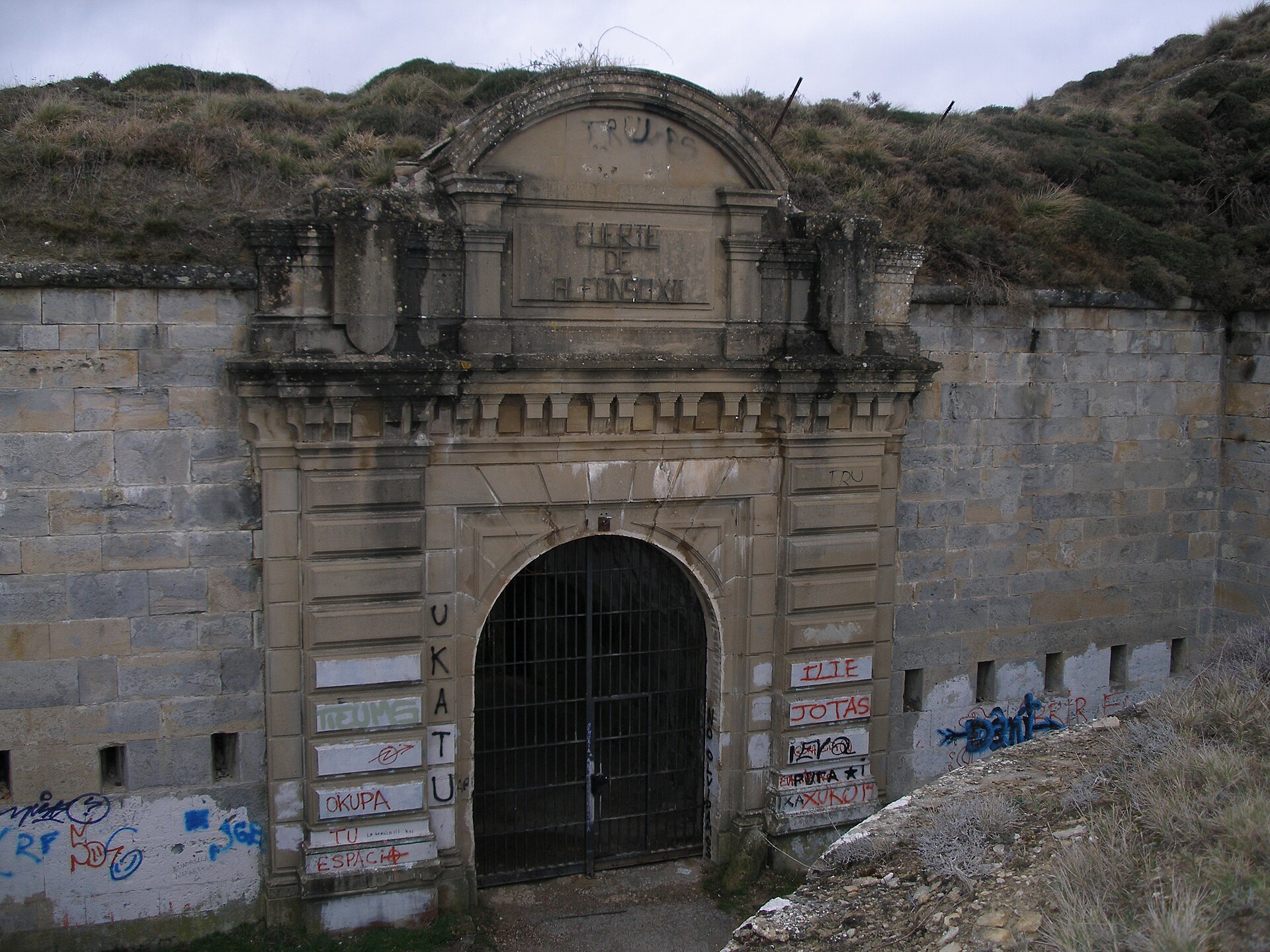
About this place
Fort San Cristóbal (also known as Fuerte de Alfonso XII) is a massive 19th-century fortress carved into the summit of Mount Ezkaba, within the municipality of Berrioplano / Berriobeiti, just a few kilometers north of Pamplona. It's one of Navarre's most striking yet lesser-known destinations, where military engineering meets one of the darkest chapters of 20th-century Spanish history.
How do you get there?
The fort sits atop San Cristóbal mountain (892 meters above sea level), overlooking Pamplona from the north. From the city center, driving up takes roughly fifteen minutes along a winding road through the Berrioplano district. Hikers and cyclists can follow a marked trail from the base of the mountain, a route popular with locals for its sweeping views. Keep in mind the site still belongs to the Spanish Ministry of Defence, so wandering the interior on your own isn't an option — visits need to be arranged in advance.
What will you actually see?
The scale alone is impressive: the whole complex spans 615,000 square meters, with the fortress itself covering 180,000 square meters of underground construction spread across three floors, buried under roughly two meters of earth and ringed by a moat. It's the largest polygonal fortress in the entire Pyrenees, designed by Colonel Miguel Ortega and built under the direction of Commander José de Luna y Orfila between 1878 and 1919, in response to the Third Carlist War. Ironically, the fort never fired a shot in the conflict it was built for — by the time construction wrapped up, advances in steel and rifled artillery had already made this style of fortification obsolete. From the viewing terrace near the entrance, though, you get a sweeping panorama over the whole Pamplona basin.
The prison years and the 1938 breakout
After decades as an artillery barracks, the fort was converted into a prison during the 1930s — first a civilian one, then, during the Spanish Civil War, a political prison holding Republican detainees. The inmate population swelled from around 750 to over two thousand. On the night of May 22, 1938, the fort was the scene of the largest prison break in Spanish history: nearly 800 of roughly 2,500 prisoners fled into the surrounding hills. Most were recaptured or killed during the manhunt that followed — over two hundred died from gunfire, hunger, or exposure, and more than a dozen were executed after being caught. Between 1941 and 1945, the fort served as a tuberculosis hospital, where more than 200 additional patients died and were buried nearby in what's known as the "Cemetery of the Bottles." It later functioned as a munitions depot until 1987, before being abandoned entirely in 1991.
When to visit and how?
The fort is now officially protected as a Cultural Heritage Site, a status granted in 2001, and was further designated a Site of Democratic Memory in 2025. Limited guided tours have run since 2009, typically scheduled during the spring and summer months when weather makes the climb easier. Near the entrance stands a memorial sculpture, unveiled in 1988, honoring the Republican prisoners who died there. It's worth booking a tour well ahead and checking the current schedule, since access to the interior remains tightly controlled.
Frequently asked questions
Can you visit Fort San Cristóbal on your own? Not fully — the site belongs to the Ministry of Defence, and entry to the interior is only possible through organized guided tours, which have been offered since 2009.
Why is it also called Fuerte de Alfonso XII? That was its original name from the 19th-century construction period; it was officially renamed "San Cristóbal" in 1931, under the Second Republic.
What happened at the fort in 1938? It was the site of the largest prison escape in Spanish history — nearly 800 Republican prisoners attempted to flee, and hundreds died during the subsequent manhunt in the surrounding mountains.
How long does it take to reach the summit? Driving from Pamplona takes about fifteen minutes, while hiking the marked trail from the base of the mountain typically takes about an hour.
Nearby places

Earn badges for the places you visit
Download NextOnTrip, discover new places and check off your trails.